
Translated material
Revolution from the box
Soap operas - progress engine
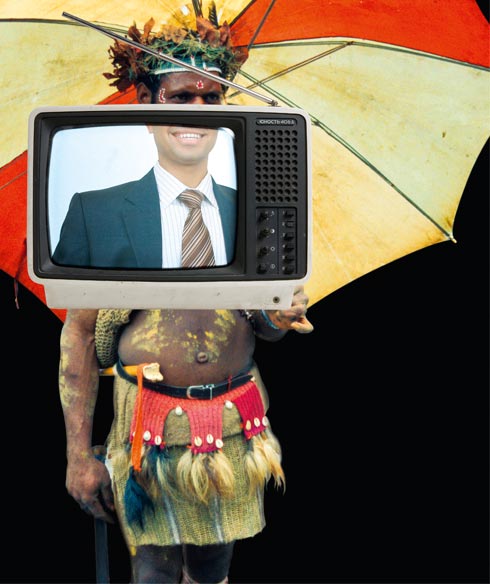
Revolution from the box. Television often and throughout the world is customary to scold for zombie the population, for excessive simplification, for the production of series, designed for a very undemanding taste. However, the American researcher of the media market Charles Kenny claims that “all these soap operas are nothing more than a transport that takes humanity to a better future”, that they are progress backward. How-the New Times became interested in in 1953, the science fiction writer Ray Bradbury began to sound the alarm. “Television,” he wrote, “this is an insidious beast, it is a gorgon of Medusa, which is a nightly turning billions of people into motionless stones, it is a calling siren that promises a lot and gives almost nothing.” The alarm then gripped more than one Bradbury.
Television as a sin ... since 1928, when the first gear was broadcast on the air, television is reproached with the same excitement as they praise. Critics of television - from insulted champions of political correctness to frantic apologists of cultural conservatism - convict him in all conceivable sins: in indulgence an unhealthy lifestyle, ignorance, moral degradation, etc. Others go even further. According to the last fatwa, released in India, the TV "is actually impossible to watch ... without falling into sin." Last year, one of the spiritual leaders of Saudi Arabia announced the admissibility of the execution of television workers for incitement to rebellion and the promotion of debauchery.
... or a tool of progress, meanwhile, television is a powerful transforming force. Potential coverage is huge: by 2007, every four inhabitants of the planet accounted for more than one TV, 1.1 billion families have televisions in the house. It is expected that by 2013 the number of such families will increase by another 150 million, if not more.
This powerful force spreads around the world not only spectacles full of glamor and drama, but also large social changes. Take at least the history of TV expansion in rural areas of one of the poorest countries, Indonesia. For two years, while the electrification of the village took place, 30% of families became the owners of televisions. Seven years later, television receivers have already spread to 60% of houses - and this is in the country where, according to population surveys, average earnings were $ 2 per day. For comparison: only 5% of families had a refrigerator. People love television so much that even in huge regions of the world, where there is no electricity, they use batteries. So, in some poor countries, such as in Peru, TVs in homes are more common than electricity.
In India, half of the families has televisions, in 2001 there were no more than a third of such families. In Brazil, four out of five families have blue screens. For comparison: 7% of the inhabitants of India and about a third of the Brazilians use the Internet. In Europe and North America, more than 90% of families have a TV. Even in poor countries such as Vietnam or Algeria, this indicator exceeds 80%. However, the most backward countries, such as Nigeria and Bangladesh, where the TV distribution coefficient, is not more than 30%, the highest potential for the distribution (and means influence) of television.
By 2013, half of the world television network will work on digital equipment, which will significantly increase the number of channels received. The average American family has access to 119 channels, and today such a technology is rapidly spreading around the world.
The TV against the bureaucracy is a sharp expansion of the possibility of choosing weakens the grip of world bureaucracy, whose representatives either directly formed and/or controlled the software net in many countries, or had a strict impact on a few television stations in a particular country. A comparative study of the situation in 97 countries of the world, conducted several years ago, showed that on average 60% of the five main stations of each country belonged to the state, 32% were in the hands of small family groups. As for the software policy, in developing countries, emphasis was mainly placed on specific practical topics - in China, for example, television of rural areas paid much attention to urgent problems of pig farming. In the actual political sphere, the content of the programs often turned out to be far from objectivity. For example, Hugo Chavez refused to resume the license of the RCTV channel, most popular in Venezuela, after it was transferred to a critical comment on the government. Chavez himself regularly performs on the state channel in his own show “Hello, President!”, Which can last from six to - a record duration! - 96 hours. Gradually, however, the times of forced pig farming and presidential speech -making on TV are a thing of the past. As the choice of programs available for viewing is expanding, people get acquainted with a wider range of opinions and gain access to the product that they really want.
Glory to soap operas! The audience, apparently, wishes about the same thing everywhere: this is a sport, a reality show and ... yes, soap operas. In 2006, for example, 715 million people around the world watched the World Cup final. More than a third of the population of Afghanistan, the Afghan version of the “American idol” - the television show “Afghan Star” is urgently watching. The longest television series in the world "Rescuers Malibu" tells of the daily life of the team of rescuers, acting in the vicinity of Santa Monica Beach in California. This program spread in 142 countries, and about a billion spectators watched it at the peak of popularity. (Today, the most massive broadcast on television is the medical drama-series “Doctor House”, which, according to the Agency of Eurodata TV Worldwide, an audience of 82 million spectators and has been around the popularity of the “crime scene” and “desperate housewives”.)
Gulam Nabi Azad, an Indian Minister of Health and Family, offers to use TV as a means of control over birth rate. “In the old days, people did not have other entertainments, in addition to sex, because they had so many children,” he thought in July in front of the television cameras. - Today, television is an inexhaustible source of entertainment. Therefore, it is very important to conduct electricity to every village so that people can watch TV until late at night. By the time the next series will end, they will be so tired that they will no longer be up to sex, they will begin to fall asleep. ”
In the struggle for this, in the 70s, the Brazilian company Rede Globo organized the regular production of “soaped” series, collecting an audience of up to 80 million people. The country, where the divorces were allowed by law only in 1977, stared at the paintings in which about a fifth of the main female characters was divorced, and every fourth heroine cheated on her husband. Moreover, 72% of women bred in these series did not have children at all, and only 7% of them had more than one child. At the same time, real Brazilian women at that time gave birth to an average of six times in their lives.
Many series heroines work outside the home, have their own business and spend money on their own. The heroes of the series, as a rule, are educated and they have few children. As it turned out, these artistic types possessed a huge acting force as social models. According to the results of the study by Robert Jensen and Emily Oster, the fact that a television cable was reached out to the villages, ultimately led not only to a decrease in the birth rate, but also to the fact that Brazilian girls began to study in high school five years longer.
Brazilian and Indian series affirmed the types of female characters that could make decisions not only regarding childbearing, but also in a wider circle of family issues. According to Jensen and Oster, the provision of cable and satellite television services to the village led to an increase in the share of girls studying in high school, and to expand the sphere of female autonomy in society. For two years that have passed after the spread of cable and satellite networks in rural areas, the difference between the city and the village in the mentioned indicators decreased by 45–70%. In Brazil, with the advent of the Rede Globo signal, the detection fell and the number of divorces increased. The manager of the Afghan Star Motherland company, it seems, is something to be proud of. This year, its director said about the presentation of one of the school graduates of the certificate with honors that this fact “helps to expand women's rights more than the millions of dollars that were spent on direct television propaganda of female rights.”
But the beneficial effects of television extends much further than the sphere of childbearing and the relations of the sexes. According to a study by the World Bank, conducted among school youth living in the bodonvilles of the Brazilian city of Fortalesis, the contingent of children attached to viewing TV consumes much less drugs and, accordingly, there are much less than early pregnancy. The comparison shows that the restraining effect of TV on drug addiction in the youth environment is twice as effective than such a factor as the relatively high education of the mothers of schoolchildren. And although the behavior of mothers may not be as convincing for their children as television and reality shows, nevertheless carefully thought-out broadcasting campaigns can achieve considerable. So, in Ghana, where only 4% of mothers wash their hands with soap after the restroom and less than 1% - before feeding children, the number of such women sharply jumped after holding an advertising campaign, the slogan of which stated that people who did not wash their hands before dinner, "together with rice eat many more."
Today, more than 700 thousand schoolchildren in remote rural areas Mexico are watching the Telesecundaria program in specially equipped classes. And although, as a rule, they begin to view it, having low grades in mathematics and language, in the graduation classes they usually reach the average level in mathematics and half reduce the mentor lag.
TV and politics What is the influence of television on the political life of the population?
On the one hand, there is an opinion that television helps to reduce civil consciousness. For example, the arrival of television on the Indonesian island of Java was accompanied by a decrease in the social activity of people, the growth of distrust between them. Similar results were obtained in the United States.
In fact, everything is not so straightforward. If people watch only one channel with a pronounced ideological bias, of course, they partly perceive its point of view. However, today, in the context of the publicly accessibility and wide diversification of television channels, it turned out to be much more difficult, as it turned out, owners of television channels to influence the outcome of the elections. In the USA, for example, where the choice of channels is extremely wide, there is no simple correlation between the time conducted by voters by the TV, and their electoral preferences, at least spectators of certain channels sympathized with the Republicans or democrats.
Let us recall what money the chef of the Peruvian special services of Vladimir Montesinos spent to bribe rival media in the 90s. Only to bribe the main Peruvian congressmen, he took $ 300 thousand per month, plus $ 250 thousand per month, for the bribe of judges, also monthly. However, in order to bribe 6 of 7 available television channels, which were supposed to loyally illuminate the activities of the government, Montesinos monthly spent $ 3 million.
American researchers studying the problem of violence on television argue about whether it helps to increase aggressiveness in real life. However, if we consider this issue in a wider context, television can play an important role in countering the global tendency to war. It’s not that the reports of deaths and destruction contributed to a decrease in the support of already walking wars - such an argument did not prevent the Vietnamese or Iraqi wars from developing. Rather, spreading cosmopolitan moods on the whole planet, television makes the self -bounds of war unattractive. And of course, it is not a new idea that the communication system has a key role in establishing interested relationships between different cultures.
Of course, there are other measures that should be taken by the governments of different countries in order to put television in the service of positive processes. But most importantly, politicians should leave TV with their worries, that's all. They should not limit the number of channels in their countries or intervene in news production. A sensitive television market based on competition can have a more beneficial effect on the audience than, say, educational programs executed by the most good intentions. Competitiveness is the key to the fact that television informs the audience, and not zombies them.
In the near future, the daily rate of TV viewing all over the world will probably come close to 24 billion hours, which will be approximately 4 hours per resident of the planet. Undoubtedly, part of this time could be carried out with greater benefit. However, television gives a person constant contacts with new ideas and people dissimilar to him, which means he opens up new prospects, contributes to mutual understanding between peoples, more complete comprehension of the world and complex aspects of life.