Translated material
Knocks and their victims
Eastern Europe is cleansed of totalitarianism
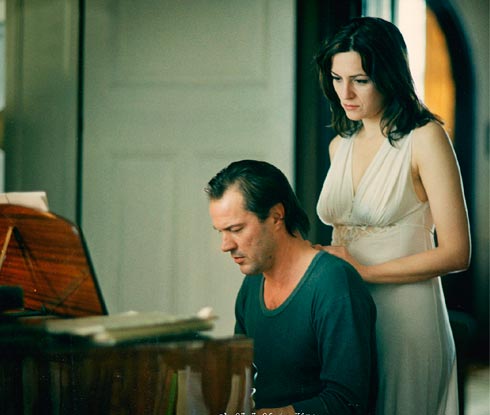
Frame from the film "Life of others",
which tells about work
Special services of the GDR
“The problem of torture” - this is how the dilemma is called in the language of political theory, which is faced with all countries that enter the path of transition from the totalitarian regime to democracy. In other words: how to live next to the executioners to the victims? Subcarms - with those whom they planted, from whom they took away their wife or who was shousing their career? Should there be justice for some and punishment - for others?
In Germany, Poland, Hungary, the Czech Republic-in the 90s, later-in the Baltic countries, recently in Romania and Bulgaria decided that the victims have the right to any justice. Somewhere this was called lustration and forbade former special services to occupy state offices and/or be elected to the parliaments (Hungary, Poland, Czech Republic), somewhere they opened up the archives of their KGB units (German Stasi, Czechoslovak STB) and allowed people to see the denunciations of unspoken employees and personnel officers who worked under the work somewhere. Covering in the most important institutions of the state. It was painful everywhere. In 12 former republics of the USSR, including Russia, they refused everyone in fairness. It still hurts. With the exception of Georgia and Ukraine, in all the rest the Chekists either stand in power, or - in the immediate vicinity of it.
The yellow attack or in German Gelbes Elend-so in the jargon of dissidents of the GDR called the political prison of the Ministry of State Security-Stasi. She ceased to exist shortly after the fall of the wall. The headquarters of the Stasi in the Lichtenberg area in East Berlin lasted a little longer-until January 15, 1990, when a crowd of posters burst into the huge complex of the buildings of the German Lubyanka, on which it was written: “Nazi dictators”. In Leipzig, Dresden, Shverin, this happened a month earlier, in December. However, they “burst” - not quite accurately: as the author said the initiators of the demonstrations - members of the round table, the staff of the staff themselves opened the gates of the Berlin complex and took the crowd from the main offices - to the cafeteria, to the meeting room. “And the main ones were the office of Milke (heads of state security), rooms with files of file cabinets and cabinets of operational dossiers,” said Hans Schengke from the Berlin Committee on Human Rights, which drove the author in these offices in September 1991. In the Milke office on the table lay a copy of the posthumous mask of Lenin and there was a phone with a direct communication button with Moscow. In the cafeteria and Congress Hall, and everywhere the floor was still strewn with papers, the glasses were inserted in some places, but robbery and plunder were felt in everything. They say that in the crowd there were many staff of Stasi (in Berlin there were more than 30 thousand of them), who knew which dossier should have been carried out first, then they became a means of blackmail and extorting money.
Informer NN in Stasi there were two types of archive-electronic, even before the defeat of the headquarters, the most part left, as they claimed, to Moscow, and paper. The most important part of the latter was contained in the spinning drums of the card file, in the phonetic alphabetical order, identification numbers of informants were recorded - the same were stored in 15 regions throughout the GDR. First, the personal number of the informant (the first 6 digits - day, month, year of birth), then the letter denoting the floor, then four more numbers - the first place of registration of the informant, then the number of the “host” - employee of the staff, units - for Berlin, for example, 14, then ... in short, it was impossible to understand this casoustics without archive staff. That is why the assault was also meaningless. By 1995, 174 thousand informants aged 18 to 60 years were identified, another 10 thousand - up to 18 years. In fact, according to various sources, there were many times more - from 500 thousand to 2 million (or approximately 25% of the adult population of the GDR). Among the officials of the State Service of the “Stasi-positive” (the term of the mid-90s), about 70 thousand were identified, in the Ministry of Internal Affairs-there were more than 20%, among the Berlin teachers-a little less than a thousand. No one knows how much remained left: among the Stasi-positive, several thousand people lost their work, but for many career was closed forever-they went to business. They were replaced by officials from Western Germany: in the Ministry of Justice, for example, by 1995, two -thirds of the posts (72%) and more than half of all judges in the eastern lands were occupied by people who grew up and received an education on the other side of the wall.
Few went to trial in the united Germany - mainly the highest leadership of the country and the border troops. About 800 sentences were issued, but only 40 of them provided for real terms - from 2 to 7 years of prison.
* * Way to Europe. Под редакцией И. Клямкина и Л. Шевцовой, М.: 2008 г. Судили по законам ГДР: по ним убийство человека, пытавшегося перейти границу страны, не считалось преступлением… И около 2 млн бывших граждан немецкого соцрая смогли, пройдя через специальную процедуру, прочитать свои досье из архивов штази: десятки тысяч после этого навсегда вычеркнули из своей жизни ближайших друзей, жен, любовниц, даже adult children.
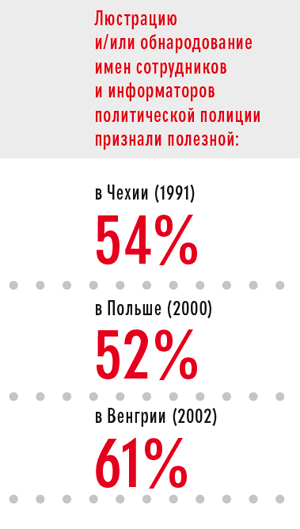
Cleansing is actually exactly since the time of ancient Rome and means the word "lustration". In countries where the relevant laws were adopted (in 1991-in the Czech Republic, in 1994-in Hungary, in 1997-in Poland), it carried out the ban on occupying a public or state office, heading state media, enterprises, becoming judges, etc. Those who were an officer or secret service agent. In the Czech Republic, 9 thousand such posts were determined, and after a check in 10 years 400 thousand people passed (3% turned out to be “Stb-positive”). In Hungary, these laws changed three times, and in the end about 8 thousand posts that were financed from taxpayers' money were determined and that former employees and political police informants could not occupy. In Poland, immediately, in 1990-1991, the law enforcement system began with the X -ray: special commissions fired 10% of prosecutors and 33% of employees of the General Prosecutor's Office. Then the process stopped, but it was either the dossier that one politician or the other, the third ... in the end, depending on the games of former political police officers and their colleagues from Moscow, was tired of the most convinced human rights defenders, and in June 1997, a lustration law was adopted, which prohibiting elected posts, and in the courts in court, in the courts and in the prosecutor's office and in the prosecutor's office and in the prosecutor's office, and their colleagues. The media people in uniform or collaborated with them. Then this law was extended to lawyers.
Justice? The political police infected with the virus was waiting for business - many employees of both the Stasi and the Czech STB went to transport companies, insurance agencies, and security enterprises. The opposition was also waiting for them, who needed people who knew well what hinges were spinning the car of the state apparatus and through which channels corruption money goes. The governments in Eastern Europe changed as gloves, and therefore it was impossible to form stable clients and business-state organized crime groups. Famous chaos, instability - a necessary element of transformation, a petrified state system is not capable of a change - the material is too densely blind. But the prize was also considerable: by the beginning of the 2000s, in most former communist countries of Central Europe, stable democracy was established. That is, the party of power must sooner or later lose the elections. And he leaves, giving way to others.
Was lustration fair? No. Did she violate the human rights of those who, under the Communists, had them in exclusive use? Yes. And for many thousands of victims, it created at least the illusion of revenge. The dead are still, but their children and grandchildren are not. The history of the vast majority of posttotalitarian and supplied regimes testifies: there are no justice in real life, the elites who come to power prefer not to disturb their predecessors without need - too everything is intertwined. But there are exceptions.