Translated material
Ailments and roads
Russian motorists may soon have to pay for travel
Ailments and roads. In the near future, Russia can be covered with a network of paid roads. The leadership of the Ministry of Economic Development proposes to lift the ban on organizing paid tracks where there is no alternative detour. What it can turn out for Russian motorists - studied The New Times under the Law on Roads and Roads, today, during the construction of a paid road, an alternative free route should be provided. At the end of October, the deputy head of the Ministry of Economic Development (mayor) Andrei Klepach suggested that this rule be abandoned, "so that there was no mandatory requirement of alternative free roads." According to him, this is necessary for the development of transport infrastructure in the country, attracting private investment in the construction of new ones and the reconstruction of old roads. Now the government is preparing a law on the issue of special bonds to attract money for private investors for the construction of new routes, mostly paid. However, independent experts seriously doubt that the payment of Russian roads is able to improve their terrifying state.
From paragraph A to paragraph B in the science of road construction, there is the most important indicator of the quality of the road network - coefficient of connectedness. It gives an idea of the density of the network. How many alternative routes exist to drive “from point A to point B” - this is the coefficient. In Moscow, for example, this indicator on average is 3.5. Motorists-owners of GPS navigators-know this very well. Because when they ask for a smart computer to calculate the path to traffic jams, the device, as a rule, gives 3-4 routes.
It is clear that the larger the desired coefficient, the less traffic jams: the flow of transport is distributed along all alternative routes. In the world practice of developing the road network of megacities, the average coefficient of connectedness of 7.5 is considered acceptable (this is, for example, in London). The record holder is Tokyo. Despite the fact that there are 17 million inhabitants, and the motorization of the population is about 100%, the average coefficient of connectedness is 12. Because over the past 30 years 11 transport rings have been built there, some of them are four -story! And the metropolis is going ...
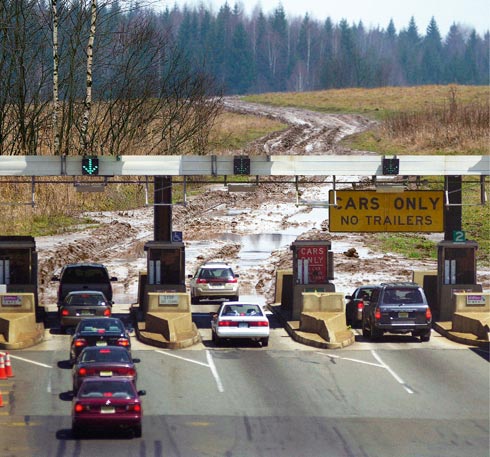
However, the Moscow situation may seem simply exemplary if you compare it with what is happening outside the capitals. Behind the Urals "from point A to point B" is often the only road leads. On average in Russia, the boundaries coefficient is 1.8 (for comparison: on average in England - about 5, in Germany - 4.2, in the USA - 3.9). Moreover, sometimes he is equal ... zero. For example, the Ulan-Ude-Chita highway is federal, its length is 600 km. However, 150 km from Ulan-Ude asphalt ends. Further, almost 400 km, the road is covered with large gravel with sharp faces. The people are the name of “Farewell, Wheels”: it is almost impossible to drive along it without puncture of tires and damage to the wheel discs. According to European and world standards, such a “road” is not considered expensive.
The new plot in the Ministry of Economic Development believes: the construction of paid roads is the only way to change the situation for the better. The mayor gives the following figures: over the past three years, the fleet in the country increased by 20%, and the length of the road network by 3%. The budget funds, especially in the conditions of the crisis, are not enough even to build the roads with the same pace.
* * In the draft federal budget for 2010, 263.4 billion rubles are allocated for the road facilities-almost 8 billion less than in 2008. The cancellation of the rule on a mandatory free understudy will help to attract additional investments in the road industry, are confident in the mayor.
I disagree with this logic
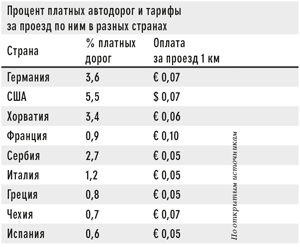
The leader of the movement “Freedom of choice” Vyacheslav Lysakov : “No one will repair a free road, if you can build a paid one and cut coupons from it.” Experts have already calculated: if the mayor’s initiatives are implemented, 40% of the federal highway can become paid. And this despite the fact that not a single paid road has been built in Russia at present: investors are not investing, fearing that the Russians will prefer to stand in a traffic jam, but will not go through a paid route. And if in 40% of cases there is no alternative, then they will pay as nice.
There are no paid tracks in Russia yet, and how much travel will cost on them are already discussed with might and main. The Minister of Transport of the Moscow Region Peter Katsyv believes that the price for the suburbs can be from 1 to 5 rubles per kilometer. The federal road agency called the tariff per kilometer along the Moscow-St. Petersburg highway: 3.6 rubles. “If a more comfortable speed limit is installed on paid roads, then motorists are ready to pay up to 2-3 rubles per kilometer for it. A higher fee can make the road unclaimed, ”Lysakov believes.
“We have wagons to Dalnyaki - to Novosibirsk, Yekaterinburg, Surgut,” says
The representative of the transport business Vitaly Zheleznov . - There are practically no alternative federal routes for trucks. If they introduce a fare for "federalists", then carriers will have to raise prices for services - presumably by 10%. Part of the business will simply kill: many in many in loans and leasing. ”
Checking the reaction may not meet unanimous approval even in power structures. “This proposal violates the article of the Constitution of the Russian Federation on the freedom of movement of citizens,” said
Chairman of the State Duma Committee on United Russia transport Sergey Shishkarev . “In addition, not a single paid road has been built in the country, the mechanism has not been worked out, there is no experience, there are no real investors either, the payback is incomprehensible.”
Independent experts are also skeptical.
Mikhail Blinkin, the supervisor of the Research Institute of Transport and Road Facilities , is categorical: “I consider the initiative of the mayor Bredova. All over the world, paid roads make up 3-5% of their total. And in Russia it is supposed to make 40%! And even more so, the mechanism for building paid roads is nowhere and never makes it possible to overhaul the road network. ” Blinkin explained: now all car owners who pay the transport tax annually. But this money remains at the disposal of local authorities and is not always used for declared goals. “Meanwhile, throughout the world, the construction of new ones and the repair of old roads occurs at the expense of target taxes that are included in the price of gasoline. There are no other working mechanisms, and the mayor did not offer them. Therefore, our road network is doomed to further degradation, ”Blinkin believes.
So far, the proposals of the Ministry of Economic Development in the government have not been considered. “I am convinced that when making a decision, the public reaction to this proposal will be taken into account,” said The New Times
Prime Minister Dmitry Peskov . Perhaps Cleepach’s statements were made exclusively in order to evaluate the degree of indignation of the public?