
Translated material
Freedom holiday
Report from the past
Report from the past. Anna Appelbaum, in the late 80s, the correspondent of the English Economist, in those November days conducted reports from Berlin. How was it? As the Germans managed to crush the wall, and with it, the regime, without spilling a drop of blood, - I found out The New Times I have very different memories of the fall of the Berlin Wall. One thing is a jubilant people, clap traffic jams, champagne is pouring as a river, people dance on the streets, politicians make soulful speeches, in a word, familiar to everyone on the television portals of the scene. Another is what I happened to see with my own eyes the next day is not at all like television personnel. Berlin was a much more gloomy, almost sinister picture: an inflated crowd, ready to explode at any moment, tense police officers, drooping, bewildered Eastern Berliners. The contrast between the two paintings was so sharp that since then I began to perceive everything that was shown on television or write in newspapers in a completely different way. Now that I see a jubilant crowd in the news, I can’t get rid of the thought that the “all the truth” remained behind the scenes.
Contrary to expectations , I remember how long we rode by car from Warsaw, with what joyful feeling we crossed the German border and looked at the first signs for Berlin. And what delight experienced when the border guards, despite the fact that no one officially opened the border, calmly missed us through Charlie's checkpoint (a checkpoint between the western and eastern Berlin). All, all the more so for us, in those days it did not care about prohibitions.
We were sure that our euphoria was nothing compared to the crowds of people gathered against the wall. It turned out no. We rode along the empty Eastern Berlin, saw the illuminated Brandenburg gates in front of us, but instead of glee exclamations, only a formidable rumble was heard. For almost two days we wandered around the United city, but never saw the people to have fun.
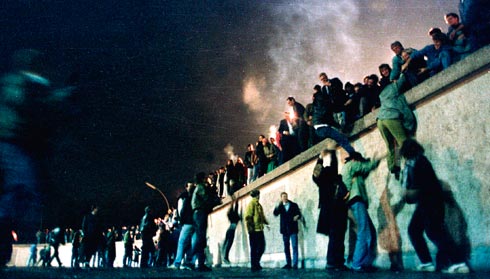
On that second night after the opening of the border, no one, of course, was sleeping, in the crowd there were many drunk, people climbed from the west side on the wall, and only a week ago it could cost their lives. Having climbed, they began to look around in confusion, obviously not knowing what to do next. After all, police officers stood on the Gader side. Although it was impossible to see in the darkness of the face, extreme tension was felt in the figures.
There were more and more people on the wall, the police began to shower the insults, then empty bottles flew. Suddenly, some guy jumped into the border lane. The police immediately tied him and expelled him back. A minute later, the scene repeated, and then people already began to pour down like peas. There was a moment when it seemed that the police would begin to shoot. Imagine that chaos reigns in the city, abandoned law enforcement officers, which no one gives any orders, and against them an angry crowd is terrible to think about what could have happened if at least one military was surrendered.
Fortunately, aggression did not result in police officers, but on the wall. People began to destroy her, using everything that came to hand (for example, we operated with a penknife). Everyone tried to break off a larger piece, and by no means for memory. They pounded the unknown sledgehammers, pieces of reinforcement from where to throw out their hatred, but hatred for whom? To the police? To the wall?
Western hospitality at dawn we left the Brandenburg Gate area and went to roam West Berlin. During the night, thousands of eastern Germans moved west, because they were afraid that they could close the border at any moment. In a small shopping center near Elector, people slept right on the floor, some man lay down at the entrance to the electronics store, comfortably wrapping himself in an American flag. In the morning of the crowd of the Gaderovites-it was easy to recognize them by the characteristic nylon jackets-they began to besiege McDonald's next to Bangof-Tsoo. Huge lines were lined up in the city for the so -called “welcoming money”, which were issued to the Eastern Germans who came to Germany. The Chancellor Helmut Kohl, showing remarkable talent and insight, ordered to extremely simplify the procedure for issuing these small amounts. He was afraid that thousands of eastern Germans, finding himself without a penny in his pocket in front of the windows of chic Western stores, would be brutalized - and pogroms would begin.
Now, recalling the confused faces of the police officers as Charlie, through which a human crowd flowed freely in both directions, it seems that events could not work out otherwise, that the unification of Germany was different, that is, peacefully, without blood, and could not happen. Meanwhile, on that November night, not everyone was counting on a successful outcome. After all, the border these days opened, in essence, thanks to the absurd accident and perseverance of the Eastern Berliners, who began to demand that they be released to the west. As soon as one crossed the border, the rest stretched after. But in fact, people who then gathered at the Brandenburg Gate exposed their lives of real danger. While friends and colleagues and my colleagues were sitting on the wall, an emergency meeting of the Politburo SUPG was held in East Berlin, at which the issue of dispersing demonstrations and closing the borders was seriously discussed. In Leipzig, where thousands of anti -government rallies recently passed, hospitals were ordered to urgently write out all the mild patients and replenish blood supplies in case of the wounded. The Gader Army ranks scratched their hands, they (I think they are still) in rage that they are not allowed to restore order. And if they were given? History could take a different path, and the fall of the wall would remain in memory as a tragic and bloody event.
The unsteady border on November 9, 1989, the Berliners seemed to find themselves in the airless space. The laws ceased to operate, and no one knew how all this could end. Hence such an inconsistency of feelings that swept people: happiness, anxiety, complete confusion ... All this is not so easy to convey, and even more difficult to comprehend. But one thing can be said with confidence: the Western liberal society has carried out of this story a very important, although a bitter lesson: the border between freedom and anarchy is much more unsteady than we would like to think. If the vacuum that arose as a result of the death of the old order cannot be filled immediately with something, freedom will inevitably turn into anarchy and chaos.
In Berlin, this did not happen only because the Eastern Germans knew exactly how to fill out the emptiness that had formed: a successful West, which they saw on TV, had to come to replace the GDR. After all, liberal democracy, especially when it is accompanied by, as in post -war Western Europe, a long world and material well -being, in essence, a very attractive thing.
Anna Appelbaum is the Columonist Washington Post, author of the book “Gulag. Web of great terror ”, for which she received the Pulitzer Prize. In the late 80s, Economist wrote about velvet revolutions in Eastern Europe as a correspondent for the magazine.