
Translated material
After the ball
Has Germany united?
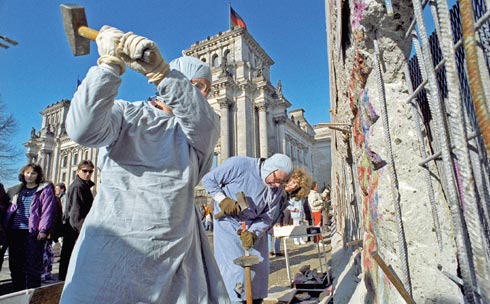
The ghost of the wall. The eastern and western Berlin again divided the wall. True, not that stone, destroyed 20 years ago, but foam, and it was not built by workers under the muzzles of machine guns, but by children. It stretched 1.5 kilometers and strongly interferes with the automobile movement. This is done specifically to remember. The wall will be solemnly destroyed on the evening of November 9 at the Feast of Freedom
“I was only six years old, but I remember that day very well,” says Mom watched the TV in the evening of November 9, a resident of Eastern Berlin Julia N.. She remembered a man with slightly lowered corners of his mouth-he broadcast something from the screen, his mother listened, not looking up, and only from time to time she frantically squeezed my hand. Then we began to constantly call the phone. “I can’t believe it,” said mother, “I don’t know”, “I'm not sure”, “I'm afraid”, “We will go tomorrow” ...
Four months before the fall of the Berlin wall, Julia's brother fled from the GDR. Hardly reasoning that in the countries of Eastern Europe a complete confusion reigned, he did not move to the west, but to the east and through Czechoslovakia reached Budapest. There, for the illegal crossing of the border, he was still detained, but no one understood what to do with such defectors, and soon the young man was in Vienna.
“The next day, that is, on November 10, my mother and I went to the Brandenburg gate and - lo and loyal! - We met a brother there. I will remember this all my life: crowds of people, all happy and hug. ”
The wall and her victims are a man with lowered corners of the mouth - this is a member of the Politburo of the Central Committee of the Socialist Unified Party of Germany (SEPG) Gunter Shabovsky. On the evening of November 9, 1989, at a press conference, which was broadcast throughout the country, he made a sensational statement: departure from the GDR will now be free. One of the journalists asked when the new rules will enter into force. Shabovsky was clearly caught by surprise by surprise, he said not quite confidently: "Right now." These words were enough for the crowds of residents of Eastern Berlin to flock to the wall.
The Berlin wall stood for 28 years and three months. On August 12, 1961, on Saturday, the Council of Ministers of the GDR announced that "to suppress hostile activities of revenge and militaristic forces of West Germany and West Berlin on the border of the GDR, including the border with the Western sectors of Big Berlin, the same control is introduced on the boundaries of any sovereign state." Saturday was not chosen by chance - many residents of East Berlin worked in the western and weekend, of course, were at home. Temporary barriers between sectors appeared early in the morning on Sunday. The streets connecting parts of the city dug up, the metro tunnels were walled up.
In exchange for temporary, constant fences - a stone wall, the height of which reached 3.6 meters, began to erect a shock pace. It was built by the Gader workers under the supervision of armed border guards.
In some areas, the border ran literally on the walls of the houses. Another, free life could be observed from the windows of their own apartment, and this pushed people to desperate actions.
Ida Zikman became the first victim of the Berlin wall. She jumped out of the window of the third floor of the house 48 on Bernauer-Strasse Street. It happened on the ninth day after the border closes. Previously, a 59-year-old woman dropped on the pavement, which already belonged to the western part of the city, several feather beds, but they did not soften the blow. Today, a wreath hangs in the house of Ida about her and other dead defectors.
The border was constantly strengthened: the entrances, windows of the lower floors, which went out to the west were melted. The wall within the city had a length of 43.1 kilometers. And the length of the border contractions separating the Western Berlin from the territory of the GDR was 111.9 kilometers. For 28 years, more than 100 thousand people tried to overcome the border, for several hundred this ended tragically.
The name of the last victim is known. Eight months before the fall of the wall, 32-year-old Vinfrid Freudenberg crashed on a home-made balloon, with the help of which he intended to get west.
The eastern Germans met the downtime of the Berlin Wall 20 years ago with glee . Then 71% of the GDR citizens were sure that the unification with Germany would improve their lives. Today, according to the sociological service of Forsa, almost half of the inhabitants of the eastern part of Germany believes that “in the GDR there was more good than bad. There were some problems, but in general, life was not bad, ”and almost a tenth generally perceives the GDR exclusively positively. Moreover, sociologists note that residual (from the German Osten - “east”) mood is not only characteristic of the older generation. They were especially strong at the end of the first decade of cohabitation. In 1996, the results of the associations expressed dissatisfaction with almost 40% of the OSSI (and almost half of the Wesser), and by 1999 this figure increased to 70%. But then the Ostalgia was decline. On the 15th anniversary of the fall of the Berlin wall, only 15% of the Eastern Germans (and 8% of the Western) were dissatisfied with the union.
“Something like the Berlin wall is still present in the minds of many Eastern Germans. For almost half a century they lived first during Nazism, then under communism, and it is very difficult for them to accept the political system of the West, which puts freedom at the forefront, ”says Lee Edwards, the creator of the virtual museum of communism.
Residents of the East often transfer their discontent to Western Germans. They accuse them of selfishness, illegibility of achieving the goal, landing. Wessers do not remain in debt, they say about the former Gaderovites that they only know that they do not know how to complain, and they don’t shine with their minds.
“I must admit that it seemed to many of us that life together would be easier and harmonious than the one now,” says Professor Bernd Bonvech, director of the German Historical Institute in Moscow. - When the euphoria passed, a lot of eastern Germans decided that the price of freedom was too high, that freedom should not be lost social security. And we, Western Germans, instead of showing more tact, willingness to help, only boasted of their democracy. ”