
Translated material
Deadly express
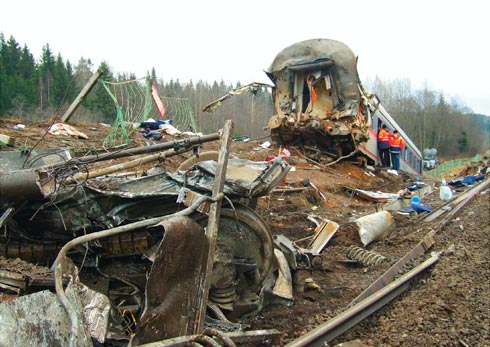
Killer chairs. The first rescuers, who penetrated the last, most affected wagon of the Nevsky Express, found that it was almost empty, and everything inside - people, armchairs, things - literally imprinted in his front end. To the screaming question: why the design of the wagons turned out to be so imperfect - tried to answer The New Times
“I am not a professional, but the design of the wagons is amazing. All seats-some sharp structural elements-could not stand the blow, broke away, flew along the cabin and were one of the main causes of injuries and deaths, with the exception of several at the beginning of the car. I repeat: not a specialist, but somehow it all looked strange. Somehow flipko were attached to massive grounds. The remnants of the fasteners - torn teeth of metal, similar to aluminum, also cut people that your knives. The chopped doors were able to open only the Ministry of Emergencies outside. It was almost impossible to break the windows, and there was nothing. There was only one staircase, and it was not possible to get it for a long time - it was overwhelmed, ” - this is the testimony of businessman Nikolai Kovarsky, who miraculously survived in the disaster of Nevsky Express. The fact that the most difficult injuries to passengers inflicted torn elements of the internal structures of the wagons, write almost all the witnesses: “In general, the car in the first minutes of the disaster was a mass of bodies uniformly scattered throughout the volume, parts of the car and the remnants of the seats ... The wounds of people were mostly heavy wounds, open and closed fractures, penetrating wounds from the wounds from The flying parts of the structure ... ”In one of the blogs, the following record:“ Yesterday, Roma told how to lean to raise the conductor’s notebook in the carriage and saw a piece of meat planted on a fragment of fastening from the floor. ”
Reading all this, it is difficult to get rid of the thought that the Nevsky Express was simply poorly designed and made.
What to pay for? But what does “bad” mean in this case? It is clear that by spending colossal funds, you can create a wagon in which passengers will remain intact and sound, even if it crashes into a concrete wall at full speed. But who can buy a ticket for such a train? And much more rationally investing - in the creation of trains capable of “surviving” in a difficult accident, or into events that reduce the likelihood of terrorist attacks? Last Thursday, it was announced that in the near future, throughout the 650-kilometer highway Moscow-Sank-Petersburg, they were going to install video surveillance systems and night vision chambers. And on other thousands of kilometers of railway tracks?
Representatives of the Tver Carbon-Building Plant producing the 61-4170 series wagons, of which the Nevsky Express are formed, argue that the design of the car is fully consistent with GOST, and we have it more strict than in Western countries. This, apparently, meets reality, since even the last car (it turned out to be the most victims), which, having got off the rails, immediately buried in a speed of 190 km/h, did not fall apart. If this happened, according to experts interviewed by The New Times, it is unlikely that anyone survived. But the trouble is that neither in the GOST, nor in any other prescribing document, it is said what load should withstand the chairs and fasteners that fix them. The reason for the majority of injuries, which was recognized by the forensic medical examination, the conclusions of which were published on December 3, was precisely the separation of the seats. At the same time, there are sad experience with chairs in our country. In 1988, on the same highway, due to the skew of the tracks, 15 wagons of the Aurora high-speed train took off the rails. 31 people died, more than 100 were injured, many due to the fact that a significant part of the seats was torn off the mounts. That experience was taken into account. Two years ago, when, as a result of the terrorist attack, all the wagons of the Nevsky Express came off the rails, not a single chair was torn off and none of the passengers died. But then the wagons were equipped with domestic seats cooked from steel pipes. In terms of convenience, they are very inferior to the Western - and the railway authorities decided to replace them with German.
Car manufacturers, installing new elements in their products, necessarily carry out crash tests. The Russian railway workers have no such practice, which was confirmed by the New Times and the carbone builders, and the expert - head of the department “Wagons and Logical Economy” of the Petersburg State University of Railways Yuri Boronenko. “In Russia, and in the world, too, as far as I know, trains are experienced only in relatively regular situations. That is, no one experiences wagons to the gathering from rails at a speed of 200 km/h. The chairs, in particular, fell off the mounts not so much due to emergency braking, but due to a blow to the ground during a gathering or due to turning. ”
“The normative acceleration for which the design of the internal equipment of the wagon is calculated,” the factory of the plant told the New Times to the correspondent, “including the seats and nodes of their fastening, is accepted by 4G (39.2 m/s2). During the Nevsky Express accident, the overload reached more than 12G, that is, it exceeded the normative three times. This was the reason for the destruction of the seats. ”
In the framework of common sense, indeed, such emergency overloads can only be obtained in crash tests, and in the case of a car test, they are very expensive, but a whole car is divided-and even exorbitant money. The maximum that the wagons are experiencing is on the so -called hard coupling, which corresponds to the impact at speed by no means 190, but a little more than 10 km/h. Now, more wider, computer modeling of various kinds of accidents is used. For example, the nine largest world car manufacturers have combined their efforts to create a virtual system of crash tests. It will be launched no earlier than two years later. It is immeasurably more difficult to develop such a system for railway compositions, so in the near future it is not necessary to count on it. Another thing is that in order to check the reliability and safety of an individual chair and its fastening it, it is not at all necessary to break a whole car or create a supercuscular program - tests on a small stand would probably show that the mounts should be strengthened, and the material of the seats (aluminum) should be changed, since it does not withstand the loads, and most importantly, acute fragments, crippled people are formed during its destruction.
But even if the design of the seats were checked using reliable tests, this would hardly help passengers. The most advanced designs require quality maintenance, but with this we do not have order. “In this case, the mounts (chairs) were simply weak, unreliable - and fell off. In addition, I do not exclude that no one has checked them for a long time - Russian Railways saves on such things, ”says Yevgeny Kulikov, chairman of the Russian Professional Union of Locomotive Brigades of Railway Workers.
Many measures that can increase safety do not require any expensive tests-only common sense and responsibility. In particular, nothing prevented him from hanging special hammers in the walls, which, in the event of an accident, could be broken down by glass (even in buses they are provided), or organized in the vestibules (as is done in the West and Japan) places for overall baggage - a lot of passengers during the accident were injured from herbal bags and suites. “On a train moving at a speed of 200 km/h,” says Kulikov, “there must be closed luggage shelves.”
The German quality, in fact, could not be particularly worried about the design of the Nevsky Express - at the end of the year it will be replaced by Sapsan, which was entirely made by the German company Siemens, which creates well -proven high -speed trains for Europe, Japan and China. But if you do not fully understand the causes of the Nevsky tragedy, passengers will continue to die on our trains. As the mother of Vera Kozlova who died in the accident wrote in one of the blogs: “I don’t need“ hands ”because of which my daughter died, I need a“ brain ”, whose duty to think about the safety of everyone who gets into the train car!”
He turned to Siemens with the question: are his cars designed for Russian emergency situations? Here is an excerpt from the response: “The tests and calculations testify to the strength and safety of all structural decisions of the train in the event of an accident. All requirements of new regulatory acts of the Russian Federation in this area are strictly implemented. ” In other words, in the event of an emergency, the seat on the Sapsan train will not fly throughout the cabin, and the situation similar to the one that occurred during the Nevsky Express disaster will not be repeated. ” I want to believe. Actually, nothing but faith remains.
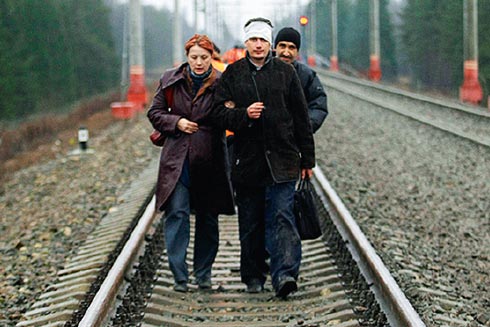
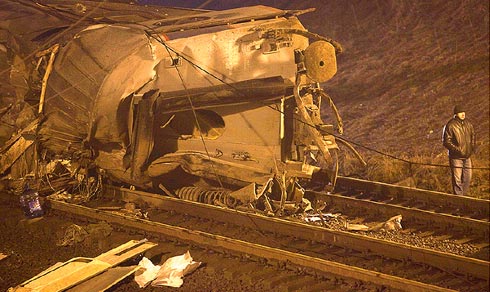
There were a lot of seriously wounded in the torn cars. They were evacuated first. Therefore, part of the passengers of the "Nevsky Express" chose to leave the scene of the accident
Photo of LLC "Interpress"/ITAR-TASS