
Translated material
The world of Pavich
Translator Larisa Savelyeva recalls the great writer
Khazars.com
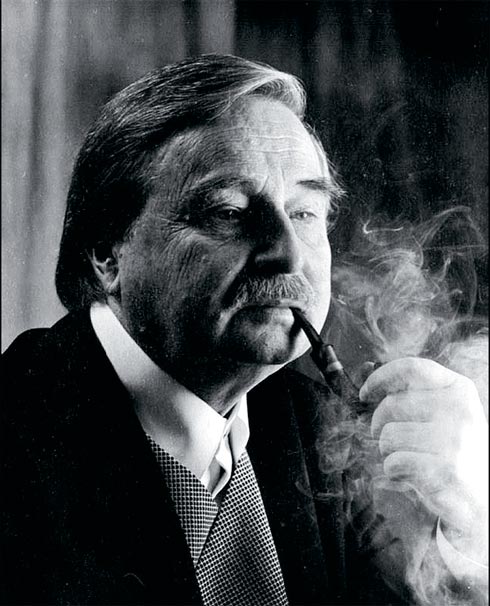
The king is dead. On November 30, in Belgrade, at the 81st year of his life, the great Serbian writer Milorad Pavich died. In Russia, he dispersed of many thousands of circulations and was perhaps the most popular representative of postmodernism. Almost all of his novels published here, we read in the translations of Larisa Savelyeva-the philologist-Slavist and the translator from the Serbian and Croatian languages. The fact that the person was Milorad Pavich, about his hobbies and the world that he invented for himself, in the memoirs of Larisa Savelyeva, specially for The New Times in 1984, I first went to Yugoslavia. In Belgrade there was a summer school of Slavists - philologists from all over the world gathered. For three weeks we listened to lectures, met the city. I noticed that in almost all windows of bookstores there is the same book - the Khazar Dictionary. Who is Milorad Pavich, I did not know then. When she returned to Moscow by train, she lay down on the upper shelf with a book and “woke up” only upon arrival at the station. Then she walked along the publishers, offered to translate the novel. The editors looked at me with square eyes ...
Five years later, they called me from Foreign Literature and said that they wanted to publish the Khazar Dictionary in the magazine. Then I just turned up another trip to Yugoslavia. I found Pavich’s contacts, asked him to meet - to get permission to transfer and publication in Russia. He invited me to visit me. He then lived in the central part of Belgrade, but the place was very quiet, nearby - a park and a cemetery. At the appointed hour, exactly a minute per minute, I went to the gate of the house and pressed the call. At the same moment, the bells rang at the cemetery. (Now, knowing Pavich, I think that he specifically made an appointment at this time - he liked to furnish everything spectacularly, later I was repeatedly convinced of this.) Then the gate opened - and I saw a small mansion, whose walls were twisted with small roses, and a writer with two greyhounds. Pavich was small in stature, he had a typical Serbian appearance: a slightly hooked nose, antennae with a brush - in general, he did not make an impression of a handsome man, but at the same time he was incredibly charming and Mil. He knew how to dispose to himself like no one else. We went into the house, into a completely unusual living room, in which there were velvet Gothic chairs, an old globe, a telescope and a huge number of books. They sat opposite each other. After some time, a very pale lady with her hair loose entered the living room, as it turned out later - Pavich's first wife. She had a silver tray in her hands, on it was a decanter with cherry bulk, and almost the same as my grandmother did in Odessa. We talked about childhood, everyone began to remember something, then we drank, and it became somehow completely comfortable and warm. Quite quickly we agreed on everything - Pavich even allowed me to independently reduce the “Khazar Dictionary” to the coffee version. Since then, we made friends and have already seen each other regularly - almost every visit to Belgrade or his arrival in Moscow.
Pavich has always very meticulously read the translations of his texts. He knew Russian well (English, French and German - even better). Once I found a serious mistake in my translation, and I was very embarrassed. Fortunately, the mistake was not in the book, but in the journal Playboy, for which I translated Pavich’s small story. In one of the paragraphs, I understood the words “Danube stood” as “Danube frozen”, and therefore there is no fish in it. It turned out that this is not at all like that: the Danube gets up literally, and even begins to flow in the opposite direction, and the fish simply goes to the depths. In general, they often ask me: "Pavich must be incredibly difficult to translate?" The fact of the matter is not. He writes very simply. And this is his main trick: he reaches beauty and non -triviality with the help of the simplest means.
It was quite difficult to determine about the hobbies of Pavich’s interests - it is so wide. Until the very last moment, he followed the new products of world literature. He was fond of music - he loved to go to classical concerts, he played the violin and piano. He loved to travel. At one time, he even bought an apartment in Paris, but later got rid of it: this is Moroka - each time to take a plane ticket when the neighbors flooded you ... He loved to eat deliciously - that’s not much, but exquisite. He was interested in tennis - he played it himself, and followed all the major tournaments. In one of my visits to Belgrade, I escorted Pavich home. There was beautiful spring weather, we walked along the street slowly, chatting about life. Suddenly he saw the poster of an exhibition dedicated to some Serbian astronomer. “Let's go,” he suggested. “I am so worried about astronomy, and how everything is arranged in the sky ...” In general, he was interested in everyone. In recent years, even computer games.
There are no real characters about imagination in his books. And as such of our life there is no - this is another planet. One of his last books “Paper Theater” is a completely invented anthology of world literature. He came up with 38 writers (according to the number of countries in which his books were translated) with biographies and bibliography, and wrote a story for each of them. All this is pure fantasy. We can say that he lived in some parallel world.
About politics contrary to common opinion, the policy was not interested in him. Believe me, political news is such trifles for a person who is immersed in his world and tries to transfer it to paper! The war, of course, could not pass by him, he was very worried-purely human. But the relations of the political elites of America, the EU, Serbia, Russia did not interest him at all, he even disdained this topic. He considered it all with mud.
This was about the last meeting in March. The director of the Amphora Publishing House went to Pavich to Belgrade to sign an agreement with him (his relationship ended with the ABC, and for some reason he wanted to change the publisher). We came to him at the Academy of Science and Art. He accepted us in his office. The walls were hung with paintings, and there, in particular, was his son's work “a landscape painted by tea”. The son literally prepared a welding and wrote it on a canvas. Actually, this picture inspired Pavich to create the novel of the same name.
The next day, he called me and invited me to take a walk in the city center. We wandered around the streets for a long time, talked about nothing, then drank tea in some cozy cafe ...
Neither I nor him wanted to part.
About the “Other Body”, unrelated after the release of the novel, told me: “This is my last book. I will not write anymore - tired. " Then he suddenly calls: “Lara, I have a new book ready here -“ Paper Theater ”. Not much time has passed, less than a year, he wrote quite quickly ... After the release of the Paper Theater, I was again told: “That's it, now it’s definitely enough - I just want to live.” But in 2009, the story "Flirt" was born. Before giving her out to be transferred, Pavich told me that "it has been in it for the first time there are many carographic moments." Indeed, when I translated, I found many things related to his life. True, one episode confused me. The protagonist, that is, Pavich himself, writes his political autobiography and bequeaths to publish it after death. I thought: “Is he really preparing for us some kind of sensation? Or just once again playing? "
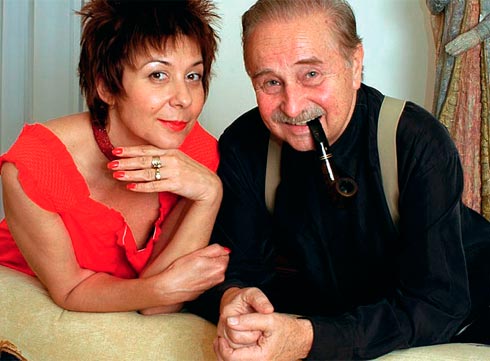
Milorad Pavich with his second and last wife, writer and journalist Yasmina Mikhailovich
Khazars.com