
Translated material
On both sides of the rod
Presidential passions in Moldova and Romania
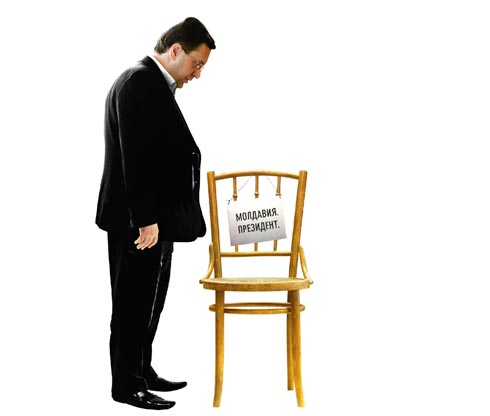
Bessarabian impasse. The Romanian leader Trajan Basescu with a minimum advantage won the second round of the presidential election and will remain in his post for a second term. In neighboring Moldova, this can only dream of this: another attempt to choose the head of state turned into a failure, extraordinary elections are waiting for the country. In the political prospects of the left and right coast of the Prut, the New Times sorted out
On the 300th anniversary of the famous Prut campaign of Peter the Great, which will be celebrated in 2011, Moldova has every chance of getting out of the political crisis-so far on the right bank of this tributary of the Dniester to political opponents is not able to come to an agreement. On the left bank, in Romania, a little more stable - November 6, the current President Trajan Basescu with difficulty, but re -elected for a second term.
Victory at 0.67%
Almost no one had almost no one believed in the victory of the leader of the Romanian Social Democrats Mirchei Joan on the eve of the second round of the presidential election. In the first round, the president went around his main competitor only 1.5% (33% versus 31.5%). According to his results, the leader of the National Liberal Party Crin Antonescu, who finished the third with 20% of votes, spoke in support of Joan. * * The New Times spoke in detail about the results of the first round in No. 43 of November 30, 2009. And then there is a loud scandal: the television channels supporting Joan replicated a video shot back in 2004. In the video, President Basescu during the election rally either specially beats, or accidentally hit a little boy in the face.
It seemed that Trajan Basescu did not have a single chance to be re -elected. The same was said about the same on November 6, the results of Exit-Pools: on them, Joana went around the current Romanian leader by 1-2%. By the way, such an outcome of the second round, in the event of Basescu and Joan, the sociologists predicted at the start of the election campaign. The more amazing were the news came from Bucharest on the morning of December 7th. After calculating the ballots, it turned out that President Basescu won the victory in the second round: he gained 50.33% of votes, while for Joan - only 49.66%. Representatives of the Social Democratic Party accused the president’s supporters of fraud and falsifications, appealed the results of the second round. On December 11, the Constitutional Court decided to recalculate votes. However, even this is unlikely to prevent Baseska in power for a second term, which means that the reforms he had begun, aimed at European integration, will continue. Perhaps the defeat of Joan contributed to rumors about his close ties with the Kremlin. Unlike the “Western Man”, Bassescu did not hide the leader of the Social Democrats that Russia, China and India would be his main foreign policy partners. Moreover, he openly admitted that shortly before the elections he flew to Moscow, where he met with representatives of the Russian Presidential Administration, securing the unspoken support of the Kremlin.
Attempt No. 3
On the right bank of the Prut, the political situation is even less similar to a stable. Another attempt by the alliance ruling in Moldova for European integration (AEI) to elect the leader of the Democratic Party Marian Lupa ended with a failure. The Communists left the meeting room, refusing to participate in the vote, and as a result, AEI did not have enough 8 votes to choose a lupa (“for the pros“ 53 deputies of the alliance voted with a 61 deputy voice necessary for the approval of the president). The plot of a half -year prescription, when in a similar situation, only one voice was not enough for the Communists, he repeated almost with mirror accuracy. Now the parliament will be dissolved, extraordinary elections are waiting for the country, most likely in August-September 2010. * * Moldavian law does not allow the parliament to elect more than twice a year, and the parliament will be dissolved, most likely, in June 2010.
What is the coming year? ..
Sociological surveys show: neither the Communists, nor the parties included in AEI, and in new elections, most likely, will be gained by the necessary majority (the Communists will receive 44 mandates, AEI - 57). The ruling alliance sees a way out of the situation in changing the constitution. The leader of the liberal party, the speaker of the parliament and the acting President Mikhai Gimpu proposes to change the president’s election scheme so that the head of state is chosen by a simple majority of votes. The leader of the Democratic Party Marian Lupa now does not exclude that the country will return to direct presidential elections, which it was decided to refuse in the early 2000s. According to Lupa, a referendum on a return to direct elections can be held already in the spring of 2010.
The Communists also found themselves in a very ambiguous situation, and their return to power seems very doubtful. The problems they have to face are multiplying before our eyes. So it became known that the Demill led by Marian Lupa merges with the Social Democratic Party of the former Deputy Prime Minister Dmitry Brahisha. Social Democrats did not go to the parliament of the last convocation, but additional voices to the democrats of the Lupa are quite capable, which means that the Communists will lose. The second problem is a split in the ranks of the Communists themselves. Immediately after an unsuccessful attempt to elect the president of the country, one of the leaders of the Party of the Communists, the former vice-speaker, former Moldova ambassador to Russia, Vladimir Tsurkan, announced his readiness to leave the party. According to him, he will not be left alone, but with a whole group of deputies. If they are pushed into the ranks of the associates of Marian Lupa (he has already agreed to accept the Communists-Rastors under their banners), then the position of the Democratic Party will intensify even more. If they form a new party, the Communists will have a strong competitor on the left political flank.
No matter how events develop now - to be an extraordinary election. And if in 2010 the events will develop according to the 2009 scenario, then the chance to get out of a prolonged political crisis will appear in Moldova only by the beginning of 2011.