
Translated material
For Kozlov - to answer
Altai against bureaucratic hunting
Seismically dangerous zone. At the end of November, in Gorno-Altaysk, the capital of the Altai Republic, a rally of protest was held against the final closure of the Prosecutor General’s Prosecutor General about the poaching of high-ranking officials. During the year, the Gorno -Altayers have repeatedly went outside on this occasion. Rallies here are a common occurrence, but street activity can increase sharply if the federal authorities begin to implement the construction of the Altai gas pipeline and the unification of the republic with the Altai Territory 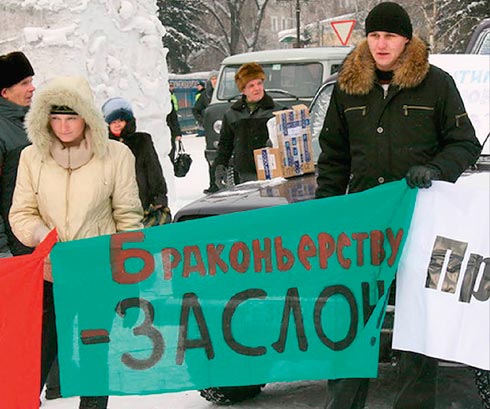
In 2009, on the streets of Gorno-Altaysk, they most often went out due to the story with VIP broconierism.
And they continue to go out
Mountain Altai seemed to be created for advertising avenues for travel agencies. There are such beauty of nature in Russia only in Baikal. Back in Soviet times, from all over the country they went on vacation to Altai - to look at Mount Belukha, see the Lake Teletskoye, go on horses to the Korbu and Kishta waterfalls. The beauty of Altai is now attracting tourists, including high -ranking exotic lovers.
They wrote off on the harmonist
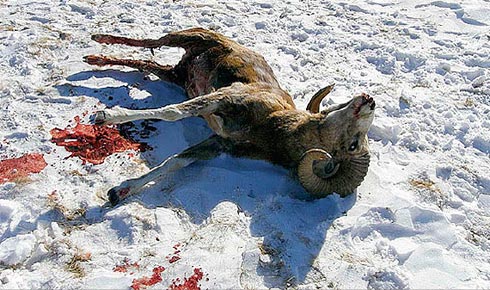
A January history with a catastrophe in the Altai Mountains made a noise throughout the country: a helicopter crashed in the Kosh-Agach district, on board the presidential representative in the State Duma, Alexander Koskopkin, the chief expert of the State Duma Committee Nikolai Kapranov, the Deputy Prime Minister of the Altai Government Anatoly Banny and the “accompanying persons group”. Among them, in particular, the harmonist Vasily Vyalkov, as well as, as local media wrote, a group of unknown girls. Koskopkin, Lyalkov, pilots (only seven people, and according to unofficial data, ten) died, the four survivors were in the hospital. At the site of the disaster, they found vodka, guns and carcasses of the dead archars, which are forbidden to hunt - they are included in the Red Book. (In Altai, which is characteristic, they immediately spoke that the helicopter was shot down by local hunters who brutally from the bloody “royal hunts.”) In September, a criminal case was suddenly closed on the fact of poaching, and a wave of rallies swept through Altai: people demanded justice. The case was resumed, and in November they closed it again. The poaching was accused ... of the dead pilots and the harmonist! This was regarded as an insult, and the inhabitants of Gorno-Altaysk again went out into the street. The resolution of a rally sent to the presidential administration speaks of the cynicism of the Prosecutor General, who found the “switchmen” and justified officials.
The revenge of the princess
The Altai people have another serious reason for concern. The tourist attractiveness of these places is at risk: through the Altai mountains, the pipeline should go through which Siberian gas will go to China. The idea of construction arose in 2006, but caused fierce protests of ecologists and the indigenous population: the pipe was supposed to be launched through the UKOK plateau-a sacred place for the Altai. Gazprom assured that he would find a certain “alternative route”, but which was not said. And in October of this year, Russia and China parophied the gas supply agreement. The head of Gazprom, Alexei Miller, clearly said: “The Western option (Altai gas pipeline) can be implemented in a very short time.” If, nevertheless, the pipes reach for the UKOK plateau, an explosion will occur in Altai.
Somewhere else, it would be ridiculous to predict the unrest. But Mountain Altai is a special place: there is a little lower conflictogenicity than in the Caucasus. And a variety of things are becoming the reason for dissatisfaction.
In 1993, archaeologists excavated the burial of a young woman to the UKOK plateau - she was dubbed the Altai Princess. The mummy was delivered to the Museum of the Institute of Archeology and Ethnography of the Siberian Branch of the Russian Academy of Sciences. The local population, the Altai pagans, began to demand to return the “princess” and buried her. And when in 2003 the Chui earthquake erupted, entailing huge destruction, the Altai people had no doubt that it was the revenge of the Altai Princess. Already not only pagans, but also the educated Altai demanded to return her remains. Representatives of the intelligentsia wrote an angry letter to the authorities: “Losely the opinions of the people, priceless treasures, the spiritual heritage of the Altai are exported ...” Letters of protest are still in all instances: the president of Russia, local authorities, international organizations ... Scientists do not want to give the relic, the authorities do nothing.
Injured memory
When the spirit of the rebellious “princess” was random over Altai, and the inhabitants protested about the gas pipeline, more than untimely thought occurred to someone in Moscow: to hold a referendum to unite the Altai Republic with the Altai Territory. She was voiced by the presidential envoy in the Siberian Federal District Anatoly Kvashnin and picked up the governor of the Altai Territory Alexander Karlin. And then it began! More than 5 thousand demonstrators-every tenth citizen entered the streets of Gorno-Altaysk. The initiator of the protests was the movement “For the Republic!”, He was supported by the Communist Party, “Homeland”, “People’s Volya”, “Patriots of Russia” and the Party of Life. It was 2006, the Perm region with the Komi-Permyak Autonomous Okrug, the Krasnoyarsk Territory with Taimyr and Evenkia, Kamchatka with Koryakia, the Irkutsk region with the Ust-Ordynsky Buryat District had already united or went to the unification. Everything went quietly there, and the authorities thought: why not do the same in Altai?
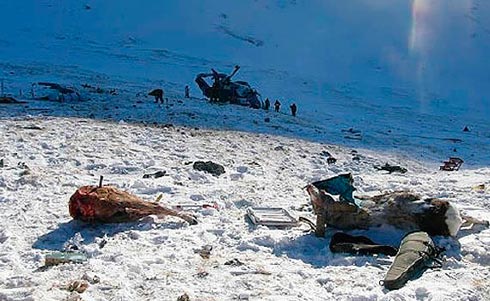
At the scene of the helicopter of the VIP hunters
It was necessary not to be at all interested in the situation in the region in order to make such a decision. There were no national and religious conflicts and mass protests in the united subjects of the Federation. And in the Republic of Altai, this idea is extremely unpopular. Deputies of the local parliament spoke out against the union. But the idea did not die, and from time to time it is voiced at the federal level or in Barnaul. The current head of the republic, Alexander Berdnikov, was in a difficult situation: Moscow expects actions from him, and he has no political support from the population and parliament. The opposition in the region is strong, the ruling party is passive (and thereby demonstrates that he does not know how to work in crisis situations). Moreover: the leader of the Gorno -Altay United Russia, the head of the State Assembly of the Republic, Ivan Beleekov, leads protests against the union. By the end of the year, the president must offer the candidacy of the new head of the Altai Republic. Rumor has it that in Moscow Berdnikov they are unhappy and can be removed.
However, if the next chapter of the republic takes up this seriously, the mass riots are provided. We must not forget that the indigenous Altai are almost viciously armed. And relations with the Russians, unfortunately, developed much harder than that of other Siberian peoples. The roots of the conflict go back during the Russian-Japanese war, when a mass national-religious movement began in Altai, which Japan identified with the kingdom of Oirot, which existed in Altai in the XV-XVIII centuries and destroyed by the Chinese. Then a folk song appeared about the "Japanese Tsar"-the liberator of the Altai. In the tense atmosphere of that time, aggravated by rumors about the upcoming massacre of the Russian population, there was a tragedy: in the Valley of Terenga, the armed settlers opened fire on the praying Altai.
In folk memory, these events are still alive. And today, due to the idea of eliminating the independence of the republic, the trust of the indigenous population to power is at a critical level.
The Altai Republic is part of the Siberian Federal District. It was formed in 1922 as an Oirot Autonomous Region as part of the Altai Territory. Since 1948-Gorno-Altai Autonomous Okrug, since the 1990s-the Gorno-Altai Autonomous Soviet Socialist Republic, from December 12, 1993-the Altai Republic. Altai make up 30.6%of the population, Russians - 57.4%, Kazakhs - 6%. The urban population is 26.4%.