Translated material
"You should not hope for a magic wand"
Egor Gaidar - The New Times
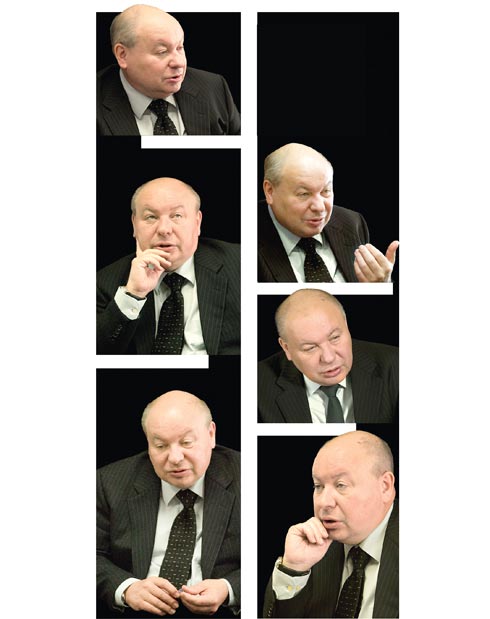
"Do not interfere with the weak to bankrupt"
When the editorial office discussed the issue with which of the economists to summarize the outgoing crisis year, the opinion was one: of course, with Yegor Gaidar. And because his professional competence was not in doubt, and because his economic judgments always differed in balanced and independence, and because he could not hedge the work of the state apparatus making a decision. And also because in almost the three -year history of The New Times, he, unlike many others, was never afraid to give an interview, once he himself came to the editor: for our young correspondents he was a living story ... He did not refuse this time: the meeting took place on the evening of December 9. And when on the morning of December 16 we turned on the editorial computer, in the mail there was a text of an interview, authorized the day before late in the evening Yegor Timurovich Gaidar. Nearby, in the news feed marked “Urgently”, there was a message that he had died ... Egor Timurovich, recently, the thesis that the peak of the crisis was left behind was constantly from the lips of the country's lips. Will the coming year really be easier than the outgoing? Whether the peak of the crisis has been passed is still unclear. In economic circles, an active discussion is conducted about how events will develop in 2010: whether the economy will be rapidly restored, or the world will cover the second wave of the crisis, or a long pause in world economic growth will follow. Each of these hypotheses is defended by completely qualified and informed specialists. From which only one conclusion follows: no one knows exactly what will happen. Therefore, I would be extremely careful in assessments, especially optimistic.
According to the tough scenario, is it a surprise for you how the crisis is developing? It goes through a significantly more rigid scenario than I expected.
More rigid - in what parameters? On the dynamics of reducing gross domestic product in Russia and in the world; in the growth rate of unemployment in the USA and in Russia; according to the dynamics of falling real estate prices in the USA and in Europe; In terms of influence on the banking system in the world.
How, in your opinion, does the Russian economy are experiencing a crisis? Hard. Although, in general, the economic policy of the authorities was quite reasonable. Another thing is that their reaction to the crisis was late for about 6–9 months. Many measures that they began to take in the fall of 2008 - for example, an increase in the basic interest rate, weakening of the ruble course in relation to the currency basket - it was necessary to begin to do it in the spring.
In your March interview with The New Times (see No. 11 dated March 23), you predicted that at the end of 2009 in Russia, GDP will be 3%, and industrial production - up to 10%. In fact, the fall turned out to be stronger - about 9% and 12%, respectively. Why was an industrial decline in Russia deeper than in other countries the "big twenty"? For two main reasons. The first is the dependence of our economy on raw materials. They react very much - in demand, at prices, for production - to the conjuncture of global economic growth. The International Monetary Fund has reduced its forecast for GDP dynamics over the past 14 months by 5%. This is a huge figure. Accordingly, the conjuncture of all raw material markets, from oil to metals, changed dramatically. This very significantly influenced the payment balance of our country, whose incomes largely depend on the export of raw materials.
The second reason is a change in the direction of capital flows. Investors who, in the era of high prices for hydrocarbons, are actively investing in countries depending on raw materials, in the conditions of the crisis, they begin to withdraw them no less actively. That is why we had a tributary of $ 82 billion in the pre-crisis in 2007. And according to the results of 2009, as the World Bank predicts, we will receive an outflow of about $ 100 billion.
A truck with potatoes before what risks the Russian economy is at the turn of 2010? The main problem is now not in achieving certain macroeconomic indicators, but in the microeconomic adaptation of enterprises. Domestic companies should be prepared for much more stringent international competition. After all, only those companies that will be able to reduce costs, improve the quality and competitiveness of their products will survive the crisis, concentrate production on the most effective activities. If our enterprises do not do the same, it will be very difficult for them to compete in this changed world.
Something does not seem to be bankrupt even frankly weak enterprises or banks. On the contrary, the government is trying to support them all afloat - even AvtoVAZ going to the bottom. Do you also consider such a government policy reasonable? No. I said that we have a reasonable policy in the field of macroeconomics - as for the budget, foreign exchange rate, interest rate. But I did not say anything about the rationality of politics in microeconomics.
What should it be? Do not interfere with weak enterprises and banks bankrupt. Do not interfere with enterprises if they want to concentrate production on the most effective elements of their business due to ineffective ones. There is no need to wait until the governor allows you to close unprofitable production: he will never do this, because he is afraid of social problems. But at the same time, one must think about how to adapt social policy, the policy of assistance and the creation of new jobs, microcrediting to the conditions when a significant number of employees are released.
How do you assess the situation with unemployment in Russia? Anxious enough. I believe in the indicators of officially registered unemployment, because if a person has no sources of income, then he turns to the labor exchange allowance. And if he does not turn, then he is busy somewhere-in a “gray” economy or in the household-and is not going to look for a workplace. So, the indicators of officially registered unemployment this year began to grow extremely high pace. At the beginning of December, according to the Ministry of Health and Social Development, in Russia there are 2.56 million unemployed, although in October 2008 there were half of them. And I think that this growth will continue in 2010.
But after all, by the wave of a magic wand, next to the bankrupt factory, you can’t create an effective factory. Are there any recipes than to occupy people who have lost their jobs in this case? Of course, you should not hope for a magic wand. No miracles: we need to make very serious efforts to develop small business microcredit. It is small business that should create jobs in such situations. Some banks are already engaged in this, including as large as VTB. The structure of credit cooperatives has been created. So there is no need to invent anything. But now the volumes of this microcredit should be increased at least several times. What is not easy - after all, we are talking about a specific type of lending, when there is no material pledge. The key to a small entrepreneur is his reputation in the local business community: he should know as a person who repaid debts. And then, please invest in the money at least in high -tech innovative activities, at least to the truck that you will carry potatoes from the village to the neighboring city.
Risks-2010 in the fall, many were waiting for the second wave of crisis. They said that banks burdened with bad debts were a weak link in the economy. But so far nothing terrible happened to the banks. Will it happen in 2010? In general, it has done so far. Our monetary authorities received reasonably, making the stability of the banking system and the prevention of panic of depositors with the most important priority of their work. And in general, we achieved the result: we did not have banking panic this year. I think that such a financial policy will continue. Because, against the backdrop of a crisis, only banking panic was not enough.
But bad debts have not gone anywhere. Pessimists argue that they still continue to accumulate in the assets of banks, and if not today, then tomorrow the banking system will definitely “tear” ... There is a risk of accumulating bad debts. But I would prefer to deal with them at the site of the monetary authorities after the main wave of the crisis passes. It is clear that we have huge problems in the banking system and that there are enough banks with poor loan portfolios. But, I repeat, this is not a reason for panic.
Recent events related to the default of the Dubai Fund forced economists of the whole world to look at new financial bubbles. Does their "pouting" of Russia threaten? I would like to hope not. In any case, the Central Bank still skillfully skillfully, in my opinion, maneuvered the interest rate. The Central Bank significantly raised it in the fall of 2008-in the conditions of an increase in the crisis, which became a barrier to the outflow of capital. And recently, he reduces her step by step to make more affordable loans within the country.
The ruble is either devaluable or strengthened, then weakens again in relation to other world currencies. What will happen to the ruble course next year? Apparently, the Central Bank is trying not to press too much on the foreign exchange market. That is, in general, the course moves to where it should in accordance with the trends of supply and demand. At the same time, of course, the Central Bank uses gold and foreign currency reserves so that the fluctuations in the course are not excessive, the panic does not give rise to, on the one hand, and speculative waves on the other. The monetary authorities calmly react to the fact that when the price of oil is slightly growing, the ruble rate slightly rises to the currency basket, and, accordingly, the opposite. The Central Bank does not try to strictly dictate its will to the foreign exchange market, although with the available volume of gold and foreign exchange reserves ($ 447.8 billion as of December 1, 2009) it may well manage it as it wants.
Fifty to fifty budget of 2010 is a overflow with a shortage of 3 trillion rubles. The hole is planned to patch up at the expense of the reserve fund. At the same time, the Minister of Finance Alexei Kudrin said that by the end of next year, the reserve fund will most likely be exhausted ... The Minister of Finance is obliged to tell the truth. So he said her.
But what will happen to the budget after the reserve fund is closed? After all, no one guarantees that by that time industrial growth will begin, and social obligations to pensioners and state employees must be fulfilled ... this may well be. Today, when the authorities still have a reserve fund, the National Welfare Fund remains in the tanning and there are considerable gold and foreign exchange reserves, it is quite easy to say that we will never cancel social obligations and we will even increase them. But if these "airbags" are blown away, you will have to somehow adapt.
I hope this will not happen. And most analysts are inclined to believe that by the end of 2010, the world economy will still leave the global recession. If so, our reserves are enough to survive the next year without very serious consequences. But only we must be aware that this is a factor that does not depend on us too much. And if all the reserves are over before economic growth begins, we will have to stretch out the legs - including in the social sphere.
You say that the exit from the crisis does not depend on us. And the recovery of industry depends on the actions of the government? Of course, it depends. We must understand: investors will always invest in oil everywhere. World experience shows that this does not require either a normal judicial system, nor an uncorrmposed bureaucracy, or even an elementary law and order. But if you want investors to be invested in high -tech proceedings, then be kind: guarantees of property rights, separation of powers, transparency of state decisions, free press, which can pay attention to corruption in the state apparatus, and so on. All this is very easy to say and not just do it at all.
In this regard, I want to return to one of your March forecasts: then you assessed the likelihood that from the crisis Russia will come out with a more liberal regime - like 50 to 50. Your assessment has not changed? It has not changed, the probability is the same.