Translated material
Account to the state
How much do we pay to the state
The events of the year according to The New Times
The check, please! How much we pay to the state for its main functions-the Federal Tax Service will summarize The New Times in the first quarter of 2010. According to experts, the fall of tax revenues to the budget will exceed 20 percent, but so far there are no exact data, you have to operate in the calculations last year's numbers. And they are these: taxes are collected $ 592 billion , or 35.4% of GDP.
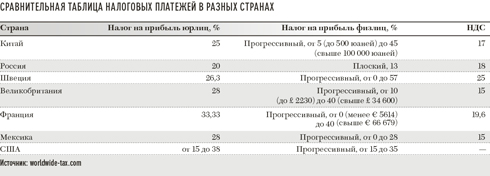
The income tax in Russia adopted, as you know, a flat income tax scale - 13%. When calculating it, some deductions from income specified by law may be made - for example, if you bought an apartment. This tax is seized directly from all income of individuals, and its share last year was 4% of GDP - $ 67 billion . In most developed countries of the world, this tax is removed on a step scale: the more a person receives income, the greater their percentage he gives. In 2001, Russia abandoned the progressive scale in order to withdraw money from the shadow to the light. Unified social tax *It is calculated based on the employee’s salary on a regressive scale: the greater the salary, the less tax rate. The usual rate for a hired employee having an annual income of less than 280 thousand rubles is 26%. The share of UST in the total tax basket in 2008 is 5.1% of GDP - *$ 85 billion .
VAT added tax , the base rate of which in our country is 18%, plays a significant role in the formation of federal budget revenues. In 2008, the amount of VAT revenues to the budget was estimated at 5.1% - order *. It is interesting that last year the entry into the budget from VAT on imported goods for the first time was more than domestic.
In addition to VAT, there are also import duties, which in 2008 amounted to 1.5% of GDP -* $ 25 billion. Excise taxes are taxed by individual mass consumption items (alcohol, tobacco, cars). The size of some excise taxes reaches half, and sometimes two -thirds of the value of the goods. Excise taxes on consumer goods amount to 0.8% of GDP - $ 14 billion .
Information income tax base rate of this tax from January 1, 2009 - 20%. Previously, it was 24%, but was reduced by the government due to the crisis. In addition, some changes were adopted in the tax system: depreciation deductions increased, property deduction increased, which will reduce this tax a little in 2009. According to the results of last year, it amounted to 6% of GDP - $ 100 billion.
Revenues from oil and gas are a special place in the budget is occupied by revenues received as a result of the seizure of oil and gas rents. These income is received in the form of a tax on mining (NPPs) and export duties from oil and gas trade. The size of this annuity, of course, depends on the price of oil and gas. In 2008, the amount of rent exceeded $ 200 billion. Some of these funds remains mining companies to master new deposits, and some are received in the form of income to the treasury. The share of the annuity seized to the budget is growing from year to year: if only the fifth part of it fell into the treasury in 2000, then more than three quarters recently. As a result, this part of the tax blanket in 2008 amounted to $ 180 billion.
The burden of the taxpayer, how much did the citizens of our country as taxpayers specifically invested in the treasury?
When they talk about oil and gas rent, they often recall that the bowels are not privatized in our country. This situation can be interpreted so that every resident of the country has the right to receive some share from oil and gas revenues, which actually does not reach it. Therefore, some analysts talk about the missed income of each particular resident of the country. But this seems inaccurate to the author, since oil and gas revenues go to the budget and are spent on all (correctly or wrong, fair or unfair - this can be argued). In any case, there is no reason to consider citizens as participants in the formation of oil and gas rent. As well as to attribute to their account a income tax that organizations pay. On the other hand, it is clear that income tax is directly paid by the employee. The UST is formally paid by the employer, but judging by the one who really carries the tax burden, then everything is not so unambiguous. If the increase in the UST reduces the profit of the entrepreneur, then the burden of this tax is capital, if the salary is reduced, then the workers bear the burden. Similarly with VAT. It is formally paid by the organization, but part of the tax burden is quite obviously shifted to the consumer of the goods. It turns out that for a number of taxes that the organization formally pays, in fact, part of the tax burden is carried by citizens. We pay part of these taxes as consumers (excise taxes, VAT), and part as employees (UST). Which part? You can consider and evaluate differently. Based on various studies, it can be approximately accepted that citizens carry half of the tax burden on VAT, imported duties, and eCs, on excise taxes all the burden lies on them. Given the direct income tax, this means that citizens as workers and consumers give to the treasury at least 35 kopecks from each ruble. What is a tidy amount of $ 180 billion in the budget tax base.
It turns out about 31 thousand rubles per person, including children, and all tax revenues were divided into three approximately equal parts: a third came from the use of natural resources, a third paid legal entities - companies and a third - citizens. It remains to add that this year, due to a reduction in oil price, the contribution of natural resources has decreased more than doubled.