
Translated material
"Britain is flooded with Russian agents"
A well -known expert in the history of intelligence published a book about British special services
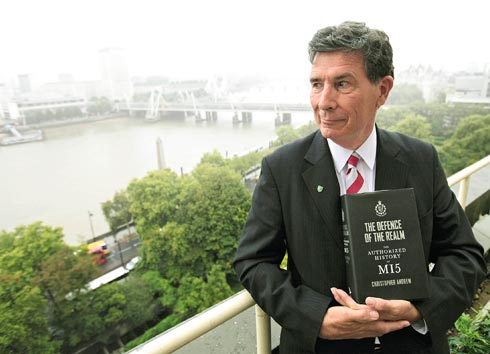
James Bond's "roof". The famous British intelligence services-foreign intelligence (Mi-6) and counterintelligence (Mi-5)-noted the centenary. On this occasion, a book, which immediately became a bestseller, was published in Britain - “Protection of the state”. The author is a famous intelligence history specialist, a professor at Cambridge University Christopher Andrew answered the New Times questions
In the preface to the book, the head of Mi-5 Jonathan Evans complains about your excessive criticality regarding his department ...
British counterintelligence did not always act effectively, there were serious failures. Take, for example, the sensational episode - the expulsion from Britain in 1971 105 KGB and GRU employees who worked under the diplomatic and journalistic cover. The Labor Government of Harold Wilson shamefully put up with their dominance, and the Mi-5 did not force him to take measures. And only with the coming to the power of the conservatives the Soviet spies were sent. There were other mistakes that I learned about while working on the book. Everyone remembers the story with the famous "Cambridge Five", which spied in favor of the USSR. In 1951, two exposed members of the five - Guy Berdes and Donald Maklin - fled to the Soviet Union, where they remained until the end of their life. Having held responsible post in British intelligence, Kim Filby, recruited while studying at Cambridge University, also managed to flee to the USSR, where he received the rank of colonel of the KGB. Almost already in 1964, the names of the entire Cambridge Five were known to Mi-5. But due to the unreasonable confidence in the information of the KGB, Anatoly Golitsyn in the early 60s, our counterintelligence had a false idea of the individuals of the Cambridge spies. Golitsyn was a very dangerous type of defector. Of course, he supplied British intelligence with very important information, but mixed with conspiracy fabrications. So he claimed - and he was believed! - That all members of the Cambridge Five allegedly knew each other.
And how many defectors from Soviet and then Russian special services in Britain were there?
Not so much, but it is quite difficult to call an exact figure, because some asked not to call their names. Of course, the most significant are GRU Colonel Oleg Penkovsky and KGB Colonel Oleg Gordievsky. Penkovsky’s information was especially important for the United States. The plan for the deployment of Soviet missile systems and their characteristics provided by him helped to successfully resolve the Caribbean crisis. Well, Gordievsky, who served under the guise of a diplomat at the Soviet embassy in London, handed over to British intelligence the CGB super-secret directives regarding the operations of the Soviet special services under the nuclear-nuclear attack in 1981. She reflected the paranoid confidence of the Soviet leadership that President Reagan, with the help of Britain, would not be a preventive nuclear blow to the USSR tomorrow, with the help of Britain. In this regard, all residences were instructed to urgently start collecting information.
Until now, it was believed that the post -war history of Soviet espionage in the British Empire begins in September 1945 - with the escape of the encryption of the Soviet embassy in Canada, an employee of the GRU Igor Guzenko ...
Actually, if we talk about the very first defector to the West, they were Konstantin Volkov, who worked in the Soviet residency in Istanbul in 1945. Before he was given out Kim Filby and he was forcibly taken to Moscow-he was pumped with drugs and on a stretcher under the guise of a patient was transported to a Soviet aircraft-Volkov managed to meet with an employee of the Mi-6 in Istanbul in August 1945 and report that two Soviet spies were working in the Foreign office. Undoubtedly, he had in mind Burges and Maklin. And seven more spies, Volkov said, serve in British intelligence, and one of them heads the department at the London headquarters. There was an agreement that Volkov in the coming days would transmit secret documents on this score, in which there are more than three hundred Soviet agents, and the name Philby was probably also in them. But Philby was ahead of him and reported Volkov to his Soviet connected. As a result, Volkov was shot in Moscow.
Of the other defectors, it is necessary to mention Vladimir Kuzichkin, who turned in 1982 in Tehran at the Mi-6 Bureau. He handed over to British intelligence important secret documents of the KGB and opened his Middle Eastern network.
And who was the first to run directly in London?
The Office of the First Main Directorate of the KGB Oleg Lyalin. He worked in Britain under the guise of Soviet trade in and asked for political asylum in 1971. In addition to important information about Soviet agents in Britain, he transmitted data about those who worked here under different coverage of the KGB and GRU employees.
Who can still be considered the largest defector?
Of course, Major Vasily Mitrokhin, an archive of the first main department of the KGB. He fled from Moscow with his wife in 1992 in Riga and there he turned to the British embassy to the Mi-6 resident. From there he was transported to London. For about ten years, until his resignation in 1985, Mitrokhin made extracts from the KGB archive, carried them with him and buried them in the garden of his cottage. He delivered only a small part of the collected to London, so the Mi-6 employee who worked in Moscow had to secretly get to his cottage, dig up the archive and transport it to the embassy. It was a grandiose luck not only for British, but also for many Western intelligence, especially for the CIA. The archive of Mitrokhin, after reprint, totaled 25 thousand pages. There were details of foreign operations of the KGB, specific developments for the misinformation of the West, discrediting Western politicians and Soviet dissidents, the names and reports of foreign agents abroad. It turned out that only about 80 Soviet agents and more than 40 important contacts operated in the United States. In France, dozens of politicians and journalists worked at the KGB. The archive included the names and twelve British citizens who were KGB agents. True, all information did not apply to the period after 1985.
Is there many Russian intelligence officers in Britain today? More or less than in the days of the USSR?
Now their number has come close to the level of the last years of World War II, when the United Kingdom was flooded with Soviet agents. However, in its significance and danger to Britain, this cannot be compared with espionage in the Cold War era. Now Russian intelligence is concentrated mainly on obtaining information about scientific and technical developments.
What was the most interesting for you as a historian while working in the Mi-5 archive?
Perhaps the dossier to the former British Prime Minister Harold Wilson. And in general, everything related to the so -called conspiracy against Wilson. For Britain, this is truly sensational material.
Mi-5 followed the Prime Minister of Great Britain?
The dossier on Wilson was brought up long before he became the prime minister. The first documents are dated to 1945, when the young left labor became a member of the parliament. The reason for suspicions gave the ties of Wilson and the Communists and KGB officers under the diplomatic roof. Perhaps he did not even suspect their real professions. Wilson often went to the Soviet Union in the 50s, when he served in one of the British export firms, where he also had meetings with Soviet officials, including KGB officers. Wilson clearly sympathized with the Soviet Union. By the way, the suspicions were justified: later it turned out that the KGB developed Wilson in the hope of recruiting it. It became known from the archive of Mitrokhin that the dossier was instituted for the future British Prime Minister, and he himself received a code nickname. The KGB treated the political gossip so seriously, which Wilson shared with his Soviet acquaintances, which even sent information about this in the Politburo. However, as stated in one of the documents of the archive of Mitrokhin, in the end the KGB admitted that Wilson's development did not give results.
Wilson guessed that in Mi-5 a dossier was brought on him?
No, he never knew about this (Harold Wilson died in 1995, 19 years after the premiere of the post of prime minister. - The New Times). But he was sure that the Mi-5 and the CIA were plotting against him, although in fact the special services never listened to either his phones or the premises of his office.
And how are the Mi-5 and Mi-6 generally controlled?
Mi-5 activities are personally controlled by the Minister of the Interior. If, for example, the Mi-5 intends to listen to someone's phone, it should get permission directly from the minister himself. During work in secret archives, I was not able to find a single Mi-5 operation over the past 30 years to listen to telephone conversations without the official sanction of the minister. Special services are also controlled by the Committee on Security and Intelligence of the House of Parliament communities, as well as the parliamentary united committee, which includes members of both chambers.
Hard control from the part does not allow employees of the Mi-5 to engage in unauthorized perelustration of letters and interception of telephone conversations. By and large, the Mi-5, even if she really wanted to, there were neither special possibilities, nor resources for surveillance of her own citizens. For example, at the beginning of World War II, only 130 people worked in the Mi-5-a tiny organization compared to the Stalinist NKVD. True, I am writing about the penetration of Mi-5 agents into the British Communist Party and the installation of listening equipment in its premises during the Cold War. But this was, from my point of view, reasonably: it was proved that the Communists were the Soviet fifth column, subsidized from Moscow.
Your book has a subtitle “Authorized Mi-5 History”. What does it mean?
Only the fact that Mi-5 gave me the opportunity to work in her archive. The content of some documents, which mentioned the names of existing agents and employees, were not subject to publications, although they were also viewed by me. No one controlled my work and I was not subjected to censorship.
Did you really find a single compromising Mi-5 document for all the time in the archives?
Why, there were also episodes that do not decorate the history of this department. For example, to my surprise, I found that for twenty years after the Second World War, the Mi-5 refused to accept Jews to the service. This was caused by the fact that during the struggle of the Zionists for the creation of a Jewish state in Palestine, who formed the UN mandate under the care of Britain, Jewish underground groups committed terrorist attacks against British goals. Mi-5 feared in this regard that British Jews, they begin to work in a special service, may have problems with loyalty to their country. I expressed my attitude to such practice very clearly, calling it a discrimination act.
Christopher Andrew, historian, professor at the University of Cambridge, author of 15 books, including two volumes of the Mitrokhin Archive, created on the basis of a huge mass of secret documents transferred to the former KGB officer Vasily Mitrokhin. The book of Andrew “KGB” was translated into Russian and published in 1992. Intelligence operations from Lenin to Gorbachev ”, written in collaboration with the defector Oleg Gordievsky.