
Translated material
Vision deceives illusion
Our vision allows you to see the world differently, depending on what task we are facing
We look at the world with two eyes. This means that the brain receives two images simultaneously, somewhat different from each other. Nevertheless, in the process of perception, they merge into one visual picture - we do not see them separately. In the same way, we do not notice that in fact we have two visual systems. Using each of them, the brain sees the same scene differently. In order to meaningfully and effectively navigate the world around us, we need both display. And although in practice it is not so easy to separate them from each other, visual illusions help to detect the difference.
As a rule, we use vision to solve two main problems. On the one hand, it gives us an idea of the objects of the world. On the other hand, it plays a key role in managing the actions that we take in relation to these objects. More than 15 years ago, the visual perception of Goodale Ma and Milner Add suggested that the division of labor associated with each of these functions arose in the brain. The signals that come from the eyes to the visual bark are then divided into two multidirectional stream of nerve impulses. The so -called ventral stream transmits information to the lower part of the brain, the inferogramporal zone, where a detailed representation of the surrounding world is formed. The second, dorsal stream is directed into the region of the posterior-dark bark and is used for flexible, carried out in real time, control of manipulations with directly visible objects. For example, when you need to grab or catch an object.
According to the authors of the hypothesis, the division of visual information into two separate streams arose during evolution, since perception and action require various ways to convert the same visual signals. In order to successfully grab the object, it is extremely important for the brain to calculate the actual size of the object and establish its exact position in relation to the observer (i.e., express it in egocentric coordinates). Moreover, the time spent on these calculations is critical. The observer and goal rarely abide in a static position relative to each other, and, as a result, egocentric coordinates can change sharply from moment to moment. It is extremely important that these parameters are calculated immediately before the start of the movement. For this reason, to keep them in memory unproductively. In other words, “vision-for-action” works largely in “online” mode.
The requirements for perception are noticeably different. “Vision-for-perception” is not supposed to calculate the absolute size of objects and their egocentric coordinates. Instead, it evaluates the size, shape and orientation of the object primarily in relation to other objects. The visible scene serves as an external reference system. This allows you to get a stable representation of the object and its environment, without requiring accurate information about its absolute size or its position regarding the observer. In fact, the calculation of the real size and distances to all objects in the field of view would lead to an astronomical load on the visual system.
Perception products should also be available much longer. They are recorded in memory. We may need to find out the objects that we saw minutes, hours, days, and even years before. Among other things, coding of such information should be to some extent abstract, cleansed of the specific position of the observer and viewing conditions. Thanks to this, you hold the constancy of the shape and color of the cup in your perception, despite the angle from which you look at it (although the actually visible characteristics of the subject change significantly). We can say that the “vision-for-perception” is characterized by “offline” mode.
It is believed that the function of perception, and therefore the corresponding signal flow corresponding to it, arose in evolutionarily later than the older system of leadership of actions. The first are associated with the developed cognitive capabilities that are not required for simple movements in the environment. In favor of the hypothesis of two streams, neurophysiologists have accumulated extensive data of brain scanning, as well as studies of monkeys and patients with local disorders in the areas of passing and processing of visual information. And those and others, in case of damage to the fields of the ventral stream, were accurately in motor activity, easily went around obstacles and manipulated with objects. However, there were obvious problems with recognition. For example, all small objects were perceived by patients as food: both macaques and people tried to put the objects in their mouths like young children. In other words, their difficulty caused a perception of context and the extraction of meaning from a visual picture with an untouched and active “vision-ate-action” of a dorsal stream.
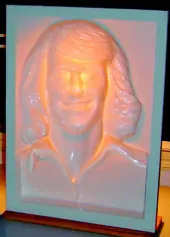
However, it is quite difficult to demonstrate the idea of two types of visual systems in a practical experiment. To do this, you need to somehow divide two types of vision and show the differences in reading the same scene. The scientists faced the task of finding a situation in which the brain sees differently depending on the selected regime of processing of visual information. For these purposes, visual illusions are best suited. They are a vivid example of how a person sees not what his eyes see. The question is whether the whole brain is deceived. It turns out that there is no: only a visual system forms a failure that forms a long -term perception. The second system, “vision-for-action”, sees the image as it is, more accurately displaying reality.
In an experiment published in the magazine Brain Research, researchers from the University of Western Ontario and the University of Bristol offered people a well -known illusion of an inverted mask.
As a rule, looking at the mask from the back, a person sees a normal convex face, although in fact the situation is opposite. The error in this case is a few centimeters in depth, which is very convenient for experience: this mistake is easy to register. The participants in the experiment were given the simplest task. They needed to quickly brush a special mark the size of an insect from a concave or convex face with one click.
Ventral and dorsal streams
According to scientists, in this task, the subjects will be involved in “vision-for-action” and they must definitely get along the mark without missing. Despite the fact that perception in both cases tells the brain that the face is convex. This, in turn, was checked at other stages of the experiment, when the participants were supposed to slowly indicate the location of the mark or draw it together with the face on paper.
The results of the described experiments were amazing. Despite the stable illusion of reverse depth, people hit the mark when it was necessary to do this as quickly as possible. Their movements in this case was led by “vision-at-action-action”, and it was not mistaken. The concave face of the dorsal stream saw the concave, and convex - convex. At the same time, the slow movements, where “vision-for-in-perception” played a large role, ended at a point characteristic of the illusory recognition of the mask. In this case, the brain considered any face convex.
In the context, the assumptions of two flows are more than convincing. The hypothesis really predicts the observed difference between action and recognition. The decisive role in the interpretation of the concave mask as a convex form plays precisely the recognition of the face in it. The face, as you know, is not concave. In this case, the visual system evaluates the entire scene entirely, using rather high levels of abstraction. In contrast, the performance of a quick action with a mark requires concentration of the brain on a specific purpose and the exact calculation of the distance to it. In this case, he does not need to calculate the relationship between all elements of retinal (coming from the eyes) of the image. Thus, the visual system, which leads the movement, is insensitive to illusions affecting perception.
In other words, when it comes to quick movements aimed at manipulating objects, we see better and act more precisely than in the case of “ordinary” vision.
Denis Tulinov
Kryliczak G, Heard P, Goodale Ma, Gregory RL, 2006, Dissociation of Perception and Action Unmasked by the Hollow-Face Illusion
Brain Research 1080 9-16. DOI: 10.1016/j. Brainres. 2005.01.107.
Goodale Ma, Gonzalez Clr, Kr^Liczak G, 2008, “Action Rules: Who The Visual Control of Reaching and Grasping Is Not Always Influenced by perceptual Illusions” Perception 37 (3) 355366. DOI: 10.1068/p5876.