
Translated material
Iran: a clogged future
The events of the year according to The New Times
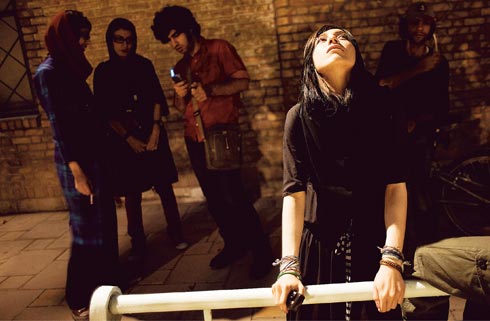
Ripe clusters of anger.
At the end of the year in Iran, it was again in the dramatic events of the summer, when hundreds of thousands of Iranians who did not agree with the results of the presidential election on June 12, took to the streets. Then the protests lasted 5 days and were brutally suppressed. Now the authorities decided to stop them in the bud. On December 7, the police dispersed a student rally in Tehran. The action was allowed, but before the start, someone put up a poster torn by demonstrators with the image of Ayatollah Khomeini, who was put up under its starting chambers of state TV. After that, the FAS team sounded. One thing is clear: in 2009, the Iranian opposition finally took shape as a real force. On Friday, June 12, 2009, the lines of the polling stations in Tehran lined up for many hundreds of meters, the closing time of the plots was moving twice for several hours. On this day, everyone voted - Muslims, Christians and Zoroastrians, Persians, Jews and even Kurds, who used to be completely indifferent. Power in Iran belongs to Ayatollahs. It is the senior clergy of Iran, who are part of the Supervisory Board, who decide whether it is possible to allow one or another candidate to participate in the presidential election. This time, four reached the finish line, but two - Ahmadinejad and Musavi - unconditional favorites. It is no secret to anyone that the current president is supported by the chief person in the country - Ayatollah Ali Khamenei. His performance at the rally on June 4, on the day of national mourning on the founder of the Islamic Republic Ayatollah Khomeini, resulted in the grandiose PR action of Mahmud Akhmadinejad.
Two camps in the evening of the same day, several thousand young people tied with green ribbons, with portraits of the candidate from the reformists of the world-house Musavi gathered on the Vanak Square in the northern part of Tehran. “Mahmoud, take your bombs and get out!”, “Freedom to Iran!” They chanted. Tehran has not seen such a Islamic revolution.
The country was divided into two camps: Musavans - students, intelligentsia, people belonging to the middle class, Akhmadins - women wrapped in hijab and their super -religious husbands, rural residents and inhabitants of the poor quarters. Like them, Ahmadinejad from a simple family - he is the son of a blacksmith, turns to people in an understandable language. But for many young people, he is someone else's. “We have no choice, I do not support Musavi, it is far from perfect and the system will not change, but Ahmadinejad is simply dangerous. We must stop him, ”says a recent graduate of Tehran University. He will be called into the army in a month. You can’t dodge, otherwise you will become an outcast: without the right to buy or sell property, drive a car, work in a public office. “I won’t go anyway, it’s better to serve this system for two years.”
Everyone here remembers how, at one time, Ayatollah Khomeini promised that every family would receive oil money. “Where is our money? -The 29-year-old programmer Ehsan asks a rhetorical question to the New Times to the correspondent. “Why are they going to support Hamas?”
It is impossible, but many joys of life, yesterday, former a forbidden fruit, are now available to the Iranians today. Alcohol, dancing, Western music - everything is and everything is illegal. For example, the Armenian club was opened, where women drop hijab at the entrance, and the Armenian men quietly whiskey whiskey. There are many such "closed places" in the city. Changes are also visible on the streets: girls are allowed to wear a scarf instead of a veil, you can both trousers and a dress to the knees. And they are no longer planted in prison for riding a bicycle. The rules governing the relationships of the floors are somewhat softer.
But there is another face of Tehran, its southern part is working quarters, bazaars. This is the territory of Ahmadinejad. Simple people love the current president, including for his implacable position in relation to America and Israel. “With him, I am proud that I am Iranian. He is a real Muslim, ”says the merchant Ashkan.
Hopes of the election promised to be a turning point. The whole country was watching the television debate. It seemed that democracy had already come in Iran. But this is visibility. For example, a “translator” is necessarily attached to foreign journalists, informing where all his meetings and movements are necessary. “Do not think that they are watching only foreigners, we are all under control,” says Ehsan.
There are five power structures in the country: the army, the police, the Sepah special forces, the morals and, finally, the most powerful weapon of the Islamic revolution - the Basiji, or the ideological police. There are almost 11 million volunteers in her ranks, or every fifth Iranian. The Basiji submits to Ayatollah himself. Nevertheless, the current election campaign showed: in Iran there is a real opposition. So, changes are inevitable.
The dictatorship time has passed? The day after the elections, on Saturday June 13, students of students began to gather around the perimeter of the huge center of Tehran, the majority - opposite the building of the Iranian Ministry of Internal Affairs. It all started, as before, before the election: green ribbons, rhythmic slogans and portraits of Musavi. Suddenly, the slogans replaced the cry of horror: the groups of special police, dressed like characters from star wars, burst into the crowd, distributing in all directions blows with rubber batons. People rushed to run, a picture of a democratic Iran of the last weeks changed the reality of the Islamic Republic.
The cruelty with which the police dispersed the protesters, leaving several dozen wounded and one scored with sticks to death, was like a fabric of a wick. After a few hours, Tehran flashed with a glow of burning motorcycles, garbage containers, buildings. The police and the army were not enough for the 14 millionth Tehran, and “Basiji” went on an emergency man-the guards of the revolution, armed with wooden clubs and rubber lashes. For a week now, with the onset of darkness, they have been driving around the city with groups of 10-20 motorcycles. Anyone who comes across him on the street is the enemy. The fact that these days in Tehran you need to be able to run quickly, the author was convinced of his own experience: stopping to stare at the fire, fell under the whip along with an elderly woman in a hijab. Moreover, it was not as terrible whip, like crazy, hating the eyes of the one who wielded it. I had to take my legs. I saw how people carried a bloodied girl with a broken head. The central streets of Tehran, where people usually walk in the evenings, turned into a zone of war.
To love the president on Sunday morning, June 14, in one of the central squares - Valiasr - the authorities gathered a festive rally in honor of the victory of Akhmadinejad. They distributed sweet water and posters with a portrait of the president for free. After a long, as usual, the speeches of Akhmadinejad, a salute broke out of the approving cries of a millionth crowd.
“I love ahmadinejad,” the girl in black informed me confidentially. - And you? Do you love him? Do you love Iran? "
Eyes in the eyes at the same time just a few kilometers from the official rally, in Engelab Square, the opposition rally took place. It ended, like the previous one, overclocking - fast and tough, with the police, soldiers, and the volunteers of the Basiji. The longest Valiasr Street in Asia was burning again. By night, mobile communications in Tehran disappeared. But another connection turned on: with the help of Twitter, Facebook and the “pigeon” mail on Monday, the opposition collected more than a million protesters, the procession stretched by ten kilometers. “We will stand to the end. Perhaps this is our last chance, ”says the journalist Nasim. “Do not call this a revolution, the one that was 30 years ago, was given to us with great blood, God forbid, so that it was repeated.”
Nasim's words turned out to be prophetic: the rally that began quite peacefully ended with the attack of young people from the opposition on the Basiji building and, as a result, the death of seven people and dozens of wounded. But the demonstrations continued on the following days, they splashed out of Tehran, the opposition’s clashes with the law enforcement throughout the country. The authorities selected accreditation from all foreign journalists and forbidden to work on the streets.
The right to a vote on June 19, the Supreme Leader of Iran Ayatollah Khamenei announced that the elections were not faded, and all the demonstrations were the machinations of the enemies of Islam, and demanded that opposition leaders take people off the streets.
Akhmadinejad called the opposition’s protests “Passions of football fans”. However, it is clear that these events found the ruling elite by surprise: the protests were in 1999 and in 2003, but almost the first time hundreds of thousands of people publicly demanded the right to have a vote.
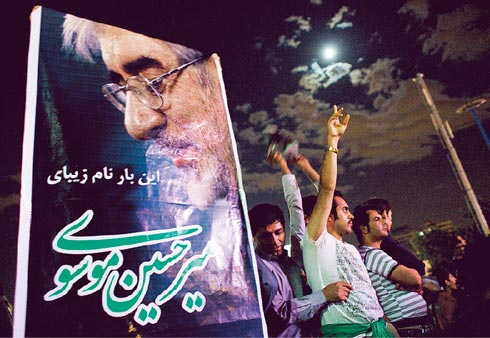
"Musavi - to the presidency!" - called students in Vanak Square in Tehran
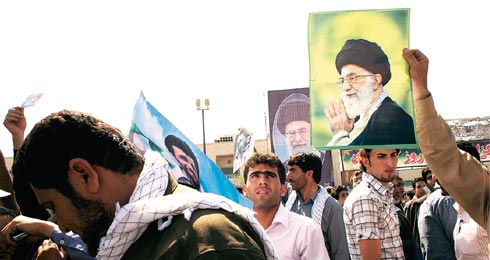
The real power in the country still belongs to the Ayatollahs
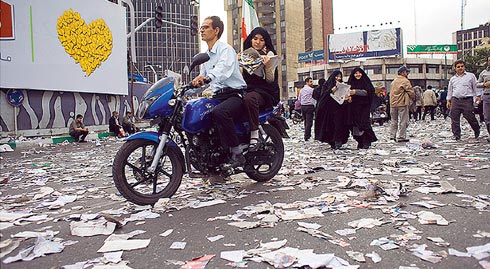
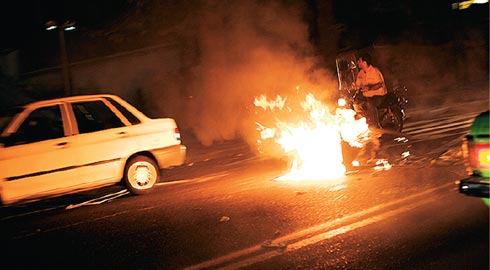
After the dispersal of thousands of protest demonstrations of the opposition, the city was covered with leaflets and blazed the glow of burning motorcycles and garbage containers