
Translated material
The asteroid flew very close to the ground. There is an opinion that this is a device forgotten by Russians
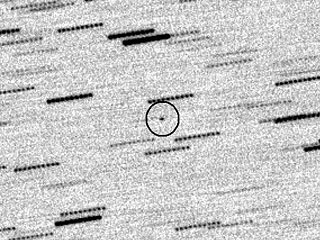
The asteroid 2010 AL30 the day before approached the ground at a distance of less than a third of the distance to the moon and struck the astronomers with its unusual orbit. Scientists cannot understand what it was: there is even an opinion that earthlings observed not a natural body, but a simple cosmic garbage or even a “forgotten” space block in orbit.
According to RIA Novosti , the 2010 AL30 asteroid was discovered on January 10 using telescopes on the experimental site of the Lincoln laboratory (USA, New Mexico). The attention of scientists was attracted by the fact that it moves in orbit, almost coinciding with the orbit of land.
"Computer" writes that the Italian astronomers captured an asteroid that passed the earth at a distance equal to a third of the distance to the moon (however, he could not have a danger, since he would completely burn out in the atmosphere).
The excitement around the heavenly body was heated by the fact that, according to forecasts, until 2024, not a single heavenly body should have come so close to our planet. By the way, on April 13, 2029, the earthlings are threatened with an asteroid Apophis (about 270 m in diameter), the distance to which will be three times less. The likelihood that he will meet with the ground is one by 250 thousand.
What was it?
Asteroid 2010 AL30 may turn out to be Russian -made Frigate Acceles Block, says Michael Kan, an employee of the European Space Agency.
"Reverse extrapolation of the position of the 2010 AL30 object in orbit shows that it was supposed to get closer to Venus in the spring of 2006 and the Earth - at the end of 2005. These elements of the orbit coincide with the time of arrival at Venus Express of the European Space Agency," writes Kan in the collective blog of Scilogs, which supports the German Spektrum Der Wissenschaft magazine.
It is stipulated that the asteroid 2010 AL30 is possible is of natural origin, however, it is impossible to completely exclude the possibility of an artificial nature of the object.
Perhaps this is the “Accelerated Broad” frigate of the Soyuz missiles, which brought the EKA Venus Express probe on November 9, 2005, which arrived at Venus on April 11, 2006, ”Kan. He notes that although this is not proved, "we are dealing with an amazingly long chain of unusual coincidences."
Meanwhile, in Russia itself there are the opinion that astronomers are dealing with ordinary cosmic garbage. This, as ITAR-TASS reports, in particular, said the director of the Institute of Applied Astronomy of the Russian Academy of Sciences, corresponding member of the Russian Academy of Sciences Andrei Finkelstein.
"The ten -meter dimensions of the space wanderer are very likely to be attributed to him, for example," to the fairing of one of the steps of a certain, previously bred to the orbit of a launch vehicle ", suggested the director of IPA, the coordinating national center in the study of small planets and an asteroid hazard. Some of these missile remains go away from the ground, the other - remains around our planet, remaining on our planet, remaining on Earthly orbits, of course, representing the danger of a collision with newly launched spaceships and devices. "In our case, the cosmic phenomenon -strip does not pose a threat to humanity by definition,” Professor Finkelstein emphasized, noting that the "ten -meter fragment" does not have a destructive speed and mass. "
IPA director said that at least one of almost one hundred thousand small planets is brought together within a day with the ground. Scientists of the institute have compiled and published "Catalog of potentially dangerous asteroids and comets," he said. Information about more than three hundred asteroids and the so -called periodic comets, "pose a potential threat of a clash with the Earth," are entered into the register. Finkelstein added that the information covers "data on orbits, photometric parameters, rotation, size, physical properties of asteroids and comets."
Separately given data on the speeds of space bodies relative to the Earth and the potential energy of the collision with our planet, if any.
"Tens of tons of meteorite substance falls from space to Earth annually," added IPA director. He also said that the European Space Agency and the American - NASA are actively creating experimental projects of a possible prevention of collision of space bodies that come closer to the ground at minimum allowable distances.