
Translated material
Media: the Russian drone "Aist" exploded during the tests
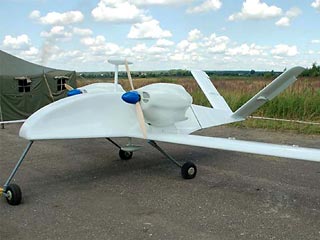
The tests of the Russian unmanned aerial vehicle “AIST” , which were held in the city of Rybinsk, Yaroslavl Region, ended: the aircraft exploded, reports Newsru Israel with reference to a source in the defense and industrial complex of the Russian Federation.
According to these data, the AIST UAV, within the framework of the approved test program, carried out jogging along the runway of the Rybinsk airfield. “At some point, for an unknown reason, for an unknown reason, broke away from the ground and, in uncontrollable flight, fell on the wing. At the same time, the observers noticed the fuel train, which was poured out of the wing console. There was a voluminous explosion that destroyed all the remains of the UAV,” the source said. The official confirmation of this information from the Russian side has not yet been received.
- At the MiG-31 interceptor, the Russian Air Force was refused by the technique: the pilot managed to sit down
- The FSB decided to protect the borders of the Russian Federation with the help of Israeli drones
- the military recognized the last unsuccessful launch of the "maces" when all the media have already written about this
According to eyewitnesses, during the tests, a delay was visually noted in the control system of the AIST UPC, which, perhaps, led to the loss of the control apparatus for the tangas. Most experts also note the constructive shortcomings of the AIST glider, which could also be the cause of the accident, the article notes.
The publication notes that we are talking about the Russian UAV, which is an analogue of the Israeli drone of the Searcher MKII, which releases the Aviation Industry concern (IAI). Israeli UAVs of this class were purchased from Israeli in Russia, and some officials openly said that Russian developers would try to "copy" Israeli planes. At the time of the tests of the Stork, the supply of Israeli Searcher MKII to Russia has not yet been implemented, the article says.
According to available information, three unmanned vehicles "AIST" are currently built. The cost of one such UAV, according to some reports, is about $ 3 million. While the process of developing and bringing these systems continues, the Russian military awaits the supply of Israeli drones. According to representatives of the IAI company, work on UAVs for Russia is in full accordance with the terms of the contract, the publication writes.
The editor-in-chief of the specialized Internet portal UAV.ru , dedicated to unmanned aerial vehicles, Denis Fedutinov, to which the Newsru Israel editors turned for comments on the unsuccessful tests of Aista, noted that in Russia over the past few years, unmanned systems similar in the class of Israeli SEARCher have been developing a number of companies. MKII.
"If you discard the Dan -Baru UAV Project, which has been working on the Kazan KB" Sokol ", but which seems to have remained at the infancy for quite a long time, then there are two most real projects competing with each other. One of them is the AIST UDL, the development of the Vega concern, the BPLA" Problem -600 "of the Petersburg company" Transzas ", - said Transasis, - said the Trans -Calm. The Russian expert.
At the same time, Interfax gives another, somewhat mitigated commentary on the same expert about this incident. Denis Fedutinov told the agency that "this incident, if he really took place, should not be completely dramatized." “Yes, what happened is certainly very disappointing, especially considering that the“ stork ”is quite heavy and quite expensive, unmanned aerial vehicle, but I believe that almost no company avoided the fate of the loss of devices during the tests,” the expert said.
He recalled that initially the work on the "drone" was carried out in the Moscow Research Institute of Kulon. Then this project was transferred to another enterprise in the Vega concern, - KB Luch, which is located in Rybinsk. “I believe that such a step could negatively affect the course of the project,” the specialist summed up.
"Stork" is called to help Iskander
The beginning of the tests of the "promising unmanned complex in the intelligence and attendant version, which can issue target designations of the Iskander operational-tactical complex, was announced a year ago in the Vega concern, the head developer of unmanned aircraft for the Ministry of Defense of the Russian Federation.
“According to preliminary estimates, the tests will last up to two years,” Rear Admiral Arkady Syrohezhko, director of the Vega concern program, said at the end of January 2009. According to him, the new complex under the conditional name "AIST", intended not only to provide Iskander, but also to solve a wide range of problems, is at the final stage of creation.
“The main difference between the new complex and previous developments is an increased weight - up to 500 kilograms, including by increasing the payload. The AIST will be multifunctional, therefore, as a payload, it will be placed depending on the tasks of the photo and video cameras, and the range of shock weapons, and relayers, and the director of the radio interference, and so on,” said Syroezhko.
He emphasized that the detailed characteristics of the payload constitute a state secret, noting only that the range of the latest UAV complex will allow it to ensure the work of Iskander, the maximum range of which in turn is 500 kilometers.
UAV "Stork" is able to carry a useful load up to 100 kg. The device has two engines. The flight speed is 130-250 km/h. The flight duration is 12 hours. The wingspan is 8 meters, the length is 4.7 meters, the run is not more than 150 meters. The range of flights is from 100 to 6000 meters.
The high-precision tactical missile missile system of the Iskander Ground Forces (SS-26 Stone according to NATO classification) is designed for secretly preparation and application of effective missile strikes for particularly important small and local targets in the depths of the operational construction of enemy troops. The complex was created as a result of the joint work of a group of research institutes, design bureaus and factories under the leadership of the design bureau of engineering (Kolomna), known as the Crender of the Point, Oka missile systems. It was used during a five -day war in South Ossetia. The range of the complex in the export version is up to 280 km, for the Russian army - up to 500 km.