
Translated material
How the Universe expanded in 2009
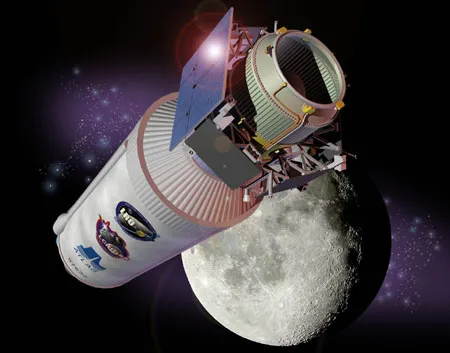
LCROSS mission, acceleration block Centaur. Image NASA
2009 was declared UNESCO by the International Year of Astronomy. The reason was that 400 years ago Galileo Galileo made the first astronomical discoveries with the help of a telescope. The last year of expectation was fully justified - many interesting results were obtained. This happened largely thanks to the work of new observational instruments and satellites.
The most high -profile event of the outgoing year of astronomy was, perhaps, the opening of water reserves on the moon. The research of our satellite was engaged in several automatic stations running by specialists in the USA, Japan, China and India. Four apparatuses in 2009 were planned to break on the lunar surface, while completing their scientific mission. We are talking about the Chinese “Chang'e-1” and the Japanese “ Kaguya/Selene ), the American LCROSS, launched in 2007, which began its journey to the Moon in 2009, and Moon Impact Probe (MIP) released from the Earth in 2008 of Indian“ Chandraian-1 ”( Chandrayaan 1 ).
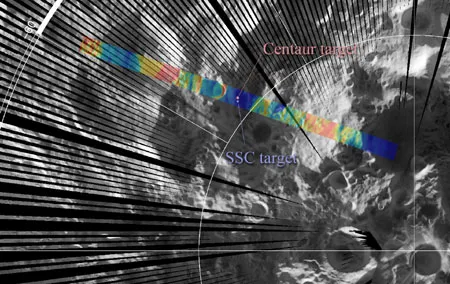
Places of falling components of the LCROSS mission in the area of the Cabeus crater. Image NASA/GSFC/UCLA
Read more about LCROSS (Lunar Crater Observation and Sensing Satellite). Together with Lro (Lunar Reconnaissance Orbiter), he compiled the first American expedition to the moon in 10 years, which started on June 19, 2009, the Handicraft block "Centaur", dropped on October 9 in the area of Cabeus crater (Cabeus), lifted a cloud of dust, which flew in a greater. The analyzing the composition of this substance. A little later, Lcross fell into the same crater, having managed to transfer data to Earth before that. The height of the cloud was significantly lower than the calculated, which did not allow me to admire the spectacle from the ground. However, the discarded substance was quite enough for analysis, and on November 14, 2009, NASA has already published preliminary results according to which the cloud of thrown particles contained up to a hundred liters of water.
In shaded lunar craters, significant reserves of water ice can be hidden, brought there with comets billions of years ago. Their detection is fundamentally important for the construction of future lunar bases. After all, water can be used not only for drinking and household needs. By decomposing it into the components - hydrogen and oxygen - we will get an atmosphere suitable for breathing and rocket fuel. In addition to the success that was accompanied by the LCROSS mission, data (in particular, from the Indian Sunda “Chandrayan-1”) were also released in September, which showed that water molecules in a small amount are present in lunar ground everywhere.
Listing the most important studies associated with the solar system, it is also necessary to mention the study of methane on Mars and water ice in its spirolar areas, as well as the new discoveries of the Goris-Geologists “Spirit” and “Opportunity” (Opportunity). For the first time, the traces of methane in the atmosphere of Mars were found in 2003, and several articles appeared over the past year (in particular, in the Science magazine), which examines its distribution along the planet and the speed of its destruction (it turned out to be very significant). All this suggests that at least part of the methane is clearly of abiogenic origin.
The pseudo -color image of Mercury craters obtained at the last flight of Messenger. Photo NASA from the site http://messenger.jhuapl.edu/
In the system of Saturn, the American apparatus Cassini ( Cassini ) continues its research. In 2008, it was possible to reliably show the presence of lakes from liquid hydrocarbons on the largest satellite of Saturn Titan, and the studies of the past year allowed to identify the greatest change in this whole picture. The lakes periodically dry out and “move” from the hemisphere to the hemisphere depending on the season. In addition, new evidence of the presence of cryovulcans on the titanium - that is, volcanoes that erupting liquid water instead of magma were found. All this can indicate the presence of hidden under the surface of the oceans.
In 2004, for the first time in 30 years, the probe was sent to Mercury - the American Messenger ( Messenger - Mercury Surface, Space Environment, Geochemistry and Raning). In 2008-2009 Messenger carried out spans three times near Mercury. In 2009, at the last span at an altitude of 228 km above the surface of the planet, images of previously never studied areas were taken. The satellite will reach a highly elliptical polar orbit around the Sun closest to the Sun in the spring of 2011
Meanwhile, the fastest in the history of mankind “ New Horizons”, launched by NASA exactly four years ago, January 19, 2006, overcame half the way to Pluto over the past year.
In May, the astronauts of shuttle Atlantis (Atlantis, the STS-125 mission) managed to restore the performance of the most famous and honored space telescope " Hubble ). The freshly renovated “Hubble” in the summer interrupted the testing and calibration of its instruments in order to take rare pictures of Jupiter, who was subjected to comet-abstralite bombing in the area of his southern pole, where characteristic groats in clouds the size of the Pacific Ocean. For the first time, this event was celebrated on July 19 by the Australian astronomer-amateur Anthony Wesley using his home 14.5-inch (36.8 cm) telescope-reflector. The only case of such phenomena was registered 15 years ago, when the wreckage of the Klumet-Levy-9 comet 9 fell into the atmosphere of Jupiter.
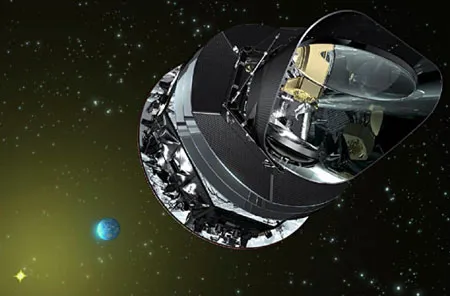
Planck. ESA image
The hopes for the study of previously inaccessible objects of the solar system (as well as remote weak galaxies) are associated with the NASA Wise ( Wide-Field Survey Explorer) in-Earth orbit in the near-Earth orbit, intended for the review of the entire sky in the infrared in infrared range.
In 2009, there were several important launches of devices working in the interests of astronomers studying distant space. First of all, these are European “ Planck ” and “Herschel” ( Herschel ), bred by ESA using one missile carrier on May 14, 2009
"Planck" is designed to study the relict background. In particular, he should build a detailed map of polarization of cosmic microwave radiation. As expected, this will help shed light on the very first moments of the life of the Universe.
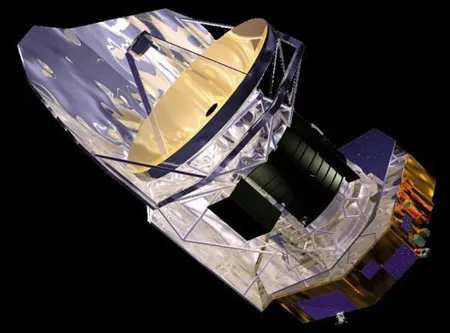
Herschel. ESA image
Herschel has the largest mirror of all cosmic telescopes (3.5 m). Its detectors will register infrared and millimeter radiation, and the key tasks of this mission are to study the processes of the formation of stars and galaxies. In addition, the hopes of obtaining new data on the facilities of the solar system are also associated with this satellite.
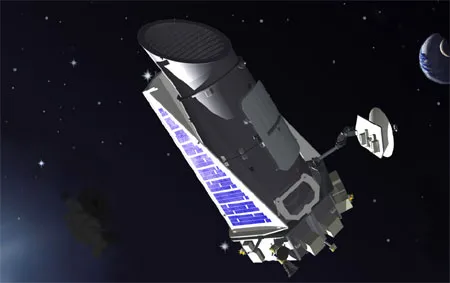
Kepler. Image NASA
Probably, the most important astronomical launch of NASA in 2009 is the Kepler Observatory ( Kepler ). Its one and a half meter mirror is designed to search for exoplanets. Over 3-4 years of operation, the device must detect several planets, in mass and distance from the star like the Earth. The first results were presented already in January 2010. The opening of several new planets was announced, but all this is only more or less familiar “hot Jupiters”.
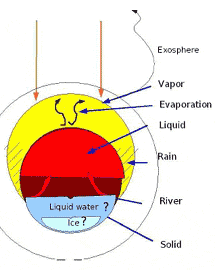
New data was actively received from the European Explanet Corot (Conview Rotation and Planetary Transits), launched from Baikonur on December 27, 2006, a fresh review on this topic can be found in the ARXIV preaprint: 0912.4655 .
Model of the planet Corot-7b. Asymmetry is due to the fact that the planet is turned to the star one side (from the article by Arxiv: 0912.4655)
Data is received (and immediately laid out in open access ) and from the American Gamma Observatory " Fermi ", launched in 2008 from Fermi, are waiting primarily for new data on dark matter. But so far there are no unambiguous conclusions, and the current state can be found in the work of Arxiv: 0912.3828 .
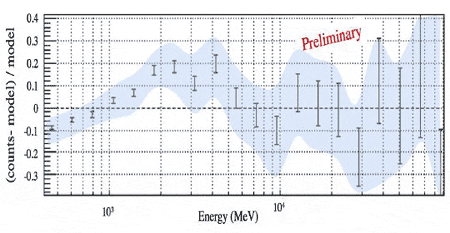
Preliminary data "Fermi" on dark matter. “Zero” corresponds to the absence of an additional signal from particles of a dark substance. An excess on the energies of 2-5 GEV is visible. But the authors insist on the preliminary nature of the results. We will wait (from the article ARXIV: 0912_3828)
Of course, the main thing is not the launches themselves, but scientific results. The results are most convenient to monitor the astrophysical section of the site arxiv.org , about a thousand articles per month appear there. Some of them were described in Astro-Ph preprints . Below we will briefly talk about the most interesting, in our opinion, articles that appeared in the Archive. This part of the review concerns primarily the “far outishment”.
Let's start with the study of exoplanets. Astronomers open more and more light planets, gradually approaching the masses of the earthly order. The 2009 record belongs to the planet in the GJ 581 system ( Arxiv: 0906.2780 ). The lower boundary of its mass is 1.9 earthly. But this is only a border, in reality the planet can be somewhat harder. Such objects are called "super -earths."
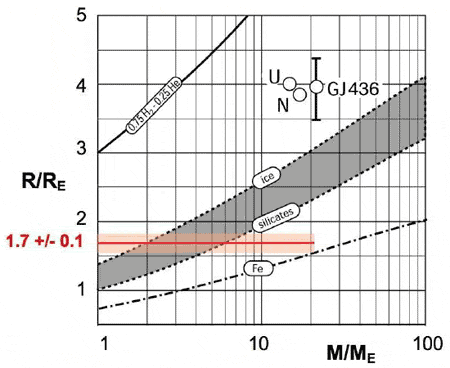
The ratio of masses and radii for different planets (silicates, iron, ice). The provisions of uranium (u), Neptune (N) and planets GJ 436 are shown. Red is shown a radius measurement for Corot-7B. The line breaks into the return limit to the mass for this planet (from the article by ARXIV: 0908.0241)
It is not easy to measure some parameters. There is only one situation when the task is simplified - if we can observe the passage of the planet along the disk of the star. In 2009, two interesting transit super -grounds were opened. The first success was achieved by scientists from Corot ( Arxiv: 0908.0241 ). The Corot-7B planet is generally the first open transit super-earth. Its mass is about 10-20 earthly. A lot. But this is the first super -ground with a measured radius. It is equal to 1.7 earthly. Determination of the radius with a certain mass gives us density. We can conclude that the planet is composed mainly of rocks. True, she is too close to her star, so we can hardly talk about the presence of life familiar to us there.
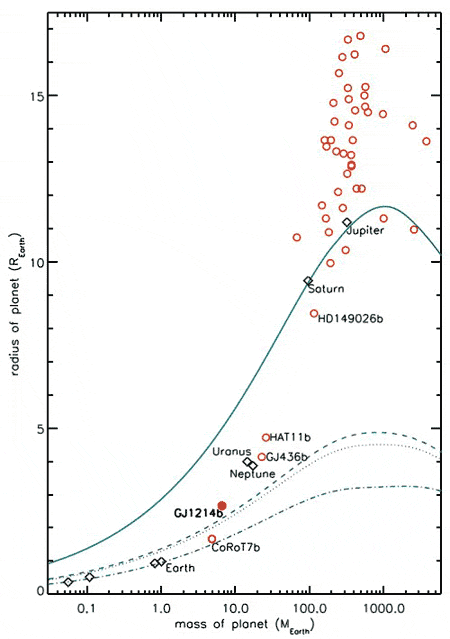
Masses and radii of different planets. The red circle marks the transit super -ground GJ 1214B. Black rhombs show the planets of the solar system. Curves correspond to different compositions of the planets. GJ 1214B lies above the "water" planets (dashed and barn curves). This means that there is obviously there is a gas shell (from an article by ARXIV: 0912.3229)
Another interesting transit exoplanet, open in 2009 ( Arxiv: 0912.3229 ), is GJ 1214b. Its mass is 6.55 earthly. It is significant that it rotates around a small -massive and close star. All this allows you to explore it in quite details.
Finally, the last exoplanetary result that we want to draw your attention is associated with the planet WASP-17B ( Arxiv: 0908.1553 ). Now, when it is still impossible to talk about the full search for the “doubles” of the Earth or obvious traces of life on exoplanets, the most important task is to study the processes of the formation and evolution of planetary systems. To do this, you need to not just “set records” and reduce the maximum mass of “hot super-earth”, but, for example, look for any unusual objects that do not fit into the standard scenarios of the birth of the planets.
And the planet WASP-17B just has two interesting features. First of all, it has a very small density - about 10% of the density of Jupiter. This is explained by the fact that this planet is very warm up by tidal forces. The second feature of the WASP-17B is associated with the properties of its orbit. According to generally accepted theories, planets are formed from a rotating protoplanetary cloud. Of course, the direction of rotation of the “ready” planets around the star should, in this case, coincide with the direction of rotation of the star itself. But in the case of the WASP-17B there is serious reason to believe that it is spinning in the opposite direction!
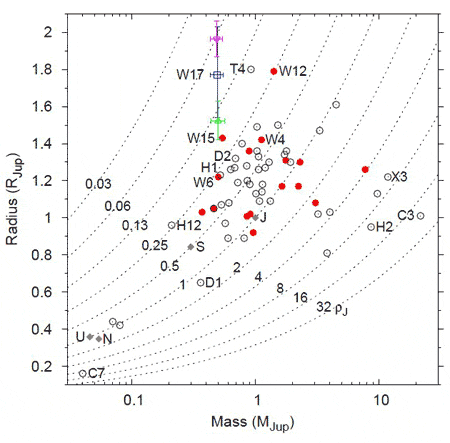
Planets on the plane radius - mass. The lines correspond to different densities (in the fraction of the density of Jupiter). Blue, green and purple icons correspond to data for WASP-17B. Blue is the most likely. It can be seen that the planet has a record low density (from the article ARXIV: 0908.1553)
How could this turn out? Apparently, one cannot do without the assumption that the WASP-17B once intensively interacted with some kind of massive body. It is believed that the "hot Jupiters" formed at distances about 3 astronomical units (about half a billion kilometers) from their stars, and then migrated to close orbits. So, in the case of the WASP-17B, a combination of intensive interaction with the planet-giant and subsequent migration, the actions of the goat mechanism (Kozai) and tidal circularization of the orbit could lead to what we observe.
From the exoplanets we will now go to the stars. Here, one of the most interesting results is associated with the work of the Corot satellite, which was originally intended to study these objects using methods of astrosimology. Astrosemology allows you to receive unique data on the internal structure of stars. The oscillations of the sunny type, which are discussed in the article by Arxiv: 0906.3788 , are associated with turbulence in the internal parts of the stars. Previously, such pulsations were found only in small -massive stars. Now, with the help of Corot satellite, they are first opened by a massive (10 solar masses) star.
Speaking of the stars, do not forget about the sun. In 2009, an important result appeared, which could put an end to disputes about how the sunny crown warms up to high temperature. ARXIV authors: 0903.3546 received serious observation arguments in favor of the fact that the energy in the solar atmosphere is transferred to Alvenov waves . Their power, according to the authors, is enough to heat the sunny crown. Actually, they thought so before, i.e. New observation results are in good agreement with theoretical calculations.
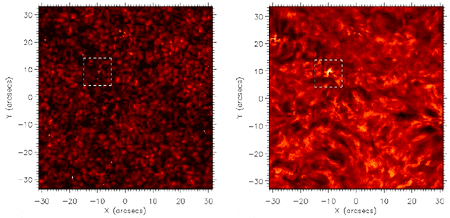
A photograph of the chromosphere taken using the Swedish Solar Telescope (SST) and indicating the presence of Alveen's waves. The studied area is highlighted. In the image, one corner second corresponds to 725 km. Photo: David Jess, Queen's University Belfast (from the article by Arxiv: 0903.3546)
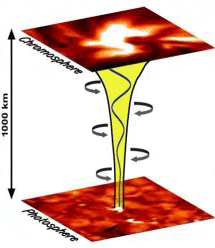
Magnetic tube between photosphere and chromospheric areas. Indignation in the tube leads to the appearance of an Alveon wave going up. Torsal vibrations occur in the direction perpendicular to the direction of the spread of the wave. These fluctuations were observed by the authors (from the article by ARXIV: 0903.3546)
But serious violations of the usual cycles of solar activity are pretty puzzled by astronomers for several years. The study of the Sun is now occupied by many scientific groups using the latest astronomical tools. For example, the launched NASA in October 2006 is actively working on the pair of sunny telescopes of the Stereo (Solar Terrestrial Relations Observatory) and the Japanese scientific satellite of the Hinode, Solar-B, which started on September 23, 2006. Unfortunately, the Russian Koronas-Photon Russian spacecraft (intended for the Sun research) launched on January 30, 2009, worked for only a few months instead of the declared three years.
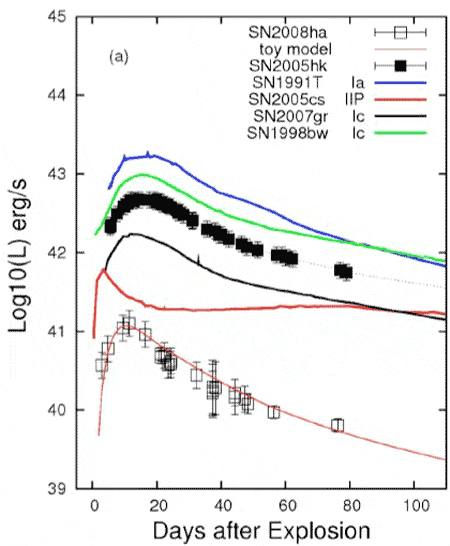
The change in the luminosity of the SN2008ha (lower curve) is compared with the behavior of other supernovae. It can be seen how much the SN2008ha is weaker than others (from the article by Arxiv: 0901.2074)
Surveys were waiting for the researchers of supernova stars. During the year, several works appeared, which talked about the discovery and study of rather strange supernova, which theorists are only trying to put in standard scenarios. First of all, I would like to distinguish not extremely powerful or bright supernovae (they wrote about them, for example, in the articles of Arxiv: 0911.2002 , Arxiv: 0908.1990 ), but rather, a very weak SN 2008ha, which was dedicated to two works: ARXIV: 0902.2794 and 0901.2074 . This is the most dull of the famous supernova. Its absolute star in the maximum amounted to only -14.2. This gives luminosity of less than 1041 ERG/s. A certain spectral spectral lines speed of the substance is only about 2000 km/s at the time of the maximum of shine. There is very little nickel-56, and in general little substance is thrown out. The authors consider different models. If a single object exploded, then it can be an electronic capture in a NE-MG dwarf or deflagration (nuclear burning without the formation of a strong shock wave) Co dwarf.
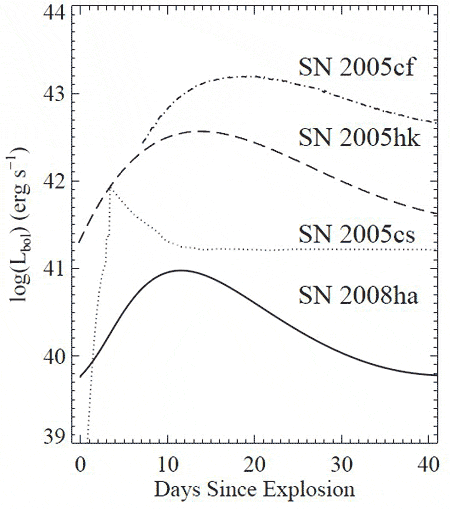
Again, the evolution of SN2008HA luminosity is compared with other supernovae (from the article by Arxiv: 0902_2794)
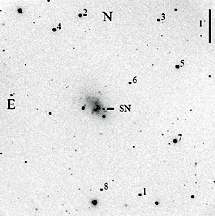
Photo by SN2008HA and UGC 12682 galaxies, in which it broke out (from the article by Arxiv: 0902_2794)
Another result of supernova is associated with the study of the very quickly evolving flash SN2002BJ: the shine quickly grew and quickly fell - much faster than all other well -known supernovas. ARXIV authors: 0911.2699 believe that it could be an explosion of helium white dwarf.
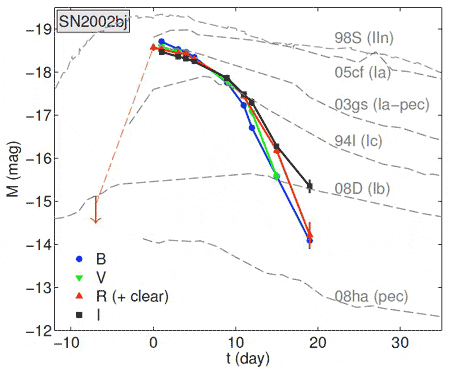
The evolution of the luminosity of the supernova SN2002BJ. Curves of different colors correspond to different parts of the optical range. Gray are the crooked shine of other supernovae. It can be seen that the luminosity falls very quickly (from the article by Arxiv: 0911.2699)
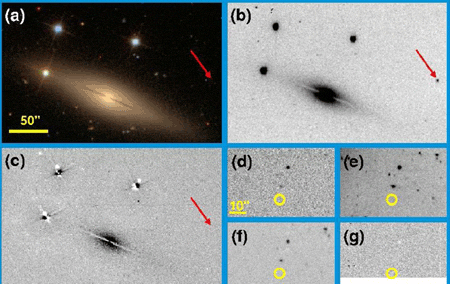
Supernova 2005E. The NGC 1032 galaxy is shown, in which the outbreak occurred. It can be seen that Supernova is “in the backyard”. The position of the supernova is indicated by the arrow. FG panels show an enlarged image of the area with a supernova (the place is highlighted in a circle) before and after the explosion. Not visible neither the area of starship, nor the ancestor (from the article ARXIV: 0906.2003)
Finally, a weak supernova type IB (SN 2005) was discovered with a small amount of substance and some anomalies of the elements content ( ARXIV: 0906.2003 ). At the same time, the explosion occurred in the outer parts of the rather close Galaxy NGC 1032. That is, apparently, the star could not be massive. All this gives the authors of the reason to say that a new type of supernova has been discovered.
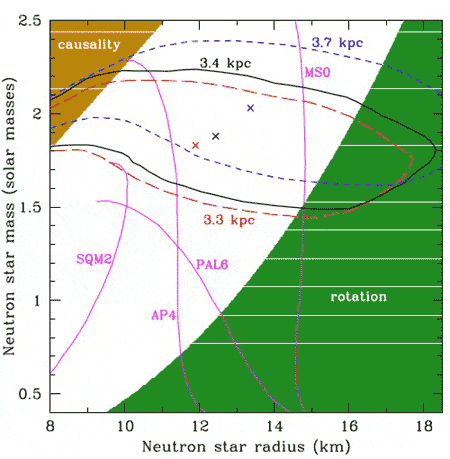
The mass diagram is a radius for neutron stars. Green and brown are marked excluded areas. Violet curves correspond to different equations of the state of the substance in the bowels of neutron stars. Показаны большие области неопределенности и их центры, соответствующие возможным комбинациям массы и радиуса источника в Кассиопее А (из статьи arXiv: 0911.0672)
Некоторые нейтронные звезды видны прямо внутри остатков породивших их сверхновых. Одним из таких интересных примеров является остаток Кассиопея А. Если по данным о расстоянии, потоке и по спектральным данным мы попробуем определить размер излучающей области компактного источника в центре остатка, то он получается небольшим — что-то вроде километра. Но радиус нейтронной звезды — около 10 км. Само по себе это не является проблемой: на поверхности нейтронной звезды может быть горячее пятно. Однако если есть пятно, то мы должны видеть пульсации излучения. А в случае Кассиопеи А их нет. Для описания спектров остывающих нейтронных звезд очень важно учитывать свойства их атмосфер. Для Кассиопеи А пробовали разные варианты состава атмосфер, но только сейчас, похоже, удалось все удовлетворительно описать ( arXiv: 0911.0672 ). Авторы рассмотрели углеродную атмосферу в слабом магнитном поле. При таких предположениях удалось описать все, что нужно. Теперь нет нужды в горячем пятне для объяснения отсутствия пульсаций.
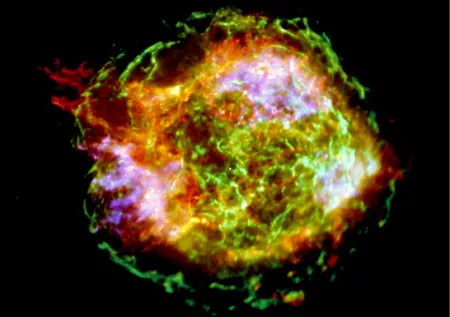
Изображение остатка сверхновой Кассиопея А по данным «Чандры» (Credit: NASA)
Два интересных результата связаны с радиопульсарами. Во-первых, прямые измерения, проведенные с помощью радиоинтерферометров со сверхдлинными базами (Very Long Baseline Interferometry — VLBI) дали очень большое расстояние до двойного пульсара J0737-3039A/B ( arXiv: 0902.0996 ). Прежняя оценка увеличена примерно вдвое. Теперь это 1150(+220 -150) парсек. Заодно подтверждена (и, разумеется, уменьшена) оценка трансверсальной (перпендикулярной к лучу зрения) скорости. Теперь она получается менее 10 км/с. Первое важно для оценок темпа слияния нейтронных звезд. Второе — для изучения механизмов взрыва сверхновой.
Во-вторых, найдено наблюдательное свидетельство в пользу важного эпизода в жизни нейтронных звезд в тесных двойных системах. Астрономы знали, что есть миллисекундные пульсары (в том числе и в двойных системах), знали о маломассивных рентгеновских двойных. Долго не удавалось наблюдать непосредственным образом, как нейтронные звезды в аккрецирующих маломассивных двойных раскручиваются до миллисекундных периодов. Потом (во многом благодаря спутнику RXTE) удалось увидеть и это. Но все равно хочется больше промежуточных звеньев. К радости астрономов радиоисточник FIRST J102347.67+003841.2, в котором подозревали наличие аккреции на компактный объект, вдруг успокоился, мерцания прекратились, и там «вылупился» нормальный миллисекундный пульсар — то самое недостающее звено в эволюции этих объектов.
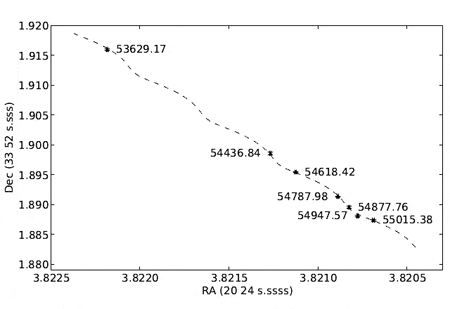
Положение V404 Лебедя в семь моментов наблюдения. Извилистость траектории показывает параллактическое смещение. Это позволяет определить расстояние (из статьи arXiv: 0910.5253)
Что касается черных дыр, то тут мы отметим три результата. Во-первых, используя данные наблюдений на VLBI, удалось достаточно точно определить расстояние до двойной системы V404 Лебедя, где есть кандидат в черные дыры ( arXiv: 0910.5253 ). Расстояние равно 2,25-2,53 кпк — меньше, чем считалось ранее. Это важно, поскольку уменьшаются и оценки светимости во вспышках источника. В частности, вспышки, считавшиеся сверхкритическими, оказываются субкритическими.
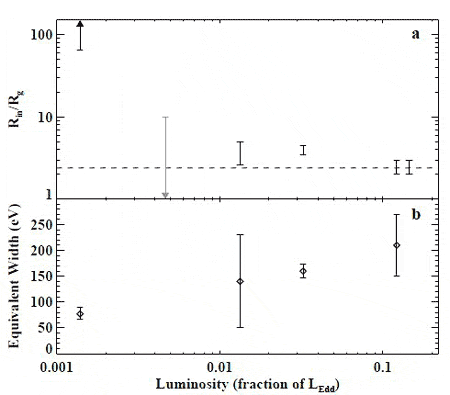
Параметры источника GX 339-4 в разные эпохи наблюдений. По горизонтальной оси отложена светимость в единицах критической. На верней панели показан внутренний радиус аккреционного диска в единицах шварцшильдовского радиуса. На нижней — ширина спектральной линии (из статьи arXiv: 0911.2240)
Во-вторых, были получены детальные спектроскопические данные для кандидата в черные дыры GX 339-4 ( arXiv: 0911.2240 ). В частности, хорошо измерена линия железа. Определение параметров системы по профилю линии позволяет выявить внутреннюю границу аккреционного диска. Это довольно стандартная методика. Но есть и новость. Показано, что радиус внутренней границы диска при низкой светимости существенно больше, чем при более высоких. Those. впервые отчетливо продемонстрировано, что, как и предполагалось в стандартных моделях, на низкой светимости диск существенно отстоит от черной дыры.
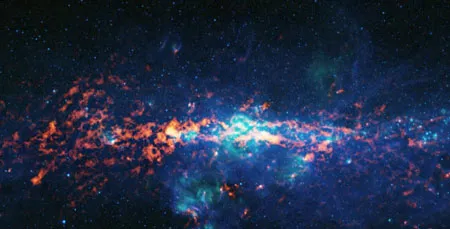
Область галактического центра и Sgr B2. Изображение получено наложением субмиллиметровых данных (красный цвет) и инфракрасных (синий и зеленый). Photo: ESO
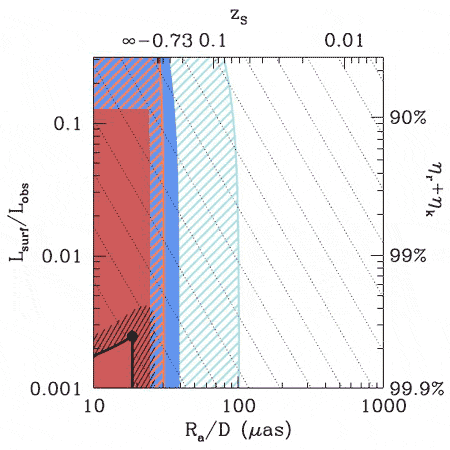
Если в центре Галактики находится не черная дыра, а какой-то объект с поверхностью, то падение вещества на нее должно приводить к излучению. На рисунке показаны различные ограничения на отношение светимости от поверхности к наблюдаемой светимости. Разрешенным является только левый нижний угол. Это соответствует тому, что 99,6% энергии излучается (в виде частиц или фотонов) до выпадения вещества на поверхность. Такая большая доля противоречит всем известным моделям. Поэтому авторы говорят о том, что поверхности просто нет, т.е. мы имеем дело с черной дырой (из статьи arXiv: 0903.1105)
Третий «чернодырный» результат, о котором хочется упомянуть, для многих будет особенно интересен. Утверждается ( arXiv: 0903.1105 ), что можно показать наличие горизонта событий у центрального объекта нашей Галактики (т.е. доказать, что он действительно является сверхмассивной черной дырой). На самом деле, конечно, речь идет о том, что в рамках некоторых наиболее разумных моделей в свете новых наблюдательных данных наличие горизонта неизбежно, но это тоже немало. Бродерик, Лёб и Нараян, используя данные миллиметровых и инфракрасных наблюдений Sgr A*, пишут, что низкая светимость источника свидетельствует о том, что там отсутствует поверхность. Наблюдаемая светимость составляет лишь 0,4% от того, что может давать аккреция на поверхность.
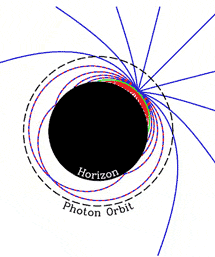
Распространение лучей света вблизи шварцшильдовой (невращающейся) черной дыры. Синим показаны лучи, изначально направленные от черной дыры, красным — внутрь, а зеленым — те, которые были испущены перпендикулярно направлению на центр дыры (из статьи arXiv: 0903.1105)
Вероятнее всего, с рождением черных дыр связаны обычные (длинные) космологические гамма-всплески. В 2009 г. был получен новый интересный результат и на эту тему. Был обнаружен ( arXiv: 0906.1577 , arXiv: 0906.1578 ) всплеск на красном смещении 8,3. Среди объектов с достоверно измеренным красным смещением это рекорд: объект дальше всех галактик и квазаров.
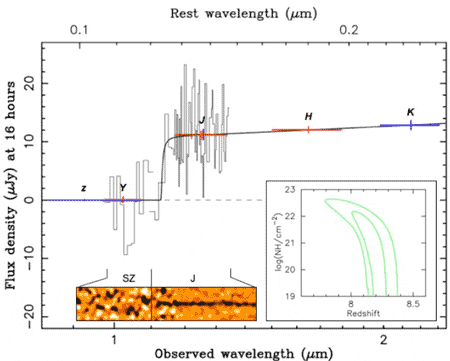
Спектр послесвечения всплеска по данным VLT. Наличие резкого скачка в спектре позволяет определить красное смещение источника (из статьи arXiv: 0906.1577)
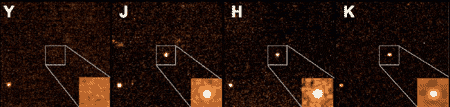
Послесвечение гамма-всплеска в разных частях инфракрасного диапазона. Три левых изображения получены примерно спустя 1,5 часа после всплеска с помощью северного GEMINI-N. Правая картинка получена на UKIRT спустя полчаса после всплеска. Отсутствие источника на левом рисунке служит подтверждением большого красного смещения (из статьи arXiv: 0906.1577)
Раз мы уже оказались в межгалактическом пространстве, поговорим о галактиках. Здесь рекордом можно считать обнаружение галактики вокруг самого далекого квазара на z=6,43 ( arXiv: 0908.4079 ). Точно определить массу галактики пока не удается, но ясно, что она достаточно массивная, а Вселенной в тот момент, согласно стандартной модели, при z=6,43 было всего лишь около 840 млн лет.
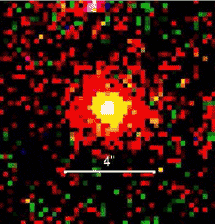
Составное изображение квазара CFHQSJ2329-0301. Цвета условные. Видно, что источник не точечный. Это галактика, в которой находится квазар (из статьи arXiv: 0908.4079)
Вообще, данные по массивным галактикам в молодой Вселенной заставили ученых серьезно задуматься. Крис Коллинз и его соавторы ( arXiv: 0904.0006 ) показали, что наиболее массивные (и яркие) галактики в скоплениях набрали 90% своей массы уже спустя 4-5 млрд лет после начала расширения. Это противоречит численным моделям, в которых формирование массивных галактик идет медленнее (90% массы набирается такими галактиками только спустя 11 млрд лет).
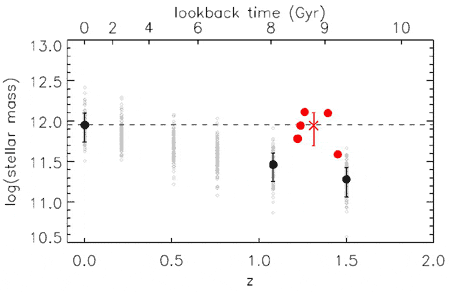
Показана эволюция звездной массы ярчайших галактик в скоплениях с красным смещением. Серым показаны результаты численного моделирования. Красным — результаты наблюдений (из статьи arXiv: 0904.0006)
В 2009 г. был описан весьма любопытный результат проекта Galaxy Zoo ( arXiv: 0907.4155 ). В процессе классификации галактик силами добровольцев был обнаружен интересный тип галактик, получивший название «зеленые горошины» (Green Peas). Выделен 251 такой объект. Это довольно компактные (менее 5 килопарсек) галактики с низкой металличностью. Они находятся относительно недалеко (0,112 < z < 0,360) и являются «родственниками» голубых компактных галактик. Новым галактикам свойственна клочковатая структура и высокая светимость в ультрафиолетовом диапазоне при относительно небольшой звездной массе. Эти свойства объясняются высоким темпом формирования звезд (порядка 10 масс Солнца в год).
На трех левых снимках — галактики «зеленые горошины». На самом правом — обычная эллиптическая галактика. Видно, что «горошины» — зеленые, а обычная галактика — желтая (из статьи arXiv: 0907.4155)
Остается перечислить результаты 2009 г. в области космологических исследований.
Наиболее интересным нам показались исследования барионных осцилляций по данным 7-го Слоановского обзора неба ( arXiv: 0907.1660 ). Первичные космологические возмущения приводят к возникновению звуковых волн в плазме, заполняющей молодую Вселенную. Эти волны «отпечатываются» на распределении обычного (барионного) вещества. Значит, можно пытаться увидеть соответствующие неоднородности в распределении галактик. Это крайне важно, так как позволяет очень точно измерить ряд космологических параметров. Новые результаты находятся в соответствии со стандартной моделью. Подробное описание барионных осцилляций можно найти в свежем обзоре arXiv: 0910.5224 .
Барионные осцилляции на разных красных смещениях по данным седьмого релиза SDSS. Линией показана стандартная модель с лямбда-членом (из статьи arXiv: 0907.1660)
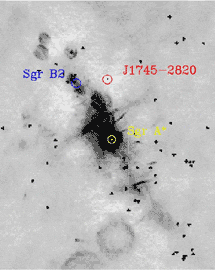
Радиоизображение на волне 90 см. Показаны источники: Sgr A* — центр Галактики, Sgr B2 — объект, до которого определяли расстояние, и внегалактический компактный радиоисточник J1745-2820. Sgr B2 — область звездообразования, содержащая мазерные источники (из статьи arXiv: 0908.3637)
Стандартные значения параметров подтверждены и в работе arXiv: 0905.0695 . Авторы используют новые данные по цефеидам в галактиках со сверхновыми типа Ia и галактике с мазерными источниками. На первом шаге получается очень точная калибровка пиковой светимости сверхновых. Это достигается тем, что выборка цефеид очень однородна, а потому можно использовать лишь относительные данные по ним, уйдя от необходимости выяснять точную калибровку самой шкалы цефеид. Абсолютная калибровка достигается использованием мазерных источников в галактике NGC 4258. В итоге получено значение 74,2±3,6 км/с/Мпк. Those. заявленная точность (с учетом статистики и систематики) лучше 5%. Приложение полученного результата дает w=-1,12±0,12, где w — параметр, характеризующий темную энергию: w=P/(ρc2).
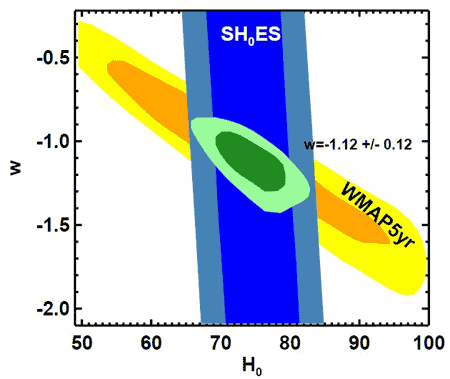
На плоскости H0 — w показаны области, соответствующие данным спутника WMAP и новым данным по цефеидам и мазерам. Пересечение двух областей выделяет наиболее вероятный диапазон параметров (из статьи arXiv: 0905.0695)
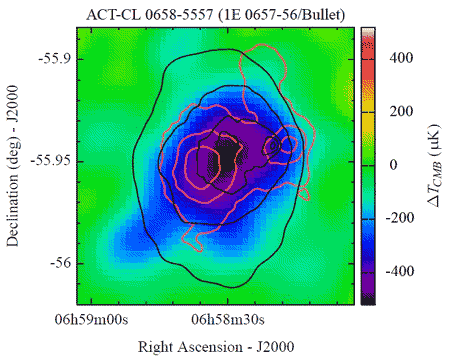
Скопление галактик 1E0657-56 (Пуля) по данным Atacama Cosmology Telescope. Черными контурами наложено рентгеновское изображение, а оранжевыми — распределение массы (по данным о линзировании, из статьи arXiv: 0907.0461)
Наконец, отметим работы по измерению свойств скоплений галактик с помощью новых наземных специализированных телескопов. Это Atacama Cosmology Telescope ( arXiv: 0907.0461 ) и South Pole Telescope ( arXiv: 0911.2444 ). Пока представлены только самые первые данные. Но важно, что инструменты работают как надо, и в ближайшие годы наблюдения позволят точнее измерить важные космологические параметры.
В заключение проведем «работу над ошибками». Во-первых, в прошлом году мы писали о работе Нойолы и др. ( arXiv: 0801.2782 ), в которой было показано, что в скоплении Омега Центавра должна находиться массивная черная дыра. Однако новые данные из работы arXiv: 0905.0627 говорят о том, что это не так. Используя данные «Хаббла», авторы arXiv: 0905.0627 проводят детальный анализ свойств звездного населения скопления. Если Нойола и др. (2008) говорили о черной дыре с массой порядка 40 тыс. солнечных, то новый верхний предел равен 18 тыс. (три сигма). Т.е., по сути, результаты статьи Нойолы и др. (2008) объявлены неверными. По мнению авторов представляемой статьи, это связано с методикой, использовавшейся Нойолой и соавторами. В пределах трех сигма новые данные можно объяснить вообще без дыры, хотя модель с дырой с массой около 8 тыс. солнечных помогает улучшить описание данных.
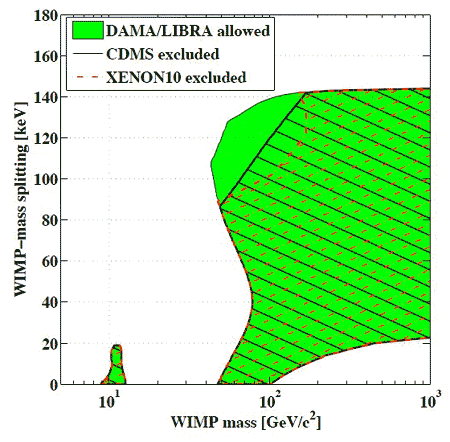
Параметры частиц темной материи. Зеленая область соответствует разрешенным комбинациям по данным эксперимента DAMA/LIBRA. Черная штриховка показывает параметры, исключенные по данным эксперимента CDMS-II (из статьи arXiv: 0912.3592)
Также мы рассказывали о работе arXiv: 0808.3772 , в которой авторы оценили массы для множества карликовых галактик и показали, что есть указания на существование единого нижнего предела масс (порядка нескольких миллионов солнечных). Теперь же авторы свежей работы arXiv: 0910.1348 провели переоценку массы для одной из карликовых галактик. Новая оценка почти на порядок ниже. Видимо, это действительно является угрозой сценарию с универсальным нижним пределом.
В конце обзора отметим, что прошлогодний результат коллаборации DAMA/LIBRA по регистрации частиц темной материи находится под сомнением. Свежие данные коллаборации CDMS исключают (в рамках стандартных моделей) практически всю область параметров, защищаемую DAMA/LIBRA.
Сокращенный вариант статьи опубликован в газете « Троицкий вариант — Наука » #1 (45) за 2010 год, полный вариант – в « Гранях.Ру «
Сергей Попов, Максим Борисов