
Translated material
Alive reduced
Alive reduced. Unemployment in Russia, which in the summer and autumn began to gradually decline, again went in growth. What will happen to employment in the Russian labor market in 2010-the New Times found out
Viktor Tverdokhleb, a 29-year-old businessman from Moscow, believes that with his example you can study the entire specifics of crisis. In the summer of 2008, he got a job in the sales department of a new trading house on the outskirts of the capital specializing in household electrical engineering. Salar - 80 thousand rubles plus bonuses depending on the sale of goods - chandeliers. “If the business plan had been fulfilled, my income had to double in a year,” Victor says. But the crisis struck in the fall. And already in October, the management of a trading house announced a reduction in costs and restructuring. Victor was taken to the staff and offered to perform the same functions not for the salary, but for the percentage of sales. “For several months he was spinning, looking for buyers, bringing contracts, as a result he received 20–25 thousand per month.”

In early March 2009, Victor was offered to return to the state, but already for a salary of 40 thousand. Plus percentage of the implementation - “in the envelope”. He agreed and even received 50-60 thousand for two months. But by summer, sales fell to almost zero. It turned out that the trading house was bogged down. For two months, Victor did not see salaries at all. By the fall, the owner was replaced by the trading house. Victor was invited for an interview, paid an official salary for the two last months (no one hinted about the “convertible part”) and offered a three -month test contract with the same salary without any interest, envelopes and bonuses. In early December, the businessman, like most of the other "old" employees, announced that they did not need his services. Over then, Victor has not found a new work since then and intends to go to the labor exchange for the first time in his life to receive benefits.
With things to exit
The story of Viktor Tverdokhleb is how original, equally typical. It was by the end of 2009 that another wave of abbreviations swept through the country - and unemployment began to grow. In November, it increased by 5% immediately, exceeding 6.1 million people (8.1% of the country's economically active population). In December, according to the preliminary data of the Ministry of Economic Development, the unemployed army increased by another 400 thousand. According to the studies of the Institute of Economics of the Transition period, in the last month of the old year, the growth of dismissal occurred in all sectors except for forest and food. In total, over 60% of the enterprise surveyed by the Institute of Enterprises announced the reduction of personnel in December 2009. Igor Nikolaev, director of the Department of Strategic Analysis of the FBK, is absolutely expected to consider such a development of events in the labor market: “The industry has fallen sharply, most of the industries comprehended the systemic crisis, the ends of the enterprise for a long time forced the staff for a long time not to reduce staff, but by the end of the year it became impossible: without restructuring, they simply could not survive. Here is unemployment and manifested. "
Tatyana Maleva, director of an independent institution of social policy, also agree with this point of view: “The process of mass reductions should have begun in September. A surge of unemployment at the very beginning of autumn did not occur only because the money allocated by the federal center for employment programs was mastered in the regions. When this money was over, the growth of unemployment began. ”
And the director of the Center for Labor Studies of the Higher School of Economics (CTI-SHE) Vladimir Gimpelson connects the leap of unemployment at the end of last year mainly with the seasonal factor. “Employment in such industries as agriculture, construction, trade is reduced in autumn-winter,” the expert explains, adding that this is mainly due to the informal sector.

The government remain calm regarding the size of unemployment in the country in the coming year. Deputy Prime Minister Alexander Zhukov predicts that according to the results of 2010, the total number of unemployed citizens of Russia will be 6.3 million people. The Ministry of Economic Development is ready for the worst scenario: it is believed there that over a year, the number of unemployed can increase to 6.8 million people (9.3% of the economically active population). At the same time, the number of unemployed officers officially registered in the employment services by the end of 2010 can grow up to 2.6 million people - almost 30% compared to the summer of 2009. The head of the Federal Service of the Russian Federation for Labor and Employment, Yuri Ghetsius, considers such an growth serious, but not critical. It recalls that over the past two crisis years, unemployment in the United States has grown by 110%, in Mexico - by 60%, in the UK and Canada - by 40%. 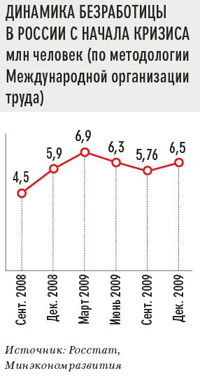
Independent experts are not inclined to calm themselves with foreign numbers. “The winter peak of unemployment has not passed,” Vladimir Gimpelson is sure. According to him, the level of general unemployment by February 2010 will be higher than the current one and will be about 9.9% of the economically active population; In the summer, a decrease in the number of unemployed will begin again, then, obeying the seasonal factor, unemployment will again begin to grow. To what peaks its level will grow by the end of 2010, the director of the TSTI-SWE will not be decided to give a forecast.
The government connects hopes for reducing unemployment with two factors: some GDP growth in the coming year and a continuation of employment programs, which have 43 billion rubles in the budget. However, Vladimir Gimpelson claims that "employment in the formal sector of the economy is poorly related to GDP growth." The expert recalls that unemployment in the industrial sector began to increase with a large temporary lag in relation to the peak of the crisis, which was a year ago because the government artificially restrained it and continues to do this.
At the same time, the studies of TsTi-SHE do not confirm that government employment programs significantly influenced a decrease in unemployment. Experts recognized only the programs to assist the small business, but only 15 thousand people were involved in them over the past year. And steps such as increasing the minimum size of benefits and minimum wage, reduction of the armed forces, tightening labor legislation for employers, on the contrary, worked on an increase in the number of unemployed.
The structure pumped up
Experts are unanimous is that the main problem of the labor market is not in the number of unemployed, but in the structure of employment. “The government continues to pour new funds into ineffective AvtoVAZ, because contrary to all the statements of ministers in Togliatti there are simply no other production,” explains Gimpelson.
In the "bad" single -industry towns - like Togliatti or Pikalevo, according to Tatyana Maleva, 5% of the able -bodied population is concentrated. This is relatively slightly on the country's scale, but the depressive regions themselves experience huge social problems. At the same time, Maleva warns a sign of equality between all single -industry towns. “The drowning AvtoVAZ and the swollen Norilsk Nickel are two completely different stories,” she explains.
Due to the recovery prices for raw materials, according to its assessment, in the production industries the situation in 2010 will be better. “In the processing industry, mechanical engineering, the unemployment rate will depend on the list of enterprises that will help,” she says. “In 2009, the government supported domestic auto enterprises, which will be in the coming is unknown.”
According to Gimpelson, the state of affairs in Moscow and other million-plus cities, where labor from “fallen” industrial industries and construction, flows into trade, is being straightened. The sectors, where high -paid “white collars” are occupied, according to Gimpelson, begin to recover. Banks, which were forced to take serious reductions a year ago, are now starting to recruit staff again, experts of the recruiting portal Superjob.ru confirm. They argue that recently requests for specialists in sales, managers, economists, industrialists with experience have been growing by 10-15% per month, that is, those who were massively reduced in the first months of the crisis.
“In Moscow, it is really low unemployment,” Maleva agrees. - But in the capital there is voluntary unnecessary - disagreement of people for a lower salary. The metropolitan banks and investment companies at the very beginning of the crisis “dropped” highly paid employees. Now they are again recruiting people to these positions, but already on much lower salaries. ” As Malev emphasizes, unemployment in Russia is not so high by world standards, but the employment structure remains extremely bad: most of the employees work in ineffective enterprises with a small salary.
Evgeny Gontmamer, Deputy Director of the Institute of World Economy and International Relations of the Russian Academy of Sciences, believes that, paradoxically, the growth of unemployment gives a chance to change the situation in the labor market for the better. He gives an example of Spain, where now about 20% of people are unemployed, but no particularly loud social protests are heard there. All because there is a very short period of unemployment: people can lose their jobs, but after a month or two they again gain the workplace and do not see the tragedy in quickly changing it. Gontmamer believes that if such mobility appears in the Russian labor market, this will redirect 7-10 million people in high -tech, modernization industries in the coming years. “If the authorities are not afraid to follow this path, it will soon become clear: it is better to have a high, but short unemployment than a low, but for a long time preserving our technological lag,” the expert says.