
Translated material
Russian revolution
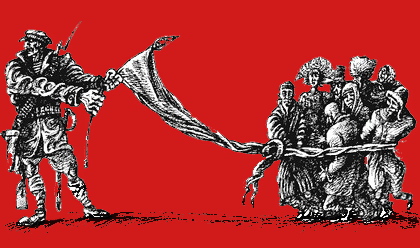
Berdyaev isolate five types of civilization in the thousand -year history of Russia: Kievan, Russia of the Tatar period, Moscow, Russia, Petrovskaya, imperial Russia, and, finally, new Soviet Russia. The last period, however, is significantly different from the first four. If in all previous periods Russia remained Russia, and the Russian people - the Russian people, then in the Bolshevik period, Russia turned into the USSR, and the Russian people into Soviet. Brodsky calls this rebirth “colossal anthropological shift” and “huge anthropological regression”. It may be more correct to name this transformation of an anthropological disaster, given the depth of the spiritual degradation of the Russian people in the Soviet era ..
What is the "Soviet man"? The most accurate answer was given by the thieves: a slave to the CPSU. There are earlier options, but the idea is the same: “Slave of the VKPB”, “Slave of the NKVD”. The thieves were meant ordinary slavery, which in the USSR was carried out in camps and collective farms. But, in addition to the usual, the Bolsheviks created a new and unprecedented phenomenon: ideological slavery. Soviet people became slaves of communist ideology. Their worldview consisted of a set of ideological cliches, which were affirmed in their minds as mathematical axioms such as “twice two four”. The same truth was given to the statements of “Marxism-Leninism-the only correct worldview”; “Communism is a bright future for all mankind”; “The party and the people are one”; “The USSR is the world's first state of workers and peasants”, etc. Several hundreds of such dogmatic provisions made up the worldview of Soviet people, periodically updated by new postulates, for example, "socialism and capitalism can coexist peacefully."
The dogmas of communist ideology were mandatory. Berdyaev called this "dictatorship of the worldview." Criticism of communist ideology was seen as anti -Soviet propaganda aimed at undermining the Soviet system.
In 1949, when I studied at the psychological department of the Faculty of Philosophy of Moscow University, I and the group of my comrades of students were arrested. The main point of the prosecution was criticism of Marxism-Leninism from idealistic positions. By the decision of the special meeting, we were sentenced to eight years of camps. The infallibility of communist ideology (Marx's teaching is omnipotent because it was true) was approved by stages in the camps.
The most striking feature of the Soviet man was that he did not know that he was a slave.
The slaves of past eras knew that they were slaves, and dreamed of becoming free. If the Soviet man was told that he was a slave, he would be sincerely indignant. This feature of Soviet people was noted by Sinyavsky: "Before us is another paradox: the slave not only does not feel his slavery, but considers himself the most free person in the world."
How did the Soviet man become the slave of communist ideology?
The main role in this process was played by the so -called communist education. “The party brings up a new person,” says the CPSU software documents. The party began to cultivate their submitted ones from childhood, but the main process of bearing at school took place. For ten years, the consciousness of schoolchildren has undergone continuous ideological processing, especially in history lessons, literature, social studies, as well as in pioneering and Komsomol organizations.
Children take the words of teachers on faith, and over ten years, the continuous zombie of the consciousness of schoolchildren, carried out according to the Orwell formula “False is true”, led to the fact that young people who were already completed by Soviet citizens, that is, people with a deformed consciousness came out of the school. And outside the school, the processing of their consciousness was carried out with the help of newspapers and magazines, radio and television - these, according to Etkind, "murderous means of penetration into any house and in any brain."
An important element of communist education was Soviet art. It created a fictitious world, pseudorality, in which happy collective farmers with songs removed the crop, and Shakhtar Stakhanov fulfilled 14 norms for a shift, and Stalin himself was sorry for his hand in the Kremlin. A joyful, happy feeling created by films (“Funny guys”, “Volga-Volga”), flowing from the songs: “Hello, the country of heroes, the country of dreamers, the country of scientists”; From the verses: “Both life are good and well” - all this worked to the transformation of life and supplanted from the consciousness of Soviet people the bad reality of barracks and communal services, heifers and rubber boots and many hours of standing in lines (all this was part of the “temporary difficulties”). Soviet art told people that the fabulous world was already nearby, that a little more heroic efforts and life will be transformed, will become the same as in films. This fictitious world, successfully called the “third reality”, possessed such a magical attractiveness that so far Soviet films are very popular in Russia, and Dunaevsky’s melodies sound in the ears. The main author of the “third reality” was Stalin. He formed it. He carefully monitored the development of Soviet art, constantly watched films. His instructions determined the direction by which Soviet art should develop. Creative workers were well aware of what Stalin liked and what I did not like, and this was the main criterion in choosing a topic, plot, heroes.
To a lesser extent, those who resisted him were subjected to zero (this part of the population of the USSR is called the “second Russia”), but no one could avoid Sovietization. Bezanson says that the Soviet intellectual at home writes “on the table” and thinks that he created a niche. He is mistaken, because in the morning he comes to his institute and speaks in the Soviet language. A teacher of philosophy, setting out students in the foundations of Marxism-Leninism, could not consider them wrong. Otherwise, he had to tell himself that he himself did not believe in them, and students say that they contain the truth, that is, a year after year deceives them. But such a split personality is impossible. Maybe some cynic could lead such a double life, but the bulk of the employees of the “ideological front” considered the diamat with the Istmat, Marxist political economy, the rest of the ideological disciplines, and the Stalinist interpretation of the revolution and the history of the USSR.
Communist ideology underwent changes. During the war years, Stalin, abandoning Marxist-Leninist internationalism, began to impose Russian nationalism, and he quickly took root. Stalin also instilled imperial thinking to Soviet people. They began to consider the Baltic states and East European countries as part of the Soviet Empire, called the "socialist camp." As a result, Soviet people formed a mixture of communist, Russian nationalist and imperial ideologies. Sliding, they formed a certain alloy - the Soviet ideology of the late Nestalin era. Since the author of all changes in ideology was Stalin, it is more correct to call it simply “Stalinist ideology”. Her power over Soviet people was so strong that 18 years after the collapse of the communist system, half of the population of present -day Russia could not be free from its magical dope and yearning for the “great era”, “the Great Empire” and its “great feeding”.
2
The ideological enslavement of Soviet people was accompanied by moral degradation. It began with the fact that the main part of the people, participating in the revolution, accepted the atheism of the Bolsheviks, renounced the faith of the fathers and abused the shrines. The churches were defiled. They were blown up, they were arranged in them warehouses, stables, clubs and toilets. They chopped icons on firewood. Priests were shot and drowned on barges. Here is what the historian D. Pavlov says: “With the ministers of the Church, people, as a rule, of advanced years, the new rulers of Russia loved to deal with special, sophisticated cruelty: they were crucified on the royal gates, cooked alive in boiling tar, scalp, strangled with epitrachils,“ communed ”with the straightened lead”. Such hatred of priests directly rises to Lenin. Of all the "exploiting" classes, he most hated the clergy. This is evident, in particular, from his instructions on the seizure of church values. In it, Lenin wrote: “We can (and therefore must) carry out the seizure of church values with the most frantic and merciless energy and not stopping before the suppression of some kind of resistance ... The larger the number of representatives of the reactionary clergy and the reactionary bourgeoisie will be able to shoot, the better.”
Another reason for moral degeneration was the installation of the Bolsheviks to attract ink to power. Soon after the seizure of power, the Bolsheviks realized that they had no supports in society. Although Lenin claimed that the proletarian revolution occurred in Russia, but he and the entire Bolshevik elite understood that it was a myth, and there was a Dictatorship of the All -Union Communist Party of Bolsheviks, carried out by the Central Committee based on the Cheka. But in order to rule the country, it was necessary to create a state apparatus. They began to recruit the mob, this is the "last class." The Bolshevik artificial selection began to operate. Party, Soviet, economic organizations, but primarily the Cheka and other terror organs, as well as the comables in the village began to be filled with low people, for whom conscience had no importance. The young Soviet government offered its citizens a simple and tempting public contract: the more you are able to commit vile acts, the more chances you have to climb the service ladder. Democents have become a standard way to advance. A typical figure in the party and Soviet hierarchy is "an honest traitor, boiled in cleaning, like salt."
Stalin made the selection of ink the basis of personnel policy, especially when the case concerned the selection in his personal apparatus. “And around him a rabble of thin leaders, he plays with the services of half -holes.” The whole country knew the names of the leaders: Molotov, Kaganovich, Voroshilov - the Stalin's half -boles of the older generation. Malenkov, Zhdanov, Suslov - from the following. Here is an example of the behavior of the Stalin subhuman: Yezhov sent to the Kremlin to approve the list of arrested wives of senior leaders. He set category No. 2, which suggested the camp period (usually 10 years). But there is no Stalin, and the decision must be made by Molotov. He is reinsured. After all, the reaction of Stalin is unpredictable. He crosses out No. 2 and sets No. 1, which meant the use of higher measures. All women were shot from this list.
Communist power morally corrupted people. They lost universal moral foundations. The Soviet man willingly learned thieves ethics: wherever it is to work, just not to work, live “for free”, deceive, steal. Became a typical form of behavior-steal something in production, sell and drink
One of the consequences of abandoning Christianity was idolatry. The deification of Stalin has reached implausible sizes. Soviet people fell in front of a tyrant. In songs, poems and poems composed by our creative intelligentsia, he was endowed with divine features, primarily by holiness and infallibility.
3
When in 1949, during interrogation, I told the investigator that the ideas incriminated to me can be found in Stalin’s works, he jumped up, turned away, flooded his feet and yelled in a fury: “Do not dare to pronounce his name with his anti -Soviet lips.”
But Stalin idolized not only “ordinary Soviet people”. Sinyavsky gives an excerpt from the Chukovsky diary, in which he tells what happened when in the presidium of the congress of Soviet writers in 1934 appeared with a group of leaders of Stalin. “Yesterday at the congress, writes Chukovsky, sat in the sixth or seventh row. He looked around: Boris Pasternak. I went to him, took in the front ranks ... Suddenly Kaganovich, Voroshilov, Andreev, Zhdanov, Stalin appear. What happened to the hall! And Stalin stood a little tired, thoughtful and majestic. There was a huge habit of power, strength and at the same time something feminine soft. I looked around: everyone had lovers, gentle, spiritualized and laughing faces to see him - just see - for all of us was happiness. Each of his gesture was perceived with reverence. I never even considered myself capable of such feelings. Pasternak whispered to me all the time about him enthusiastic words. We went home with Pasternak, and both reveled in our joy. ”
Stalin created a nation of slaves. The execution as the main tool for managing society acted without fail. Stalin was a sadist and killer by nature, but he was not a pathological killer, as many of his biographers believe. He was a planned killer. He planned the murder. His first task was revenge on the party leadership, the so -called Lenin Guard, to those who laughed and mocked him, considered him mediocrity and insignificance. All these Zinovievs, Kamenevs, the “party’s favorites” should have been not only destroyed, but before death to kiss his boots. They had to be forced to admit that they were real criminals: they were engaged in wrecking, sabotage, and spies of foreign intelligence, created underground organizations to kill Stalin and other leaders and restore capitalism in Russia. And they were forced to admit all this, using the most brutal torture.
When Yevgeny Ginzburg was transferred in a Butyr prison to the camera, overlooking the investigative corps, she saw that the cellmates plug her ears with cotton. A few minutes later she realized why. After the end, interrogations began, and screams and groans of hundreds under investigation, subjected to torture, hung over the Butyrka. They all recognized, they promised them to "save life." They were all deceived and shot all.
The second planned task was to replace the old party composition with a new one. Total composition, completely. Party members who could have their own opinion were not needed by Stalin. No one should have doubts about the correctness of his chosen path. The upper and middle echelon of the parties were to be shot, the rest went to the camps. Stalin destroyed the Lenin Communist Party and created his own, Stalin, consisting of robots, which implicitly fulfilled his will.
The third task was to intimidate the population to such an extent that people tremble with fear at one mention of his name. The main method was the total terror and the total, “chilling fear”, according to Etkind, but rather even a mystical horror that lived in the subconscious of every Soviet man. After all, everyone could be arrested and shot at any moment. "In the stomach and death, God is powerful." Wrong. In the country of the victorious socialism in death, one Stalin was powerful.
Stalin completed the case, begun by Lenin: he built “the world's first state of workers and peasants” and inhabited him with Soviet people who passed the Stalinist selection. But he understood what Lenin did not understand: in order to fulfill this task, it is necessary to mercilessly destroy everyone who can be disagreeable, including their own party, including even those who are only suspected of meaninglessness.
To be continued
Drawing Mikhpil Zlatkovsky/ zlatkovsky.ru