
Translated material
Karl was stolen
The unknown picture of Bryullov "Christ in the coffin" was the reason for the trial
Passion for Karl Bryullov. On January 29, one of the district courts of St. Petersburg will be heard in the case, which one party considers the case of smuggling, and the opposite-by the state racket. The subject of the dispute is the picturesque image of Christ in the coffin made by the hand of the great Russian artist of the 19th century
This story began in one of the Orthodox parishes of Belgium. Collector Alexander Pevzner, who has been collecting Russian and Western European painting for many years, found a picture in the parish, which, according to local experts, could be written by Karl Bryullov. It was in 2002. There was no signature of the artist under the picture, and therefore, having drawn up a preliminary contract of sale with the owner, Pevzner drove the canvas to the Russian Museum. Where else? In the same place, Pevzner believed, first -class specialists work. They found that the picture was painted by the great Bryullov for the house of the Count Adlerberg's house in St. Petersburg, later Governor General Finland. In 1881, after the murder of Alexander II, Count left Russia and settled in Germany, where, most likely, he took the picture. History is silent how "Christ in the coffin" ended up in an Orthodox parish in Belgium.
A masterpiece for the museum
Conducting the examination of the picture, the museum workers did not hide their admiration: they called her a masterpiece, and her find-a historical and cultural sensation. This is how Pevzner himself describes the picture: “This work of Bryullov, according to museum experts, is unique. It is large: 2x1.5 m. It depicts Christ with an angel leaning over him in prayer. The picture is written in unique technique. Imagine: a two -meter piece of the thinnest canvas of arched shape, on which starch is applied as the soil, and a thin layer of oil paint is applied from above. Therefore, if the picture is highlighted from behind, it begins to glow and resembles a two -meter slide laid on the matte glass illuminated behind. ” The collector was going to give a picture for restoration to the Russian museum: “The picture was in extremely poor condition: a leak occurred in the parish room, the picture was flooded with water, and it was badly damaged by mold.”
But nothing came out with the restoration. Ten days after the examination, the FSB Office in St. Petersburg opened the case ... in the fact of smuggling. The picture was arrested and left for temporary storage in the museum. Three days after the initiation of a criminal case, they came to Alexander Pevzner with a search. Five months later, the FSB investigator charged him with the smuggling of cultural values.
Picture VS Freedom
From the resolution on attracting Pevzner as the accused: “On March 18, 2003, having intent to sell K. Bryullov’s painting“ Christ in the coffin ”, the State Russian Museum, in order to avoid customs payments, informed the customs officers and declared obviously inaccurate information about the purpose of the import of the picture, customs regime and its customs regime and its value ... on the basis of his statement, Pevzner filled the customs declaration in his name without indicating the authorship, name and cost of the picture, inaccurately declared the picture in the preferential regime of temporary import ... "
The lawyer of the collector Anna Stavitskaya considers these accusations insolvent: “Pevzner could declare the picture only in temporary import mode. He could not indicate either authorship or the cost of the picture, because he did not know them before the examination in the Russian Museum. If he did this, then it would be smuggled, ”the defender explains.
Pevzner was not going to sell the picture to the Russian museum, despite the repeated requests of museum workers. There, all these seven years did not hide that they dream of getting a unique picture in their funds.
In 2005, acting Director of the Russian Museum Ivan Karlov directly wrote to Major General Mikhail Milushkin, deputy head of the FSB department in St. Petersburg: “We confirm that they are interested in the receipt of the paintings of K.P. Bryullov "Christ in the coffin" to the funds of the State Russian Museum for permanent storage. "
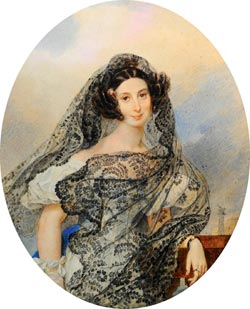 |
| How much does the painting “Christ in the coffin” cost (canvas 2x1.5 m), so far no one knows. It is only known that in October 2009 in London, Bryullov Watercolor “Portrait of Giovanina Pachini” size 17x21 cm was sold for $ 455 thousand. |
Pevzner believes that after arriving in Russia, his phones were auditioned, and when it became clear that he only wanted to conduct an examination of the picture, restore it and take it back to Germany, where he has been living since the late 90s, a criminal case was instituted against him so that there were reason to leave a picture in Russia.
The lawyers of the collector and lawyers from prestigious German universities agree with this, who thoroughly studied this case of the “state racketeering”. Suspicions are confirmed by the chronology of the criminal case. Firstly, it was aroused immediately after establishing the authenticity of the picture, and not when the singer crosses the border of Russia. Secondly, despite the multiple interrogations of the accused, the investigator did not take the subscription from him to leave and did not interfere with his departure to Germany. Thirdly, the investigation of the case is suspended due to the lack of the accused, and the picture continues to be stored in the museum, despite the numerous statements of Pevzner to different instances about its return.
“Investigator Vladimir Kraevsky knows the whereabouts of the accused, but no one is looking for him. The investigator is talking to him on the phone, ”says lawyer Semen Haifets. -In private conversations, he makes it clear that Bryullov’s picture should remain in Russia, then it will be possible to somehow solve the issue with a criminal case. But Pevzner believes that he has not violated any laws, and the picture is his property. ” Vladimir Kraevsky himself refused to comment on The New Times, referring to the secret of the investigation.
Bryullov is in danger
The collector worries that the unique picture has been without restoration for seven years. The case file contains the explanations of the restorer of the Russian Museum of Klenova, from which it follows that back in 2002 the picture was damaged by mold. According to Pevzner, then answering his question about the preservation of the picture, the restorer assessed her condition as follows: "The patient is seriously ill, but he can be saved."
In 2005, acting Director of the Russian Museum Ivan Karlov in a letter to Major General Mikhail Milushkin, deputy. Head of the Department of the FSB in St. Petersburg reported the need to restore:
“They are forced to state that at present the state of the picture, which is exclusively artistic value, causes serious concern in its safety. Long -term storage of this kind of unique artistic monument without regular preventive restoration measures can lead to irreparable losses of copyright painting. ”
Grigory Goldovsky, head of the Russian painting department of the XVIII - first half of the 19th century, was less categorical in an interview with The New Times than his colleague in a letter to the St. Petersburg Chekists: “We are watching the picture. Since there is no change in safety, the picture is quite well mothballed, we do not see special urgency in any restoration measures. ”
This approach of museum workers is not at all satisfied with the owner of the picture of Alexander Pevzner. He believes that she still needs an urgent restoration: to keep the masterpieces crumbling and molded and moldy without restoration for seven years.
Legal misunderstanding
Experts interviewed by The New Times admit that investigators have already stated “up” about the “gaining” of Bryullov’s invaluable masterpiece, which can become a decoration of not only the Russian museum, but also the Konstantinovsky Palace, which is under the management of the Presidential Affairs. Three years later, the statute of limitations in the case will end. Meanwhile, Pevzner has recently begun to fight more actively for his property. His lawyers filed two complaints with the demand to return the picture to the owner and stop the criminal case.
The judge of the Dzerzhinsky District Court of St. Petersburg did not want to take responsibility and consider the complaints of lawyers on the merits. He sent them to the court of Vyborg. The judges of the Cassation instance of the St. Petersburg City Court, where lawyers appealed the decision of the Dzerzhinsky court, in turn, made a decision, which one of the lawyers called the “legal misunderstanding”: they decided to listen to the complaint of Stavitsky’s lawyer in the Dzerzhinsky district court of St. Petersburg, and a similar complaint of other lawyers-in the court of Vyborg.
Defenders shrug. In their opinion, neither judicial nor law enforcement agencies know what to do with the case of Bryullov’s masterpiece. And the owner does not want to give the picture, and not to give - run into international courts. “The actual removal of the picture from Pevzner violates its ownership rights. If this is proved in Strasbourg, ”says the lawyer of Stavitskaya,“ Russia will have to compensate for the damage corresponding to the real cost of such a picture. ”
Great Russian artist Karl Pavlovich Bryullov
Born December 12, 1799.
He studied painting at the Academy of Arts in St. Petersburg. In 1822, at the expense of the Society for the Promotion of Arts, he went to study abroad. In 1827, there he began to write his first large picture “The Last Day of Pompeii”. In 1836, Bryullov returned to Russia. In Moscow, he met Pushkin, wrote his portrait. Then the painter settled in St. Petersburg, where he taught at the Academy of Arts. At this time, Bryullov became a fashionable portrait, but was engaged in monumental painting. He painted the churches, in particular, the Lutheran Church on Nevsky Prospekt and the Isaac's Cathedral. In 1849, the artist left Russia and left for the island of Madeira. He traveled a lot around Europe. From 1850 to 1852 he lived in Italy, where he died on June 11, 1852 in the town of Marchano near Rome. Bryullov’s paintings are stored in many museums - in Russia and abroad.