
Translated material
For Iraq will answer
Blair on call. The ex-prime minister of Great Britain is returning to British politics for one day. On January 29, Tony Blair will testify before the Chilkot Commission, investigating London's participation in the Iraqi war. The hearing will last six hours. How can it end for the former prime minister - found The New Times 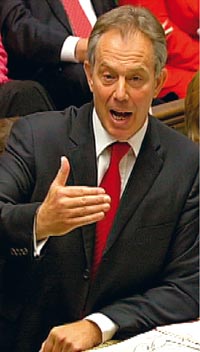
The Iraq Inquury Committee includes famous and respected people in Britain: political scientist Lawrence Friedman, former ambassador to Russia Rodrik Line, a member of the Baroness Ears, a member of the Oshad Lordes, a professor-historian from Oxford Martin Gilbert. The commission was headed by 70-year-old John Chilkot, who until 1997 held high posts in the civil service. For skeptics, however, this fact of his biography like the “Achilles heel”: they say, Chilkot is too closely connected with the ruling elite, so that the hearing is truly blowing up British policy ...
The commission began work last summer with meetings with relatives of the murdered soldiers and the military personnel who were still in Iraq-this, according to Chilkot, helped his colleagues more accurately formulate questions for the persons called for survey. The testimonies have already been given by the former ambassadors of the United Kingdom in Washington and the UN - Sir Christopher Meyer and Sir Jeremy Greenstock. Both said that the decision on the invasion of Iraq was made, in essentially, Keleino during the personal meetings of Blair and Bush. The former Mi-6 head John Scarlett also performed at the hearing: he noted the absence of reliable sources of information in Iraq with British intelligence. The former head of the General Staff of the British Army Admiral Boyce spoke about the planning of a military operation. And on January 12, another very influential figure was called to the carpet-Alistair Campbell, former press secretary of Tony Blair. At the hearing, he justified the actions of his former chef. And then the turn of Blair himself came.
A significant detail: hearings are not a court. The speakers do not testify under the oath, although they sign statements with the promise to tell the whole truth. The commission does not intend to make sentences or censure to individuals. Initially, the current British Prime Minister Gordon Brown proposed to hold hearing in closed mode, which both members of the commission and the public opposed. Therefore, meetings are open in nature - in the presence of representatives of the public, press and ordinary British. By the way, Brown himself, who at the height of the war in Iraq was the Minister of Finance, will appear before the commission not after, as was supposed earlier, but before the parliamentary elections scheduled for May-June this year. Already now, all measurements of public opinion show a sharp decrease in the rating of the ruling Labor Party. The Opposition Conservative Party (Tori), according to the January survey, can count on 41%of the vote, the Labor-by 28%, the liberal democrats-by 19%. The situation is laid for the Labor, the British commentators note, is largely explained by the unpopularity of the war in Iraq and a wide discussion of the activities of the Chilkot commission.
Does Tony Blair can help the same party members somehow? The New Times asked Professor Bill Bowing, one of the largest British experts in international law.
Can I expect on January 29, sensations or at least surprises?
It is unlikely. Most likely, Blair will justify the decision made by him in 2002 in every possible way to connect Britain to military operations. And probably, he will even present him as a necessary step in the fight against international terrorism.
This is the so far the only important information obtained as a result of the hearings: Tony Blair and George Bush long before the start of the war had a personal agreement that if the United States decides to use force against Iraq, the UK will not stand aside. This means complete neglect of the law.
Why?
From the point of view of international law, the war in Iraq was absolutely illegal. International laws allow the state to use its armed forces in a foreign country either for self -defense, or in the case of a clear and unambiguous sanction of the UN Security Council. Great Britain and the United States covered themselves as a resolution of the Security Council under number 1441 (adopted in November 2002. - The New Times), although it does not say a word about the use of power against Iraq. In the practice of the UN, there is a traditional formula that implies the mandate for the use of force, and it sounds like this: "use all the necessary measures." In resolution 1441, such a phrase is absent. Accepting this document, all members of the UN Security Council were fully aware: the use of force is not authorized by them.
Did no one in the country warn Blair about the illegality of the power option?
Two weeks before the beginning of hostilities in Iraq, the Prosecutor General Lord Goldsmit prepared a detailed confidential report for Tony Blair, from which it followed that the legality of the war in Iraq in the absence of the UN second resolution is very doubtful. And after another ten days, i.e. Four days before the war, Goldsmith spoke in parliament with a short edited version of the report - and it already stated that there was no need for the second resolution. “Resolution 1441 contains a demand to report to the Security Council about violations in Iraq and discuss them, but there is no requirement to make a further decision on the use of force,” this is what Goldsmith said to the deputies literally. (Excerpts from the detailed report of Goldsmith became the property of publicity in 2005, after they managed to get the Air Force and the fourth channel of British television. The authorities never published it. - The New Times). For some 10 days, the Prosecutor General changed caution to confidence ...
What do you think - why?
You see, preparing a confidential note, Goldsmith probably knew that the legal advisers of Forein Office (British Foreign Ministry.-The New Times) also warned Blair about the illegality of the use of force. After all, it is known that the deputy head of the legal department of Foreign Office Elizabeth Wilmskhorst even resigned in protest against the participation of Britain in the war.
Do they expect a qualified legal assessment of the Iraqi war from the Chilkot commission?
Well, firstly, there are no lawyers in the commission. Anyway, her task does not include clarifying the legality of this war or anyone's personal guilt. According to Sir John himself, the commission intends only to “learn lessons from the war for future leaders of the country.”
How long will her work last?
The final report is expected no earlier than 2011. After all, the volume of work is colossal ...
The Iraq Inquary Committee investigation commission was created in 2009 under pressure from the British public, the first meeting was held in London in July of the same year. Members of the commission are not in the civil service, but its activities are subsidized from the budget.
Interesting information on how the decision on the war in Iraq was made is contained in the memoirs of the ex-Prime Minister of Canada Jean Chretin published in 2007. In September 2002, at one of the international summites in Johannesburg (South Africa), he recalls Chretien, Tony Blair invited him to dinner, during which he announced the decision taken by Washington and London to start a war with Saddam. “For a moment I was speechless,” writes Chretien, “and then he asked if Kofi Annan (then Secretary General of the UN. - The New Times)? Blair shook his head negatively: not yet. ” The US military operation in Iraq began on the morning of March 20, 2003. Canada refused to participate in hostilities as part of the coalition forces.