
Translated material
"Chekhova annoyed directing"
The main director of the Hermitage Theater about the play for the anniversary of Anton Chekhov
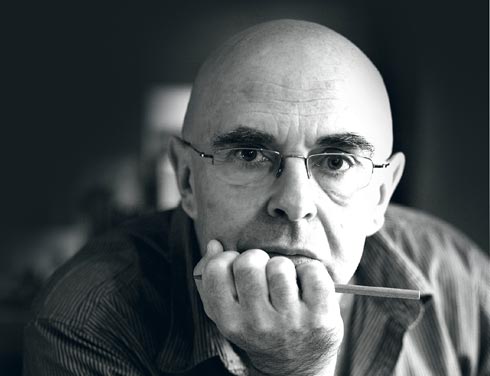
2010 will be held under the sign of Anton Pavlovich Chekhov. January 29 marks the 150th anniversary of the birth of a great writer, who largely determined the development of world culture of the twentieth century. At the end of January in Moscow, days will take place
A.P. Chekhov, in which new Chekhov theatrical productions will be shown. The Hermitage Theater prepared for the anniversary the performance “Secret Notes of the Privy Advisor” based on the Chekhov story “Boring History”. About the prose of Chekhov and the modern theater The New Times talked with the chief director of the Hermitage Mikhail Levitin
You once said that you do not like Chekhov, why did you decide to put this performance? I talked about Chekhov's plays. And not that I do not like, but I do not want to proceed with them. I realized that even if I solve some mystical secret of Chekhov’s plays, all the same, a great artist should play every role in them. The directorial searches do not fundamentally solve anything. The fact that we have directed by Chekhov’s plays endlessly demonstrating the directorial concepts, repels me. I am not so much drama as I do not digest the Chekhov Theater. And Chekhov’s prose is one of the most important in life for me. And Chekhov himself is more important than important, it was all that the writer and man should possess. He causes a desire to endlessly listen to him, to delve into him.
So you decided to put prose?
“Boring History” is one of my favorite works. I consider him the main story of Chekhov. Although, perhaps, he would have made him a little differently if he wrote later, when he himself had already encountered the disease and related feelings. And the dying thoughts of a mature or old man, as his hero, maybe it would be even deeper, even more difficult ... But I had enough complexity that was written by Chekhov at 29 years old.
Coincided with the classic
You invited an extraneous star to this performance - the actor of the Mayakovsky Theater Mikhail Filippov.
I invited not an extraneous star, but the most important artist of this theater. We have been familiar from youth when I met him in the studio "Our House" Rozovsky, him and Filippenko.
Filippenko played Sancho Pansa, and Filippov was Don Quixote. The studio was closed, we did not have time to release the performance. But then another studio arose, which included Leah Akhedzhakova, Sveta Bragarnik, Vanya Dykhovichny, Seva Abdulov, Misha Yanushkevich, Olya Ostroumova ... and we made the “whims of Marianne”. Filippov told me all now, because I, to my surprise, was very forgetting to my life. Mikhail and I were still in the studio at the Kurchatov Institute, then I had a Buffonada studio, where, by the way, Marietta Chudakova went. And I did two more performances with Filippov on television, and he played in my “Alice in the behind -the -ry” ... Filippov artist, whom I would like to be.
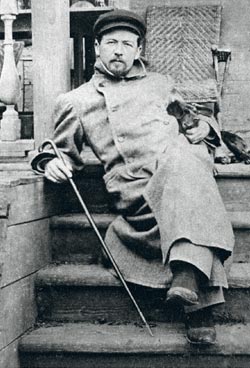 |
| Chekhov himself is more important than important, it was all that the writer and man should have |
It seems that the performance that you staged, according to thoughts about life, is largely autobiographical ...
I always shrugged deep, generalizing thoughts, the theater is a living, simple and concrete business ... Well, it really turned out that we are the peers of the hero of Chekhov, that we have a lot in common in fate. At least we are able to understand what he is talking about, and the performance in this sense, of course, is about ourselves too. There was no such task, but it happened.
But then in all your works, starting with Harms, Olesha and so on ...
... A lot of me. Not even me, but unwritten to me, or inconsistent, or do you can happen to me - as if the embodiment of incredible desires.
In frivolous performances, I simply realize my dream to become a clown. When I did not become them, there was no profession - I realize this dream in productions. And here suddenly we were talking about old age, about love, about the family - and all this coincided with the breath of Mishin, and with mine, and with Chekhov ... there is a cult execution of this story by Boris Babochkin on television. This is just an incredible story. I once talked with Oleg Nikolayevich Efremov, and he said: “Yes, you know, this is the best of acting. The best that I saw in my life is a “boring story” performed by Babochkin, then I learned to play this performance! ” Then I realized that I coincided with a certain type of actor and man, with the male type. Filippov is like that. It works very clear, accurate technical means so that the intentions are clear. This is important, I do not want to give anyone the opportunity to interpret.
Did you like any of the Chekhov performances you see?
No, never, not one! Even the old Mkhatov performance "Three Sisters", the same. But I already saw him at the end, although anyway, he also played mushrooms in him, in my opinion, played Tarasov, but all this was already old people. At the same time, when you watch Ostrovsky’s “hot heart”, where such powerful characteristic roles, you understand the beauty and power of the performance. And on Chekhov - no! You understand that there is prose, prose, prose, which must be pronounced to good, powerful artists. That's all. In general, Chekhov annoyed the art theater, annoyed Stanislavsky, annoyed the directing. And I understand him perfectly: well, a good artist comes out, like Artem, * * Alexander Rodionovich Artyom (the real surname is Artemyev; 1842–1914) was a favorite actor A.P. Chekhov, who wrote specially for him the role of Chebutykin and Firsa. For example, the text says well, what else is needed?!
"Life" questions
What is the main thing for you in Chekhov?
We are talking very often about the preaching of literature, its visual power and less often - about the personality standing behind this literature. We look for disgrace in the biography. And such books began to appear about Chekhov, here the fat English volume came out (Donald Reifield. “The Life of Anton Chekhov.” - The New Times), where disgrace is written about Chekhov - how many women and with whom, but when. Chekhov, even in the stories, has few household details, he has a powerful moral impulse, not a head, not intellectual, not public. He is accused: what kind of writer it is if he does not answer life questions. Well, what questions can a person answer? To the questions of another person? Yes, never in life. He may ask him: why are you doing this? Or: Do you think you're right, having committed it? But to say: you are wrong, you shouldn't have done this! - This is excluded ... That's why I love him.
Chekhov has no complexes about what he did. All vanity, all kinds of bacchanalia are excluded. And what is a writer without complexes according to the current concepts? We believe that the writer must describe exclusively his complexes. We are so interested in the complexes of another! There is nothing more to do, how to be interested in other people's complexes ...
Theater in the center of the world
The Hermitage Theater turned fifty years old. Are you sure of his future?
Always not sure. Our theater of those whose life is entirely dependent on the artistic director, that is, on me. If so, then this is shaky.
Are you to blame for this?
No, it was and will always be, that’s normal.
That is, the Taganka Theater depends on Lyubimov ...
Fully! Fomenkovsky-from Fomenko ... In principle, I must tell you, a person dies-the language of the theater dies, the method dies, the students do not understand anything in the end or understand in their own way and must create theiraters. The theater is such a personal individual business ... Absolutely.
Where is the Hermitage on a modern theater map?
I am convinced that every powerfully working director must consider himself a center. If you do not have the feeling that you are in the center and the world solves issues through you, and people address the main questions to you, then there will be nothing - neither the theater nor art.
Altruism is impossible artist. Therefore, I have the feeling that the Hermitage Theater occupies the main place. Another thing is that several more theaters occupy the same place.
Carnival for life
You always declare that you are interested not so much the absurd theater as - a carnival ... What is the meaning of a carnival?
Only one thing is to be happy. I am now dissatisfied with myself, because sometimes I stop being happy. This did not happen to me before. I had a happiest childhood. The best parents in the world, the best friends in the world, the best city of Odessa in the world. It seemed to me that this was enough for me for a very long time. But now I am exhausting this feeling.
The carnival is still one day, well, three days, then there is what remains - dust.
But Harms is not a carnival for three days, it is for life.
I'm talking about the explosion of happiness, fun ... incredible frivolity. - frivolity - such invaluable metal as to get it? People call it either a musical or a roar, but they make a genre, but I do not make a genre, but a worldview. What is this form - "dimensionless tango"? Go understand. Look at the “capnist there and back” - what is it? And the viewer is happy, the viewer yells, there is laughter in the hall. I know how he achieved it in the final: the performance ended, but there will be one point that will hold everything and the viewer will not leave, he will die with laughter ... Now there is less and less joy, probably, this is age. There is a lot about this in the "Secret Notes of the Privy Counselor." Age, struggle with oneself. After all, he is also dissatisfied with himself, our hero. How he is unhappy with what he thinks about it, and not about love!
But the hero of your performance is an egocentric, an egoist. He does not see either his wife or daughter ... Yes, he sees! But he sees differently, through the prism of old age, through the prism of what happened to him. Somehow Misha and I said one exact phrase: "It's not that we will die, but with what and how they will be left without us?"
You, apparently, love things like drafts, sketches ...
Adore!
And they simply inserted quotes from the “Seagull” into the performance of Chekhov.
On this stage was the Chekhov "Seagull" once. I am glad that she walked here that the mise -en -scene of dinner naively repeats the famous scene from the Moscow Art Theater, when they talk, sitting with their backs to the audience, although I have a different game. I quote with pleasure. The tradition for me is the “hand of God”, as Maradona said. She leads me all the time ...
Mikhail Levitin
The artistic director of the Moscow Theater "Hermitage". The first in the USSR staged performances on the works of the Harms-contest poets! Charms! Shardam! or the school of clowns ”(according to D. Harms, 1982),“ Evening in a crazy house ”(according to A. Vvedensky, N. Oleinikov and N. Zabolotsky, 1989),“ Circle, possibly God ”(according to A. Vvedensky, 1994). The author of the books “Alien performance?”, “Bolero”, “My Friend believes”, “Continuous indecency”, “Jewish God in Paris”, “Brother and Blagodest”, “I was not”, “School of clowns”, “Bach bang”, “False-seeker”, “Bohemian trilogy”, the novel-biography of “Tairov” (ZhZL).Days of A.P. Chekhov in Moscow January 26–31, 2010
"Wedding", director Vladimir
Pankov. National Academic Theater. Y. Kupala.
"Uncle Vanya", the production and scenography of Andrei Konchalovsky.
State Academic Theater. Moss council.
“Secret Notes of the Privy Advisor”, the play and production of People's Artist of Russia Mikhail Levitin. Moscow Theater "Hermitage".
"Essay on the occasion", director of Dmitry Chernyakov. International Theater Festival named after A.P. Chekhov.
The Cherry Orchard, the script and production of Mark Zakharov, director Igor Fokin. Theater Lenkom.
"Ivanov", director of Yuri Butusov. Moscow Art Theater. A.P. Chekhov.
"Tararabumbia", director of Dmitry Krymov. Moscow theater "School of Dramatic Art" (Russia).
“Donka” (“Message to Chekhov”), author and director Daniela Finzi Pask. Theater Sunil (Lugano, Switzerland).
"Three years", director of Sergei Zhenovach. Theater art studio. "Three sisters", director of Yuri Pogrebnichko. Theater "Near the House of Stanislavsky."
"Uncle Vanya", the production of Rimas Tuminas. Theater named after Evg. Vakhtangov.
“I, a seagull”, director Akop Kazanchyan. Moscow Drama Theater of the P/r Arman Dzhigarkhanyan.