
Translated material
Memory of Jerome D. Salinger
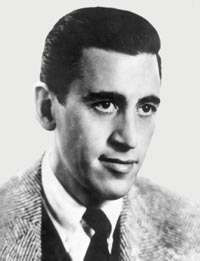
One of the idols of the generation of the 60s, the author of the religious novel “Over the abyss in rye”, Jerome D. Salinger, died in his home in the American state of New Hampshire. He lived a long life - 92 years old. He survived in the war, knew love and success, saw the multimillion -dollar circulations of his books. But was it happy - only he knows
Julia Bolomlinskaya
Who is he, our hero, Jerome di Salinger? Originally from what land? Where is his "land"?
Father is a German Jew. From shopkeepers. From sausages. Successful meat trade brought him as a result not somewhere, but to New York, to the Avenue Park. To the place of compact residence of a rich white Protestant America. In the area where the family settled, there were no colored color at all. And there were almost no Jews. But if there is money to send your son to an expensive school - you send it, for example, to Macberney's secondary school, "a private educational institution belonging to the Association of Young Christians." The next year after entering this school, Salinger is held by Bar-Mitsva-a solemn entry into the thirteen-year-old age in the Jewish rite. And a year later, the boy first learns that his mother Irish, who accepted Judaism for marriage with his father. That is, he is a semi -Rulery. To be an Irish or Italian in the then, still pre-war New York was a little better than a Jew or a black man. For the Avenue Park-the “second variety”.
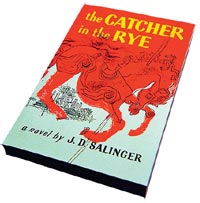 |
| The novel “Above the Rye” was released in 1951 and became a kind of hippie generation manifesto |
America of the thirties is the heyday of all types of racism. He is a handsome guy, tall and with a white -toothed, quite a Hollywood smile, nevertheless he felt like an outcast. Stranger. At the same time, parents dream of his admission to one of the universities of the Poyshch League. Salinger hated this world-the world of Park Avenue and the "ivy" universities. And before that, the world of English private schools closed. At the end of the tenth grade, fifteen-year-old Jerome Dee moves to Valley Ford, a military school of Pennsylvania. This purely white closed school was another attempt by a boy to integrate on Wednesday of the Anglo -Saxon “indigenous population”. And it was this school that became a partial prototype of the Pension school in “Over the abyss in rye”. The problems that the young Salinger had to face there to the story there.
At the end of Welly-Ford, Salinger enters the University of New York. But after the first course, he unexpectedly leaves from there and is arranged by the mass-stall on a cruise ship. Having returned, he, despite all his hostility to the Poyshch League, is signed up for a writer's seminar in the “Painy” University of Columbia. He has already decided to become a writer and considers such a seminar necessary. And at this time-the first publication: the story "Teenagers" is published in the New York magazine "Story".
Salinger begins to print: they take the story “New Yorkker” and a couple of famous magazines. Salinger's early stories are all about the same snobbery, about misunderstanding, about loneliness, about a person who is difficult to fit into the environment. And of course, about pretty women who came across in the way of this lonely and incomprehensible person. We do not know how he would become if he had remained there: on the Avenue Park, in the cozy audiences of Columbia. But then he, according to the apt expression of Marina Tsvetaeva, "grabbed fate by the hair." In the spring of 1942, Salinger was drafted into the army. Jerome Di ratded in the Second World War. So, Private Salinger, twenty -three years old. Under the number 32325299 ...
He ends the courses and becomes a signalman. Then he gives a petition to the school of military translators and counterintelligence. Then he is sent to England, where he undergoes special preparation of a counterintelligence agent before the decisive day of the landing of the allied troops. About this time - the story “Dear Esme ...”, his hero Sergeant X - this is the author himself. Salinger describes the “landing” itself in his other military stories. The American headquarters Salinger landed on the “hospitable” European coast in July 44, consisting of the fourth division of the twelfth infantry regiment. He was lucky to survive. In the first month of fighting, the twelfth infantry lost 76% of officers and 63% of the ordinary. These figures say what war went to Salinger. In the infantry. In hand -to -hand combat.
At the end of August, the twelfth infantry entered Paris. There, in Paris, the headquarters of Salinger meets Ernest Hemingway. Then the regiment goes with battles through France and Belgium to Germany. For a month of fighting in the Gyurtgen forest, one and a half thousand people die, but about the same amount just freeze in the trenches full of ice water - without winter shoes, without warm overcoats, without blankets ... And this is the end of the forty -fourth. This winter, in trenches with ice water, Sergeant Salinger writes poetry. And he sends them to the New Yorker magazine poetry department. And then the surviving Salinger enters the hospital with an interesting diagnosis: "Combat overwork." It sounds quite political correctly. But translated into human language means - "I went a roof and thundered in a fool." They are going to demobilize it. But the Salinger rushes back into service, and as a result he is prescribed. Judging by the story "Dear Esme ...", all in the same "reduced" state.
Salinger returned from the Second World War a man of a little crazy. A person who is in need of help and psychological rehabilitation. And this is clearly visible to everyone around him. But then the second part of this drama begins. The heroes of Salinger are returning to the world of a successful large New York. There was no war in the world where, in essence, there was no war. Where she was not noticed. In a world where others, of course, is clear that this guy is a psycho, and why he is a psycho, why he is a psycho is incomprehensible. Around him was the world completely alien and completely indifferent to what he experienced. Then he can only repeat the act of Simora Glass and leave this life, from people who do not understand him. And Salinger is leaving. Not out of life, but from people. At first, he still hopes to find himself a “fellow countryman”. Salinger marries the most pretty girl who caught his eye. As always, in this case, he is sure that he will marry love. Then he drags this dove into the thicket of the forest. In an old empty house without hot water and heating. And there are already two children. Here are the very ones that Holden Caulfield dreams of. Take the children and catch them over the abyss in rye ...
Claire Douglas, a lovely butterfly, caught by Salinger into a net and transferred to him with the same park Avenue to the deaf forest of Vermont, did not make his life with two children and without hot water. The family fell apart. And then Salinger begins to live in his forest alone. Margaret Salinger in a book about his father writes that even with their life together, he managed to dive into all kinds of cults, beliefs and various kinds of Izma. Zen-Buddhism, Vedanta, Kriya Yoga, “Christian science”, cetology, homeopathy, acupuncture, macrobiotics ... This is all the family before the divorce.
Eight years after the divorce from Claire Douglas, another woman appears in his life, an 18-year-old student of the Yale University literary program Joyce Maynard. Salinger at that time is fifty -four. She withstands next to him not for long. And further, after another twenty lonely years, the 70-year-old Salinger finds the following love: the young nurse Colin. The last marriage of the writer with a very young Medical girl was more successful than the former. It is clear that young Colin decided to live with a great writer to become a nanny, a nurse and a friend. Did he meet in her face, finally, the very “countryman” that he dreamed about all his life?
The essay can be read in full on the website Booknik.ru
White crow named J. D. Salinger
Valeria Novodvorskaya
It was good a seagull named Jonathan Livingston. She could at least fly away. And where can the White Crow fly away? Blacks scold them to death. That's just one white raven named J. D. Salinger flew to where the white crows can hide: to the best world, to the kingdom of the one who himself in his earthly life did not step in his leg.
J. D. Salinger rarely recalled God, but he created the most Christian literature of America: the literature of the defenseless and lonely, who did not have a city of the real, but the exacting hail of the future.
American literature is mainly so ruddy, strong, cheerful, victorious. Heinline, Dreiser, Hemingway, Jack London, Bret Gart, Faulkner, Mark Twain ... Heroes “make life”, finding treasures and gold veins, fighting the right (or even for the wrong, like a Hero of Faulkner) The case is to the last drop of blood. Yes, these people who do not know how to reflect and hesitate the heroes created the power and wealth of America. But the right and the most legal state needs dissidents, they need disagreed and displeased. The ideologist of these dissatisfied intellectuals of America was Salinger.
 |
| The writer's recluse filed interest in him: Slinger's letters to Joyce Maynard at the Sotbis auction in New York were sold for $ 1,50,000 |
His heroes do not see the point in publicity, success, career, they always dig to the point, restless and ridiculed. If they have something well for them, then only a banank fish is on the verge of suicide. Instead of hastily praying to God and fleeing their earthly affairs, they either break their lives by repeating the mantras from an accidentally found foreign book, or even see the future and die at an early age in a concrete pool without water, without trying to change their fate known, because they also do not value life either.
The chief dissident of America Holden Collfield from “Above Rye” is able to obscure his expensive suitcases, because the neighbor has cheap ones, and understand that his talented brother D. B., who wrote well, “tricked” completely, working in Hollywood for money to buy a “jaguar”. This teenager will not make a career, he does not accept the falsehood of the establishment, and in general he throws everything that he is not interested in. Learn for marks, work for salaries ... continuous Czechs among a clear and correct American reality. He wants to save children over the abyss in rye, and where in America there are so many ownerless children, where is rye and where the abyss? There is no such specialty in the USA, and teachers teach things useful in life. Which Holden himself did not want to study. From Holden to hippies and soldiers who threw their orders for Vietnam for the fence of a White House - a stone's throw. “Flowers are better than bullets” - this is the starting point of protest of anti -American. Make Love, Not War! -Holden will certainly say this in the 60s. For the suffering and non -conformist intelligentsia of the USSR, American literature became a compass and a sail. At first, Ham took everyone away in sweaters with a beard and a guitar to the forest and to the mountains, to the tour, in the KSP. His covenant: “Fight to the last drop of blood” - was too cool for our intelligentsia. And after the Salinger led the non -conformists to the Dangornitsky and boiler rooms, if only not to the seizures at the cost of joining the CPSU.
Salinger lived up to the day when disagreed America had accumulated strength and sent a reader and a follower to the White House, uniting non -conformists Barack Obama to the White House. Well, in Russia, in Russia, in Cuba, Venezuela, North Korea, China and Iran, confused children roam and strive to jump into the abyss of totalitarianism. Let's see if the students of Holden Collda will be able to catch us.