
Translated material
Doubtful organs
Russia is included in the five countries where most deliberate murders are committed
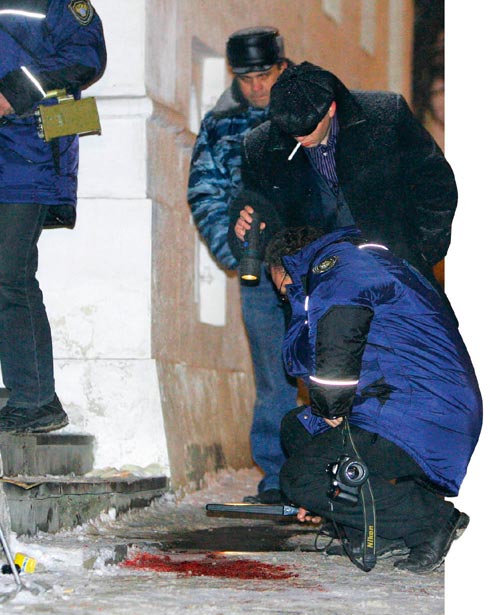
The numbers do not lie: Russia is part of the five countries where the most deliberate murders are committed. The situation is worse only in Colombia, South Africa, Yamaika and Venezuela. Corruption and inefficiency of the law enforcement system, as the studies show, is one of the main reasons. What are our chances to rise from the bottom or at least not to slide even lower - I found out The New Times
The state, as an institute, is actually not many responsibilities. Take care of the blue and wretched. To establish such rules in the country so that there are fewer poor, and more able to do without social crutches - more: sharp social stratification as in Russia and other countries of the sad five, when, on the one hand, 2% super -boggy, in the middle - the abyss, and below - mass poverty, another most important reason for the growth of crime. Finally, the third function of the state is to ensure social security. For buying individual protection against crime, even if there are millions (all the more so - if they are not), it is almost impossible: no security will stop the hired killer. And if it is also known that they will not catch, they will not condemn, and if they catch, then you can pay off?
Price
However, in addition to the prospect of being killed or robbed, a bad law enforcement system is also a very expensive pleasure for both the state budget and taxpayers filling it. Crime growing upwards is additional costs for police, investigators, prisons, camps, vertukhaev and prickly wire, which are calculated by billions of dollars (for the United States, for example, this is 2.1% of GDP annually). This is the loss of the able -bodied population: instead of creating surplus value, hundreds of thousands of people learn to sew mittens in camps. The average age of the killers in Russia is 37 years, the rapists - 31 sitting for robbery - 28.
* * Data from a joint study of the University of Chicago and the Moscow Research Institute of Health, based on the study of the Russian prison and camp population in 1999. This is the low life expectancy again among the most able -bodied part of society: the risk of being killed on the streets and in the entrances of the Fatherland is especially high among men aged 30–55 years. And this, in turn, affects the economy: in Latin America, for example, the costs with this are exposed in annual losses for the continent from 7 to 13% of their total GDP, and in a single Colombia, which leads in terms of crime on the continent, is almost 10%.
* All numbers in Latin America: Rodrigo R. Soares, Joana Naritomi: “Understanding High Crime Rates in Latin America. The Role of Social and Policy Factors, 2007. In other words, the poor become even poorer and replenish the ranks of crime, and the wealthy incurred they have additional expenses in order to protect themselves from them: in Brazil, where the mortality rate from violence is lower than in Russia (34.4 by 100 thousand people against 49.9 in the Fatherland), more than half of managers and more than half of managers and managers) Company owners called crime the main limiter for the development of their business.
Reform in bulk and retail
In other words, the reform of the Russian law enforcement system, which today is discussed more and more behind closed doors and those who are personally interested in it significantly less (FSO, armored vehicles, closed villages guarded by special forces) than ordinary Russian citizens are a gloomy problem for each of us.
But whether it will happen is a big question. Meanwhile, the experience of countries such as Colombia or Brazil (not to mention Georgia close to us), where the level of corruption comparable to Russia, but, however, democracy and more freedoms shows that the joint efforts of the authorities and society in this direction bring relatively imminent and very tangible results. So, in the Bogot, the capital of Colombia-after 10 years since the beginning of the reform (1994), the number of deliberate murders decreased by 4 times, in San Paulo (Brazil) over 6 years-by 79%.
* And on December 7, 2007, there was a holiday in the capital of Brazil: for the first time in 50 years, not a single murder happened in a day. Chances
Mark Galeotti, professor of New York University and author of the book “Organized Crime in Russia and in the post-Soviet space”, does not experience much optimism about the prospects of law enforcement reform in Russia. From his point of view, three main reasons are hindered by this: the use of law enforcement and police primarily for political purposes, corruption, lack of resources that the state is ready to spent on reform.

“The Kremlin is not interested in any serious reform of the police that would turn it into an effective and subordinate to the law,” he said. - The loyalty of police officers to the authorities of all levels - from the Kremlin to municipalities - is much more important for them more important than professionalism. It is no accident that the number of riot police, which is actively used to suppress street protest, is constantly growing: if in 2003 there were 98 such divisions, then in 2007-already 121, which have more than 20 thousand fighters in the country. ” The professor also notes that in December 2009 the reduction in the number of internal troops of the Ministry of Internal Affairs, which are also primarily intended to suppress unrest and protests among the population (from 184 thousand to 170 thousand), firstly, only 7.6%, and secondly, it will not happen at all soon-when “either the shah Permret, or the ishak will die”. As for promises to reduce the number of the Ministry of Internal Affairs by 20%, then this is more likely to be sad. Firstly, he claims, the problem is not in the number of police officers-in Russia, in comparison, for example, with Great Britain, they are even less than necessary: in the United Kingdom, one policeman falls on 254 residents, in Russia-one by 101, and in the fact that they are poorly trained, they are not received, they do not have enough technical means and are corrupt to extremely corrupt. Not to mention the fact that the number of cabinet police officers moving in a circle of pieces of paper is running in, but they will be fired last. Galeotti is also echoed by the teacher of the University of Syracuse, the author of the study “State structure and Putin Russia”, Brian Taylor, who was preparing for the publication of the study: “The Russian police,” he believes, “inherited the worst features of the Soviet one: it considers the population more like a threat than people who should serve. In turn, the population does not trust her and is afraid: that is why so many crimes are not even registered. ” Taylor also believes that the authoritarian regime is little located in this kind of reform. Of course, there is an example of Singapore, but this is a city-state, which also inherited the traditions of the English colonial bureaucracy with its ideas about serving the state and society.
Fish rot from the head
Finally, both professors believe that the fish both rot from the head and it should be cleaned from the head. “The success of the police reform largely depends on three things,” says Galeotti, “the authority and legitimacy of the authorities, primarily the minister, among ordinary employees, and Nurgaliev, obviously, does not possess such authority; the persistent desire of the country's leaders to carry out such a reform, but it seems that the views of Putin and Medvedev do not coincide in this matter; Finally, serious efforts and resources in order to cleanse the police of dirt, and this is impossible without going to the measures unpopular among officers: to dismiss the old ones, to train and gain new ones. ” That is, to do what was done by Mikhail Saakashvili in Georgia. “If Russia really wants to change something in the Ministry of Internal Affairs, then you need to remove the person who stood at the head of the department for the last years-this will be a signal and everything else,” Taylor believes. American professors, of course, are not a decree. But exactly the same New Times was also said by ordinary police officers.
Here, for example,: “Firstly, the policeman top must be removed-they are all tied, appoint those who are beneficial. They pull their own guarantee, parents are preparing places for their children. It is necessary to appoint chiefs on a competitive basis, so that professionals are headed by the system, ” - Vadim Smirnov, a former traffic police inspector of the Central District of Moscow.
Or here: “The reduction of the police should not begin with operas, district police officers and other employees working on Earth. While we have a personal secretary with the rank of lieutenant in the UVD ATD. Each department has “dead souls” - athletes, all kinds of inspectors. We must start with them. In this case, it is necessary to increase the number of posts that really monitor the order, and increase the number of precinct. Forbid to take people without an army or higher education in order to cut off the kids of the bosses, ”-Sergey Suslov, sergeant of the patrol service.
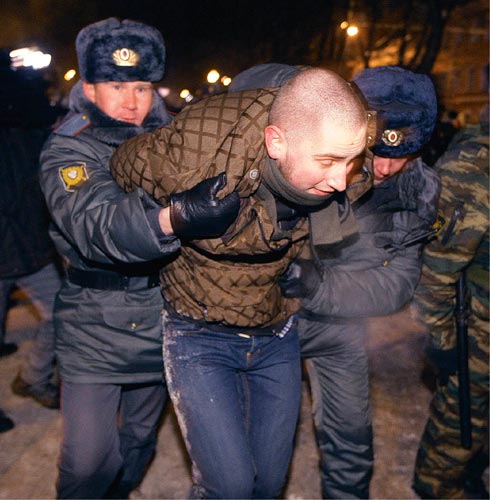
The police consider the population more like a threat than as people who should
serve
And one more thing: “In the last place of my work, in one of the Moscow police department, in 2008 a new boss came, completely inadequate. He so forced to increase the disclosure that the detectives, the opera walked and slipped grenades, grenade launchers, pistols, drugs, and the cartridges of handfuls and homeless people then put him in prison, ” - Alexey, an ensign, and an employee of non -departmental security.
“An effective police is when a society trusts law enforcement officers, and people in their form to their fellow citizens. In Russia, the Ministry of Internal Affairs is an institution of control over the population, not its defender. Until this situation will change, there will be no results, ”Mark Galeotti, professor of New York University of the United States ...