
Translated material
The duty of the homeland
Russia is returning to the external borrowing market: this year, the Ministry of Finance is going to occupy $ 17.8 billion on the world markets to finance the budget deficit. In subsequent years, the volume of borrowing will increase even more. Independent experts warn about the danger of such a policy in the presence of large corporate debts. Indeed, in each large holding there is a share of the state, and in the case of default on corporate debts, not only the oligarchs, but also the state budget will have to pay. The risks evaluated The New Times
Russia met a crisis, possessing a colossal corporate debt. As of July 1, 2008, its size amounted to $ 527.1 billion (of which $ 295.5 billion accounted for companies, the rest was banks). During the “fat years”, domestic business is so accustomed to developing in debt that he has lost a sense of proportion: the total size of borrowings of Russian companies since 2002 has increased by 12 times. True, at the same time, Russia was just as actively reducing its sovereign duty. A few days ago, the Minister of Finance Alexei Kudrin cited the following figures: after the 1998 default, our public debt was 140% of GDP, and by the end of 2009-only 8%. At the same time, the security level Kudrin called the debt size of 60% of GDP - exactly this is now with the United States.
However, the Minister of Finance did not say a word about Russian corporate debts. Meanwhile, it is no secret that the share of state participation in the capital of large Russian corporations and banks is very high - from 40% to 70%. And according to the strict rules of the global financial market, the owner is obliged to respond to debts. The Russian authorities are too memorable by the judicial scandals with Noga, * * In 1997, the Swiss company Noga filed a number of claims against the Government of the Russian Federation in international courts. She demanded a return of $ 800 million on credit agreements signed in 1991-1992. As a result of a protracted trial, Noga managed to win several ships. However, the Government of the Russian Federation refused to pay. After that, the arrest of property belonging to Russia began. In 2006, the owner of the American IPD Capital company, Alexander Kogan, bought the debt of the Russian Federation for $ 70 million and immediately resold it to the Russian Ministry of Finance. To allow this again - and even on a much larger scale.
I would live
And the threat was. As a result of the devaluation of the ruble in late 2008-early 2009, all currency debts of corporations overnight became 30% more expensive in ruble equivalent. In addition, access to the global capital market (where these debts could be re -re -bets, albeit at a large rate), for Russian companies, it was closed for almost a year. There was no guilt in this: due to the financial crisis and the universal distrust of investors to each other, the world capital market simply got up to each other-the volume of transactions on it for a year decreased by 200 times.
In a critical situation, the authorities made a number of operational decisions to allocate a loan in the amount of up to $ 50 billion to pay off debt to foreign companies through Vnesheconombank. At the end of 2009, Prime Minister Vladimir Putin reported to the State Duma to eliminate the threat of mass corporate defaults: “In recent months, Russian companies have largely paid or structured their debts for $ 174 billion. The state has not borrowed any obligations on corporate debts. The Government of the Russian Federation, providing assistance to Russian companies in repaying corporate debts, ensured the return of strategic assets laid down from the West to Russia. If companies cannot pay off, the penalties will be turned to these assets, but they will remain in Russia. ”
The problem, however, is that there are still a lot of “non -strategic” assets of Russian corporations in foreign financial institutions. And the state cannot support the business to infinity, especially in the conditions of a scarce budget and by no means bottomless reserve funds. Today, the Russian government is not up to help its corporations - it itself is forced to resort to external borrowings. This was stated in early February Alexei Kudrin: “In the near future, Russia can release the Eurobonds and begin to attract borrowed funds. Russia will increase the amount of debt of 2-3% of GDP per year. ”
Salvation in IPO
In such a situation, large business began to look for options on how to get out of debts on their own. Back in mid -2009, Russian companies took up the placement of foreign currency bonds and the re -exposure of debts in foreign banks. However, the rates on these placements and loans were quite high, * * On April 17, 2009, Gazprom posted currency bonds, Eurobonds, $ 2.25 billion at 9.25% per annum for 10 years. On June 30, Lukoil managed to attract a syndicated loan from the club of French banks for $ 1 billion at a rate of about 9% per annum. that in the face of a slow exit of the economy from the crisis, it is fraught with great troubles for companies. After all, if the industry - even oil or gas - is globally growing by 3-4% per year, and the corresponding company takes a loan or places bonds under 9% per annum, then this is nothing more than the path to ruin. Because such a loan is simply impossible to pay from current profit.
Therefore, domestic companies turned to alternative capital sources, in particular, IPO. Oleg Deripaska, who had big problems with the debt of Rusal, dared to go to the public placement of shares. * * The Rusala IPO procedure ended in Hong Kong on January 25, the total revenue of the company amounted to $ 2.24 billion. At the same time, Rusala debts are estimated at $ 16 billion. The company was preparing for the placement for a very long time and carefully. But the result still turned out, to put it mildly, ambiguous. On the first day of trading after an IPO, January 27, 2010, the company's shares on the Hong Kong Stock Exchange fell by 10.6%. The placement of global depository receipts (GDR) “Rusal” on the EURONEXT exchange in Paris also turned out unsuccessful. To close the bidding, the Rusala receipt was quoted at € 17.65, which is 11.4% lower than the cost price? 19.91.
Among the reasons for such a sharp fall, experts call the fears of international investors regarding just a high external debt of the company. The chairman of the Board of Directors of Rusala, Viktor Vekselberg, answered the skeptics that he does not see “there is nothing wrong with the trading results,” promising that “in the future the company’s shares will be located on the Russian Exchange.”
Reckoning time
Be that as it may, Russian companies continue to experience acute need for capital: after all, the debt also needs to be served, that is, interest on it. In 2008 and 2009, domestic corporations began to negotiate with lenders about delay and restructuring, since the crisis of everyone made accommodating. In the second half of 2009, Russian companies were supposed to pay about $ 49 billion on interest and payments of the main debt. The transactions were non-public, but the total corporate debt was not only reduced for the end of the half of the year, but even grew up: the companies managed to increase it by $ 6 billion. On the other hand, the absence of angry creditors with courtses indicates that there were still some agreements that there were still some agreements. reached. 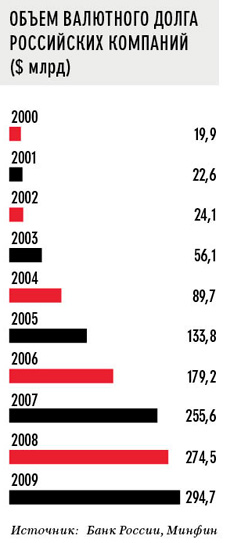
Nevertheless, today, according to Merrill Lynch, the total external debt of Russia - the corporate plus sovereign - exceeds $ 540 billion, and the volume of international reserves - less than $ 440 billion. That is, in the case of a certain hypothetical situation, the simultaneous presentation of all debts to pay the “pillow of safety” will not save. If we talk about the threats of more real ones, then, according to the calculations of the head of the analytical department of the BCS investment company Maxim Shein, this year it will be necessary to pay about $ 26 billion this year, and companies about $ 50 billion against their debts. The chief economist of Troika Dialog, Yevgeny Gavrilenkov, believes that they will cope with this: “In the conditions of the crisis, when the economy is falling, corporate debt really became a heavy burden. But now there is a hope that the economy will begin to get out of the recession and begin to grow again. This should remove the acuteness of the problem. ”
In any case, Russian companies will not be able to delay debts on debts to infinity. And the longer the reckoning process is delayed, the slower the domestic economy will go out of the crisis. Because the current profit of corporations will not be directed to investment and not even for consumption in the domestic market, but for paying debts. In this case, the danger of corporate defaults remains. And then the state will have to pay as a major owner. That is, ultimately, a blow may come to ordinary taxpayers.