
Translated material
Take Berlin!
Discoveries and disappointments of Berlinale
The anniversary 60th Berlin Film Festival, held from February 11 to 21, in unofficial rating-No. 2 in the world after Cannes. For the first time in the last five years, the Russian film was presented in his main competitive program - “How I spent this summer” by Alexei Popogrebsky. The best paintings by Berlinal traveled the New Times The festival was amazed to be solid. Why amazement? Because the usual claim to Berlinale (as the festival calls itself) is its politicization. For the Cannes festival, the most important films. That is the art of cinema. For Berlin, the political or social topic is relevant in the first place. In second place is also a topic. And on the third - the topic. And the movie is only in fourth place. But in his anniversary year, Berlinal managed to collect paintings that are interesting and inveterate moviegoers.
The crisis, oddly enough, almost did not hit Berlinal, although he rumbled over Berlin as a city. The fact that now the crisis could be judged by the Berlin Carnival. He, by chance, coincides with the festival, takes place in the center of the former West Berlin, in the Zoo area - Kadewe (who knows, he understands) and lies in the fact that auto platforms with discharged people who throw chocolate into an enthusiastic crowd on the sidewalks, and all with enthusiasm are rolled up “Shlissen-niht Shissen-Boule-Bul-a-yai-yai-yai-Vurden-Burgurden-Fassborder-Bai-Bai!” Previously, a similar nightmare lasted six hours. Now - only two hours. 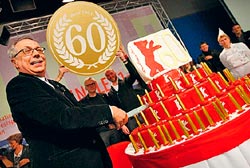
Blue car
Scolding Berlinal for the obvious fact that the theme of the film is more important than artistic quality for him, we lose sight of an important circumstance: Berlinale is better than any media to understand what exactly concerns liberal Europe today. Berlinale is a litmus paper of European liberalism.
Of course, the festival has its distortions. The problem of non -traditional sexual orientation excites him like no other. Almost no doubt it can be argued that any Russian director and producer guarantees a place of honor in the Berlinal program if he removes the film “On the topic”, which will become a candidate for the authoritative Teddy Award (the traditional Berlinale Prize awarded by the jury of sexuals). The honorary right to open this year the second most important (after the competitive) Berlin program “Panorama” was granted by the picture “Veselchaki” by the unknown film world by Felix Mikhailov, who, by the standards of the art of cinema, is a pure misunderstanding. This is an amateurish cabbage, albeit with the participation of Renata Litvinova and Ingeborg Dapkunaite in passing roles. This is such a provincial KVN. But the Berlin festival does not just show such a film, but serves as an event. Why? And because about transvestites. Damn them, let them live. But Nikolai Nikitin! The selector of the Berlin festival in Eastern Europe! Can't you find a better movie in Russia?
So. We were demolished to the side of the road. Let's get back to the topics. Here are the topics of the 2010 Berlin festival. • Parents and children. Responsibility of parents. Separately, the responsibility of men.
• The nastiness of patriotism converting to militarism. The meaninglessness and ugliness of the wars are external, that civilian.
• brainwashing and personality suppression.
• Prison and Sum.
• Muslims. Islamization of Europe.
• Personal protest, sometimes taking ugly, and sometimes bizarre forms.
• PSTO. Paranoia.
•Crime. Murder is a separate topic.
• betrayal (a special topic - what exactly is betrayal). 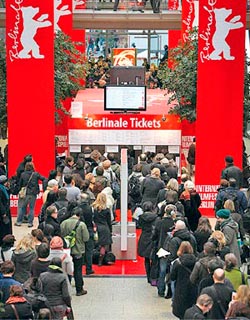
The set is curious. Some conclusions to which Berlin films were brought are directly paradoxical. Like you, for example, are:
• It is better to be an alcoholic than a faithful Muslim, or
• Better to be crazy than normal, because the real world is nightmare?
Progrebsky rating
Surprisingly, two days before the results of the festival, on the morning of Friday, when this text was given to print, the film No. 1 of Berlinale-2010, according to the polls of critics from different countries, daily conducted by the British magazine Screen International, our film directed by Alexei Popogobreksky and producer Borisevich’s producer “How I spent it as I spent by it. in summer". 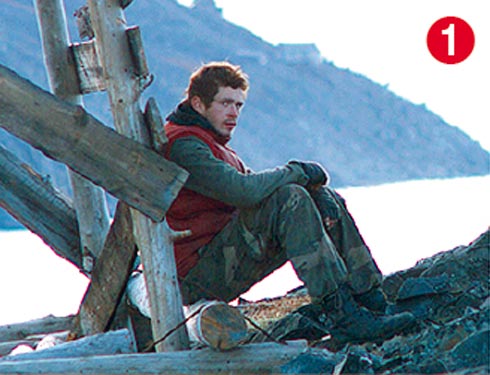

That's the right - you will never guess that it is from ours that the Western audience will like. Moreover, it sometimes gives our films such meanings as their creators did not dream of. It will not be amazing if this film is about the life and the work of two men - an experienced and young - on a weather station cut off from the large land in the Far North will be understood by the Western audience as an actual story about the crisis of post -Soviet technologies. Or as an even more relevant story about environmental pollution, since a certain rocket of the rocket played an important role in the plot plays an important role in the plot.
Meanwhile, this is a film about relationships. About the conflict of ages and experiments: men who are under fifty, and a kid who is slightly over twenty. At first, everything is fine. No grandfather. The senior belongs to the youngest with a light sort of father's irony. The conflict begins when the youngest receives a message that the older family was a disaster and, apparently, died. The younger one does not dare to convey this, and moreover, holds the elder from communication with the great land, gradually by swinging here and there. We can say that this is a film about the stupid inexperience of youth, which does not know how to say the truth, but in addition it has enough idiotic ideas about tact. And in the end, everything only spoils. This thought is expressed in the first half of the film. In the second (especially at the end), such a stub begin and a piercing that it becomes a pity of a destroyed plot. Whether the film took some of the Berlin prizes, the reader today probably already knows. We only note that Berlin refereeing was specific this time. The jury was headed by Werner Herzog, a great, without fools, a director, who fell, however (as usual, as usual over the years of the great), into a light (and possibly heavy) creative insanity. In the festival press, his statements about the modern film process were quoted. Among them were the following: “I believe that the meaning of the festivals is exaggerated. All of them-Cannes, Venetian, Berlin-mean no more than any festival in Burkina-Faso. I believe that prizes are possible only at dog exhibitions. I watched only two paintings in 2009, and both turned out to be so terrifying that I won’t call them better. ”
Well, yes, only to such a person and distribute the Berlin prizes.
The most noticeable Berlinale films
Pictures selected by the author are divided into three groups:
Interesting movie; Interesting, but with reservations; Disappointed
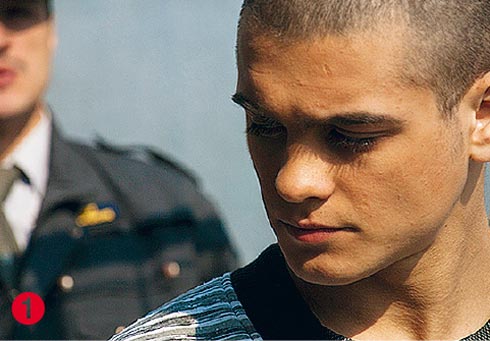
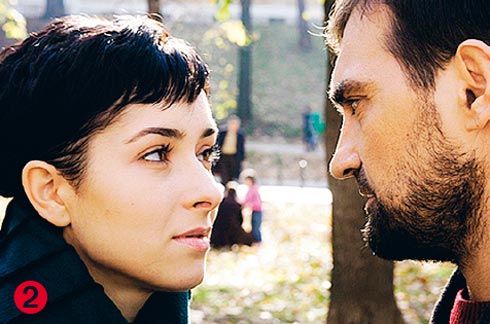
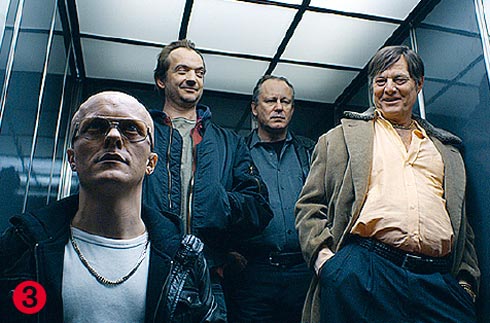
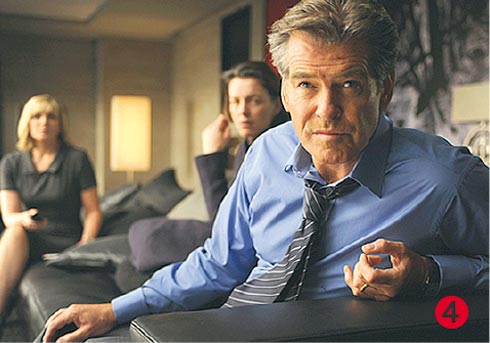
1. “If I want to whistle, then I will populate” 2. “On the way” 3. “A decent man-looking man” 4. “Writer-ghost”
Interesting
He continues to amaze with a hint of a “new wave” of Romanian cinema, from which have been waiting for exclusively shocks for five years. Berlinale was a picture of the debutant of Florin Shcherban, whose name is translated from English as “if I want to whistle, then whistle”, but in fact, it is probably translated somehow idiomatically, such as “like a wolf”. The standards of the "dogma" of Lars von Trier - the extremely documentary image of reality - still make a strong impression. The film of Shcherban fixes the life of the Romanian colony for minors, or rather, the life of an 18-year-old guy, who remains the days before the will, but he is not able to survive them. Because he learns that his mother-stacked, who threw them with his younger brother, suddenly returned from Italy and wants to take the youngest with him. The elder is afraid that for his mother-duck is just a game, that the younger will eventually repeat him, the eldest, a desperate fate. And he goes to the nightmare: he takes a hostage in the colony to call the mother in negotiations. He consciously prepares a second term in order to save his younger brother. The most interesting and sad thing is that we are now retelling the film in a primitive way. It has so many psychological subtleties (for example, in the relationship of the criminal and hostage) that it is not to be conveyed.
Of course, Berlinal shocked the premiere of the film by Roman Polyansky, whose name seems to be translated as “The Ghost Writer), although it is most accurate to translate in Russian as a“ literary black man ”. Polyansky clearly anticipated that he would be imprisoned at the command of American justice, and made a film in advance: this is the anti-American “Fak Y”. The most amazing thing is that this film about the total power of the CIA, about how it controls British prime ministers and unleashes anti-terrorist wars for the sake of weapons, is professionally perfect. Want a sample thriller? Here you have a thriller. Want a thriller with irony? Here you have irony. If Polyansky is imprisoned, this will be a crime not just against the personality, but against art. Because here who does not age a soul. And all his last films - “Ninth Gate”, “Oliver Twist” and even “Pianist” - are wonderful.
The Norwegian film by Hans Peter Muland “A decent man” (a somewhat Gentle Man) about an exit from prison and trying to establish life, which is actually a professional killer, was delighted. This killer is portrayed by one of the best actors of our time Stellan Skarsgard. It is ridiculous how he enters into touch with all the women who harass him from attractive to completely not. The film is not for feminists, but for lovers of the Finnish master Aka Kaurisma. In the Berlin critical behind the film, the film was scolded for the fact that it is too typically Scandinavian. Can you imagine such a watch, where the film is judged by the degree of its Scandinavianness? But the author of these lines will give five rubles and even five euros to the one who will be able to remove such a picture ...
Here is another film, in the assessment of which your author was dispersed - with a backstage discussion - with other Russian critics. The film is a native of Sarajevo Yasmila Zhbanich "On the way" (Na Putu), which is actually logical to translate as a "road to the temple." This girl was already won on Berlinal with the recent film Grbavitsa about the psychological consequences of the Yugoslav wars. And now she made a picture, for which I, sincerely, can be killed. Because this is a film about the Islamization of Europe, about how normal Muslims who have felt like Europeans in the same Bosnia suddenly and these days turn into Wahhabis, who make wives wear a burden. The main character is a Muslim, but a European, understands during the film that she does not want to have a child, because he can comprehend the fate of a Muslim. Strong, yes? Some colleagues said after watching that this film is flat propaganda. Nonsense: This is a psychologically subtle cinema. And this is a terrible movie - primarily for modern Europe.
We also note the film “Revolution” shown in the Berlinale Special outcard program. These are cinema almanas dedicated to the Mexican Revolution. Like all almanacs consisting of short stories, he is heterogeneous. But, like all almanacs, it is interesting. Because different views and styles. Among the authors of the short story, such a modern Mexican master as Carlos Reigadas, as well as two star actors, who also begin to get carried away with directing: Gael Garcia Bernal and Diego Luna.
Interesting, but with reservations
A very strange film was shot by the Chinese master Zhan Imou-“Woman, Pistol and Lapshi Shop”, in English A Woman, A GUN and A NODLE SHOP. The author of the “Red Gaolyan” who won in Berlin, as well as such global hits of the 2000s as “Hero” and “The House of Flying Daggers”, suddenly decided to surrender the honor of the Coenes to the brothers and did something like a remake of their film “Just Blood”, whose action was transferred to China of a fictional Middle Ages. Everyone betrays each other, everyone orders each other - at the same time, everything is exaggerated in the style of the Beijing opera. 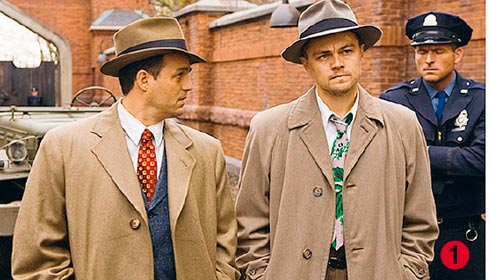


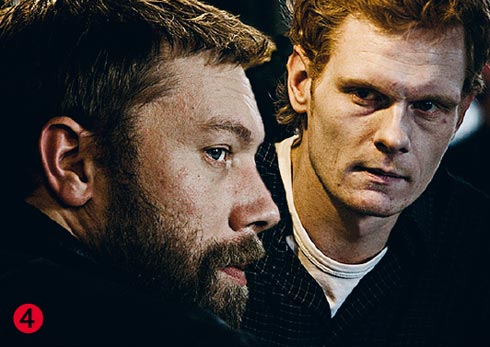
1. “Island of the Damned” 2. “Howl” 3. “Woman, pistol and noodles store” 4. “Submarine”
The drama “Submarino” (Submarino), shot by one of the “dogma”, Lars von Trier Thomas Winterberg, also leaves an ambiguous impression. There are many intersecting characters, sex, alcohol, drugs, Copenhagen streets, love and death, but in the end it is that paternity is paternity. And this is a high concept. The trouble is that the film has a lot of doubtful in terms of reliability. Well, they can’t put a person in jail, without unlocking him not a bandage even, but a home -made bandage on his hand (you never know - there may be a razor). And do not notice the gangrene.
Another film generating questions is the Japanese director Kodzi Vakamatsu “Caterpillar-Crimean”, in English Caterpillar. In it, the wife during the Second World War receives from the front of her husband in the form of a stump without legs, arms and clearly (but erroneously) insane. He is now - the hero of the empire. She is obliged to portray the wife of a glorious hero. In addition, he, albeit a stump, is sexually active. There were no more anti -war films. Its essence is that the true victims of the war are not even stumps, but their wives. But, as in the case of the film of Popogrebsky, there is a feeling of praise, excessive discharge of emotions.
Disappointed
First of all, the Extracurricular Berlin film Martin Scorsese “Island of the Damned” was disappointed last week. There is so much surrealism that there is no place for real empathy, a real thriller, and few will sit down to a dumbfounding denouement.
The American film “howl” (Howl) directors of Rob Epstein and Jeffrey Friedman is also good (in quotation marks) and an American film) and a quotes) and an American film. The name is based on the famous scandalous poem of one of the ideologists of the time of Allen Ginzberg. Everything seems to be inventive, but predictable to nausea. There is a ordered reading of the scandalous non -conformist poem of Ginzberg, which is called Howl (we translated both as “howl” and as a “cry”), it is illustrated by animation. There are shots from the life of Ginzberg, Keruak and others. The famous people of the late 1950s-the film begins to pretend to be documentary. Etc.
And finally. The German director Oscar Roler, who was already noted by the lean film adaptation of the “elementary particles” of Welbek, created a tape about the Nazi games around the famous propaganda film “Jew Zyss”. The film is stupidly called "Jew Zyuss - an unscrupulous film" (Jude Suess - Film Ohne Gewissen). And here, by golly: it would be interesting to see a picture that really recreated the story of this Nazi film, surrounded by a mass of ugly legends. Instead, we see a theatrical production about the relationship of the sold actor with the authorities. But guys: more serious paintings were also shot on this subject. For example, Mephistopheles Istwan Sabo. You can’t know this!
But this is where we have Berlinale.