
Translated material
The check, please!
Russia expects the verdict of the Strasbourg Court in the Yukos case
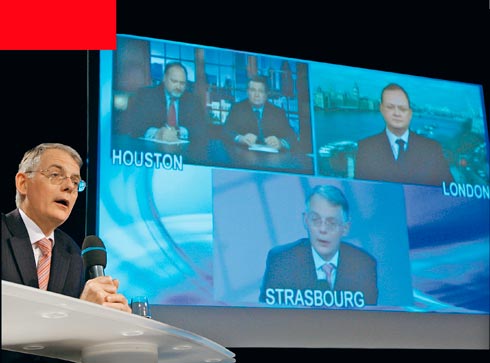
Pierce Gardner, representative of the company Yukos in the ECHR
The case of one hundred billions. The Strasbourg court, with the third attempt, held a hearing in the case of the Yukos Oil Company against Russia. The price of the issue is $ 98 billion. It was on the same amount that the shareholders of the Yukos counted unlawful tax charges in the process of intentional, as they believe, the company's bankruptcy of the Russian state for political purposes. Even the partial satisfaction of these requirements by the court is believed by experts, in the current crisis conditions may turn out to be an unbearable burden for the Russian budget. Not to mention the possible avalanche of lawsuits from the minority shareholders of the disappeared oil giant. Behind the "process of the century", as the lawyers have already christened the "case", The New Times observed directly in the hall of the Strasbourg Court
During a visit to Paris, Russian President Dmitry Medvedev on March 1–2, French politicians and businessmen about hearings in Strasbourg did not say a word. But barely Medvedev flew away, worried calls began to be heard in high Parisian offices: what, in fact, is the status of tomorrow's hearings? Will official Paris be represented in the Hall of the Strasbourg Court? Is Yukos an experienced lawyer and what are his chances of success? The calls mainly came from the former French shareholders of the Yukos. There are few of them, much less, for example, than American shareholders, but they are. Moreover, some of them were present in the very room where the “cream” of the French business gathered for a meeting with Medvedev. They try not to advertise their shareholders. Of the fears that now for their business refuence in Russia is rather a minus than a plus. But as one of the shareholders admitted to The New Times on the basis of anonymity, if the Strasbourg Court satisfies the claims of the Yukos, the minority subsidies will begin to sue for damages, and then “Russia will drown in the abyss of claims”. According to approximate data, Yukos has from 60 to 100 thousand shareholders. Territories are money, and money is a policy. And big.
Right-lane where is the side
March 4. 8.15 in the morning. A crowd of approximately 100-150 people gathered at the court’s building: mostly Russian and foreign lawyers, experts of the Council of Europe, students of legal faculties of local universities. There is no excitement and queues about which some Russian newspapers wrote about. Security - too. At the door of the court, Reuters and Zyuddeche Rundfun, the Rundfun, are on duty ... There are no Russian television cameras-as if Russia is suing, but Sierra Leone. But the delegation, representing the interests of Russia in the Strasbourg Court, has as many as 22 people - against one barrister * * the highest lawyer category in the UK. Gardner Pierce from Monckton Chambers, representing the interests of Yukos. They are seated in the right half of the hall. The sympathizers of Yukos, including the lawyer team of Mikhail Khodorkovsky and Plato Lebedev, involuntarily occupy the left. Journalists also sit on the left-here the press service of the court took their places.
8.30. Michael Sveinston, Barrister of the Brick Court lawyer, hired by the Russian government shortly before the hearing, appears at the court door, accompanied by two assistants, which resembled boxes from under a photocopy, only it is known that there is a tom of the court case, which Sveinston has not yet managed to study. Otherwise, you will not explain the letter sent to him on February 18 to the judicial chamber with a request to postpone the hearing for another six months. It did not help. Then the Russian delegation resorted to another attempt to postpone the hearing again: she appealed to the court with a request to transfer the consideration of the case from the small chamber to the large. At a press conference after the Pierce, Gardner explained the New Times the essence of the reception: in this case, the large chamber would have to re-start the entire judicial procedure, including the consideration of the continuity of the claim. And Russia would have a chance to get a delay for 3-5 years. But Russia did not take into account one thing: in Europe everything is customary to do according to the regulations. The lawsuit was filed - the lawsuit was adopted. Everything else is from the evil one.
8.50. In the courtroom, to the surprise of the author, Pavel Palazhchenko appears, a former translator of Mikhail Gorbachev, and takes a place in the cabin for synchronous translation. In the “right” Russian half, a dignitarous people in expensive costumes are being pulled up. Among the audience was noted Mr. Ivanenko, lawyer Gennady Timchenko, the owner of the oil-winner Gunvor and Personal Friend of Premier Putin.
9.00. La Cour! - "The court is coming" - proclaims the judicial major. Ten judges, including the new judge from Russia Andrei Bushev, participating only in this case (AD HOC), are seated in places. It is forbidden to photograph in the hall, get out of it before the break is the break - too.
The official representative of Russia in the Strasbourg Court, Georgy Matyushkin, did not waste time on trifles: in 10 minutes he questioned the powers of Gardner, rejected all the accusations of illegal expropriation of Yukos assets and deliberate destruction of the company, pointed out the competence and independence of Russian justice - and sat down. His performance was framed by a bright duel of two British lawyer offices. “There is no punishment without the law,” Pierce Gardner reminded the court and all those present. This is about the methods of the Russian law enforcement system. “A fraudster cannot become innocent on the basis of the fact that he was seized, and others like him,” said Michael Sveinston. This is about Khodorkovsky and Co.
The Chairman of the Chamber, Greek judge Christos Rosakis, gives each of them to the introductory word for 75 minutes - this is more than twice the usual regulations.
Moving to personalities
By and large, under the round arches of the European Court, nothing fundamentally new will be said in addition to what we have heard for the long 7 years of the Yukosov saga. The main innovation, as the former top manager of the Yukos later told The New Times to the correspondent of The New Times (he is one of the initiators of the lawsuit) is that for the first time the Yukos case is not in the Russian court of jury, but in an independent generally recognized court.
But it is precisely this circumstance that Sveinston did not know, clearly appealing to the feelings of the judges and constantly turning to persons. He built his speech on two theses. First: the powers of Gardner as a representative of Yukos are doubtful and evidence -free. Second: Yukos leaders are inveterate scammers and therefore cannot be recognized as the victim. And in general, with scammers other countries come even tougher.
Strange, but Sveinton did not pay attention to two significant details. First: Gardner's powers are already recognized by the Strasbourg court by decision on the partial acceptability of the complaint of Yukos. And the second: if the leaders of the Yukos are thieves and scammers, then why the attack on the company was originally built on tax articles. After all, the same Permanent Chamber of Matyushkin admitted that Yukos was not prosecuted on the basis of the Criminal Code - only administrative.
Pierce Gardner, on the contrary, in his speech rests on numbers and facts. He even names the name of the employee of the Russian Ministry of Taxes and fees, which from 2000 to 2003, when Yukos allegedly did not pay taxes, actually regularly recorded the properly executed Yukosov reports in the building on Neglinnaya 20, Kab. 203.
Reflections in the break
According to statistics, only 5% of complaints filed in the Strasbourg court are recognized as acceptable. In 90% of cases, if the lawsuit is adopted for consideration by the European Court of Human Rights (ECHR), the decision to satisfy it is at least partial. It is almost impossible to exert pressure in one form or another on judges of the European Court. And the point here is not only in their personal decency and incidence. The chambers of the court are formed according to the principle of multipolarity, that is, they consist of representatives of countries with absolutely dissimilar legal systems. Now the judges are sitting in the hall with Cyprus, from Norway, Azerbaijan, Croatia, Russia, Greece, Luxembourg, Switzerland ... The difference of languages, mentality, legal cultures, experts note, practically leads to zero the possibility of a conspiracy of judges.
Curtain
Gardner and Sveinston are gentlemen, and then opponents. They both use a “my scientist friend”, traditional for the English court. Judges listen to both with obvious pleasure. Gardner has a fever on "illegal expropriation and sale of assets." Sveinston assures that there were no real assets of Yukos - only a series of fictitious transactions with unaccounted profits in the form of “gifts” from puppet trading companies. In 2004, Yukos could pay for taxes if he sold his 20 percent share in Sibneft. “The government was not interested in the ability of Yukos to pay taxes - it wanted the destruction of the company,” Gardner is sure.
13.00. Judge Christos Rosakis announces the hearing closed. The court is deleted to the meeting. The date of the decision in this case, Rosakis clarifies, the parties to the dispute will be notified. “In fact, they will also make a decision on the case today,” explains The New Times, the director of Oksana Preobrazhenskaya, the director of the Center for International Protection of International Protection in Strasbourg. -And the next two to three months they will need to document it, which will be done in the strictest secret. Unless, of course, there is a leak ... "
The case “Yukos against Russia”, whatever it ends, says Oksana Preobrazhenskaya, has already spurred the Russian authorities to serious steps on the reform of court proceedings: “Just the other day, Medvedev said that the issue of decriminalization of criminal cases of economic crimes is now being discussed. * * Medvedev proposed to mitigate the punishment for economic crimes on February 26 at a meeting with entrepreneurs in Barvikh. What does that mean? They are clearly afraid and do not want new claims and new Khodorkovsky. ”
What to wait?
Pavel Ivlev, a former Yukos lawyer: “Material compensation is the most painful for Russia in the Yukos case. The Strasbourg Court for the first time seriously considers the possibility of making a decision on the recovery of a huge amount from the respondent state. After all, even if not $ 98, but $ 20-30 billion, that is, as much as Yukos cost in 2004, this will be a serious test for the Russian budget in the current conditions. But you will have to execute the court decisions and pay, albeit by installments, with reservations.
It is this - and nothing else - they are afraid in the Kremlin and the Moscow White House.
If it was really about under-paid taxes, the Russian authorities would have agreed with Yukos back in 2004. Trading is appropriate here, this is a common practice for governments in Europe and the USA. In addition to Hugo Chavez, no one in the civilized world is engaged in expropriations. The Russian Federation refusal to consider in the principle the issue of compensation testifies to the fact that the rulers of Russia just wanted to take Yukos. Nevertheless, Yukos is ready to agree on the amount of compensation. But the representatives of the Russian Federation on any version of the settlement agreement do not even stutter. Apparently, the order is given to them to fight to the end.
The Russian Federation accuses Mikhail Khodorkovsky and Platon Lebedev of theft of 350 million tons of oil and at the same time in tax failure. Why? With "stolen" oil? The Russian authorities do not even think about the fact that they put forward mutually exclusive accusations. If the court in Strasbourg eventually confirms the legitimacy of the Yukos claim, the nudity of Russian justice will become egregious. ”
European Court of Human Rights (ECHR)
It was created by the states of the Council of Europe in 1959 to consider cases of violation of the European Convention on the Protection of Human Rights and Fundamental Freedoms, signed by 47 member states and providing protection of the rights of more than 800 million people. National governments that signed the Convention (the so-called participating states) include its principles in their national legislation. The court decisions are mandatory for the states that signed the Convention and have priority over the norms of national legislation. Decisions made not in favor of the participating states provide for the payment of compensation or, in more serious cases, suggest the need to change national legislation to prevent violations of human rights in the future. Today, Russia leads by the number of complaints filed in the ECHR: about a third of the total number.43-year-old Andrey Bushev-
Associate Professor of the Department of Commercial Law of the Faculty of Law of St. Petersburg State University, who studied at it simultaneously with President Dmitry Medvedev. Arbitrator of several arbitration ships. From Russia, he acts in Strasbourg as a judge AD HOC - that is, to consider a separate case. The appointment of Bushev was required after the professor of the law faculty of St. Petersburg University Valery Musin, who had previously played the judge in the Yukos case, took a self-settling in connection with the election of Gazprom's board of directors.Yukos shareholders accuse Russia of deliberately destroying the company and illegal alienation of its assets and demand to finalize the Russian authorities by $ 98 billion. With a complaint about the actions of Russian tax authorities, the shareholders of the Yukos appealed to the Strasbourg Court on April 23, 2004. The lawsuit was drawn up by the British lawyer Pierce Gardner. On January 24, 2009, the court recognized the complaint acceptable at once by several paragraphs of Article 1 of the European Convention on Human Rights, including the protection of property rights and the right to a fair court. At the same time, the court confirmed the powers of the Gardner pier as a representative of Yukos in court. The hearings have already been postponed twice (November 9, 2009 and January 14, 2010) at the request of Russia.