
Translated material
Difficulty to Europe
From Moscow to Brest with truckers - The New Times report
From Moscow to Brest - on domestic maps, this road is indicated by number 1: The main connecting thread with Europe. On M1 day and night, cars heading to Poland, Germany, Austria, France and further, to the Pyrenee peninsula. The New Times correspondent tested the track on himself and arrived with truckers from Moscow to the Polish border 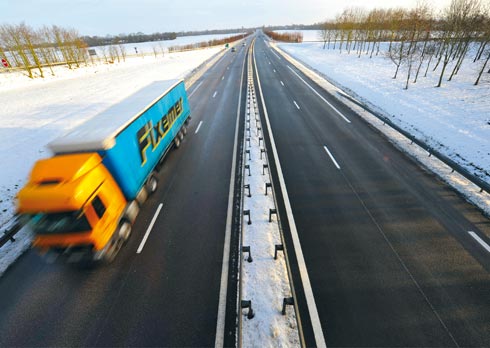
The trucker Igor from the company "Council" is slightly over 40, a short haircut, a multi -colored T -shirt and fleece sweatshirt. Igor moved to the new white tractor Man relatively recently, when four months ago he changed his place of work. But the territory has already “marked” - under the glass of the cabin, a sign in the form of a car number with the inscription “Garik”. Behind the driver's seat is a sleeping place and another folding shelf for a fellow traveler, like on a train. But they rarely use it-the trucker travels with a partner if you need to deliver any perishable load.
Igor drives his man with an empty in Poland. There it will load cosmetics and return to Moscow: for everything about everything - one week. “This is a short flight,” says the driver. “And often European goods have to be taken to Siberia or Central Asia, then we live in a car for weeks.” Everything he needs with him: a TV with a DVD player, a gas burner, a supply of food, water in cans.
Igor behind the steering wheel since the beginning of the 90s. Then the work was dangerous - truckers often robbed in Belarusian forests, had to go astray into columns. “We killed the boy alone, he was only 25 years old,” the driver recalls. - Now there are no robberies in the Belarusian direction, they say that they sometimes attack wagons in the Chelyabinsk area, but none of my friends personally came across this. And to steal - they steal. They can calmly remove the spare tire or drain the diesel tank. ”
Igor’s cabin without special driver’s jewelry, only over a passenger seat a small picture with two drunkards and a rhetorical question: “Will you be the third?” Igor takes out a bottle of vodka and offers to drink, himself-no, no, sobriety behind the wheel is holy. “If we go together, then we often do this-one leads, the other drinks,” Igor-Garik shares.
Mozhaisk. The second hour on the road
“At the 145th kilometer, the post is more accurate,” the trucker walking towards the walkie-talkie, and Igor reduces the gas. The speed limit on the highway is 70 km per hour, and observing it means guaranteed to be late, to disrupt the load. But the carrier companies are concerned with only one thing: to deliver the goods to the place as soon as possible, therefore, they violate everything with the speed regime, and the traffic cops use this: in eight hours of road to Belarusian customs in Red Gorka, we met at least six traffic police officers with radars. “Such severity is only in us in Poland,” says Igor. “On the Belarusian highway, the truck can calmly go at 100 km per hour, on the famous German autobahns for trucks - 80 km per hour on the highway and 89 - during overtaking.” Drivers warn each other in advance about road ambushes by walkie -talkie. Each trucker has it - this is the first item that is bought for a new tractor. Behind Russian, Ukrainian and Belarusian drivers, the 15th channel has been reserved, their frequencies near the Baltic states, Poles. By the walkie -talkie, you can contact any colleague within a radius of three kilometers: say hello to the oncoming friend, agree on how to settle in the parking lot, ask the road in an unfamiliar place and just chat so that it is not boring on the way. From time to time, pleasant female voices wedge into the canal - they advertise car services, sinks and cafes, sometimes in poetry.
Yartsevo. 3 hours on the road
M1 is a wide highway, along the entire length there are two stripes in each direction. Therefore, the truck goes fast, and the collapsed elevators and brand new mobile tower are raised outside the window. Here and there, potholes come across, and the car shakes noticeably, it is especially felt when the truck goes without cargo. The driver says that roads are best, of course, in Germany, the worst of all in Ukraine. Igor praises the highway in Khakassia, scolds the Leningrad region - in winter the roads are poorly cleaned there. “Much depends on the local bosses,” the driver is convinced, “otherwise, how to explain that the Smolensk section M1 is removed from snow noticeably better than the Moscow region?”
Soon there are a couple of bulldozers raking roadside blocks. “When it is heavy snowfall, we only remove snow to the side of the road, and we clean the roadsides later,” says an unshaven bulldozer with a rumpled face. - We have a plot of 30 km. To remove it on both sides, you need six cars and three hours of work. In snow, you have to immediately go to the second round. ” When asked why the highway in the Smolensk region - continuous pits and bumps, replies: “Mattle repair according to all the rules must be done in the summer. And money from the budget is allocated only in the fall, at the end of the year, so you have to put asphalt in winter. ”
Indeed: literally after a couple of kilometers there is a team of repairmen. Although until the evening it is still far (one day), all four workers are no longer knitting and support themselves in an upright position, only leaning on shovels. Road workers patch potholes in the coating right on top of the resulting thin snow. “Yes, it is impossible to put asphalt in snowfall, but the bosses were forced,” the foreman retorts calmly. “In the summer we will redo everything again.” But the workers blame the road in poor condition not the authorities, but the trucks: they say, the coating on the second row intended for them is most spoiled. “Something in Germany does not fall apart,” comments the trucker. - I saw how the roads are repaired there: a pillow (a pillow on which the road surface is laid. - The New Times) is removed, everything is laid again, and then they don’t touch 10 years. And everything is simple: they put a new asphalt layer and put on every year. ”
Kamenka. 5 hours on the road
Every driver has his favorite eatery. In Igor, this is a cafe "Birch" in the village of Kamenka. The food is worth it: in a simple dining room, the waitress gives a huge portion of Lagman, smoking manti, donuts with heat with heat, 250 rubles for all pleasure. The owners are a Russian couple from Uzbekistan, which went to the Smolensk region in the early 90s. Husband is a mechanical engineer, wife is an elementary school teacher. In 1997, they put a trailer by the road, sold kebabs and salad. Then they attached another, third. They bought the ground, carried out gas, water, light, pushed the parking lot. They planned to remove the temporary workers and build a full -fledged pavilion, but then the crisis began: “We live thanks to the road. Everyone who regularly lunch has long known customers, but now the stream has decreased by two -thirds. We survive due to the fact that we work with my husband for 15 hours a day, ”says the mistress of the cafe Galina Mikhailovna.
Red hill. 8 hours on the road
The Belarusian customs is easy and relaxed - Russian cars do not even need to stand in line. A few minutes, and a completely different road begins: a flat coating, not a single garbage heap, organized free parking with toilets and covered arbors, emergency phones. Automatic chambers record speed violators.
“The wide road that permeates the whole of Belarus from west to east, from Brest to Krasnaya Gorka, was built to the Moscow Olympics, we call it“ Olympic, ”says Igor. “Previously, she was concrete, and a couple of years ago they put asphalt.” For everyone except Belarusian cars, the track is paid. You need to enter through the checkpoint, there will be three more of them to Brest. On each, foreign cars pay 22 Russian rubles, and trucks - 612 rubles. Money, as “tax collectors” claim, go to maintain the road. Another reason that the road is good is the temperature regime set here. Igor tells about him with hatred: in the summer, when the thermometer shows above 25 degrees Celsius, loaded trucks are allowed to travel to the Belarusian highways only at night. Sitting all day in a hot cabin is a dubious pleasure. But the asphalt suffers less and lasts longer. The order is not least explained by the brutal Belarusian fines: for the garbage thrown out of the car, the garbage will have to be paid from 35 thousand to 70 thousand Belarusian rubles (at the current rate - 358–715 Russian). For comparison: $ 300 by Belarusian standards is a very decent salary.
Columns. 12 hours on the road
In column, Igor announces a halt. The driver has no right to go without stopping. Special equipment writes down when the machine works, and when it stands still, and if the work schedule is violated, the driver is fined. Even if there are two in the cab, at least eight hours a day you will have to stand still - these are safety requirements. For an overnight stay, Igor chooses a familiar gas station with a cafe on the opposite side of the road. Sergey, his old friend in his last work, stops there. Right in the cab, they boil dumplings on a burner. Belarusian vodka, homemade lard, TV. And on the hinged upper shelf in the cab of the tractor, it sleeps no worse than in the train compartment. In the morning - breakfast here is in a roadside cafe: the glazing of three eggs costs 20 rubles with our money, a solid portion of pesmers - only 16.
Baranovichi. 26 hours on the road
Closer to noon - again on the road. At the turn of the Slonim with Igor you have to part. On the way, he did not miss a single store of spare parts, but did not find the right LED for a burned overall fire. Ahead is an exemplary customs, and cars are not even allowed with minimal damage through it, you need to look for another, less picky. The path through Brest is closed to him.