
Translated material
Hyvei democracy
Western experience in construction and theft
Hyvei democracy. Each domestic motorist, who had to make international trips on his car, knows: the fact that the homeland has ended can not be determined by the border post, but by a completely different quality of the highway. Native bumps are magically replaced by even and smooth highway. Why do Europeans manage in the field of road construction to achieve that we can’t do it? Having asked this question, The New Times studied the experience of one of the recognized world "road" leaders - Germany, the middle -minded - Italy and the neighboring Finland with Russia, similar to it according to weather conditions
Alexey Slavin
Berlin
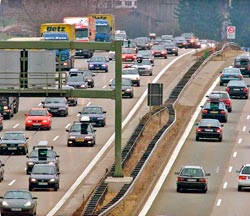 |
| Autoban Munich - Zalzburg is able to cope with any traffic flow |
Germany:
"Roads are power"
This phrase was once uttered by the young Frederick the Great, wandering with the army in southern Silesia. According to legend, since then the German state, whoever heads it, has not spares the strength and means to lay the highways.
Outside Germany, it is mistakenly customary to connect the boom of road construction with the era of Hitler's reign. In fact, back in 1926 in Germany, a society was formed on laying the Hamburg-Frankfurt-Basel (Hafraba) highway, which began large-scale planning of new highways. Actually, the Cologne -Bonn highway, opened in 1932, was called "Autoban" - by analogy with the railway (Eisenbahn). In total, it was planned to build 22 thousand km of roads in 30 years.
When Hitler came to power, 60 volumes of construction plans, where there were maps, land calculations, economic justifications, routes and, very importantly, information about the already acquired areas of the Earth, became the basis of the Fuhrer road plan. In September 1933, Hitler made the gasket of autobahns a state idea. It was planned to build 6900 km of roads, but by the end of the war only 2100 were commissioned.
Autoban philosophy
What is a German autobahn? This is not just a speed track. This is a road with a special philosophy. Here all the rules of movement are that as many cars as possible can drive as possible. Almost everywhere - a dividing barrier between directions of movement, the absence of traffic lights and intersections. Departures and entrances, as a rule, only on the right side. Speed - not lower than 60 km per hour (if less, you need to either leave the track or have a special permit). It is forbidden to stop even on the sidelines for no serious reason, otherwise the police will come to you very soon - to find out what is the matter. If your car is faulty or there was simply not enough gasoline, of course, they will help you, but then they will make an account, and in addition they will be fined: when leaving for an autobahn, you should have taken care of “about the uninterrupted movement”, that is, at least refuel.
Unlike most countries in Europe, traveling through German car car carriers is still free, for cargo over 12 tons of costs - 12 cents per kilometer. Film for non -payment dragon - up to € 50 thousand for malicious non -payers. There are no general speed restrictions on German autobahns - and there are no more such countries in the world. Therefore, some segments are just a paradise for dashing. On the autobahn, you can’t unfold or move back - this is one of the most serious violations: you can lose your rights for a long time. You can’t drive along the right row faster than on the left, thereby interference of the mandatory use of the right row, if it is free.
By the way, your humble servant not so long ago “hit” a hundred euros - because he rode carelessly in the left row on an absolutely empty autobahn. A police car appeared from somewhere behind, drove through the author of these lines three kilometers (the necessary minimum), after which the cheerful police officers stopped the author, reported and wrote out a fine: so that they would not interfere with the movement ...
There is no thicker
The German network of autobahns is the dense in the world. On a relatively small area, 12,550 km of high -speed roads were built. For comparison: in 1950 it was 2128 km, in 1990-8822 km. In recent years alone, the “Baltic” Shchezin -Lyubek highway, the Galle - Gettingen, Erfurt - Vyurtzburg, Dresden - the Czech border have been laid, and the construction of the Magdeburg -Sverin road is in full swing. Dozens of autobahns were extended or interconnected. And about the expansion of tracks from four to six, or even eight lanes, to replace an obsolete road surface to even speak unnecessary.
Of course, this road expansion is not without problems. Constructures became a real scourge of car owners. In problem areas, the number of accidents increased several times and 40-kilometer traffic jams are not uncommon. Nevertheless, reconstruction is vital. In some loaded areas, for example, in the area of the Berlin Elector, 191,400 cars pass in the day, at the forking Vostochny Kologna - 165 thousand. By 2015, an increase in passenger transport in car battles by 20%, cargo - by 60%, and transit by all 100%! Now six -lane car carriers occupy about a quarter of all speed roads. And the German government claims that at least 40%is needed.
The construction of autobahns is a very expensive matter. According to various estimates, the cost of laying one kilometer is from € 6 to € 12 million, the expansion or replacement of the coating (now it is, as a rule, a special concrete designed for at least 30 years of service) -
€ 9 million. However, according to Report Munchen, real drill costs are much higher - € 26.3 million. It is curious that the cost of construction actually amounts to less than half of this amount (€ 11.8 million). The rest is the costs of examinations, audits, plans and “expenses for the bureaucracy”. What is called "kickbacks" in Russian.
Astrite Dacco Il Manifesto - especially for The New Times
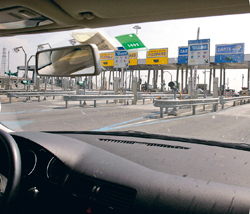 |
| Italian highway: it's not a pity to pay |
Italy:
The mafia on the highway
More than two thousands of years ago, the ancient Romans created an exclusive quality system: it covered the entire territory of the country. For centuries, it was these ancient Roman roads that were the only ones in Italy. The Apennins received a new impulse only in 1924: the first paid highway in the world of Milan - Vareze was launched here.
Know-how for a superrada
The modern roadway began to appear in Italy only in the late 50s of the XX century. It was then that the Left -centric government launched in Italy the construction of a large -scale national road network. Today, its total length reaches 6.5 thousand km, and the quality of both the project and execution is considered very high.
It all began with the Milan -Naapol motorway opened in 1964. Today it is the main autoretm of the country A1, crossing Italy from north to south (its length is 759 km). Then, for 20-30 years, other superdrames were very intensively built. It is curious that the impulse for their construction each time gave the next elections: the politicians of a region promised the electorate good roads - and promises had to be fulfilled. For decades, the Fiat, * fiat , the manufacturer-monopolist of cars and trucks in Italy, played a very serious lobbying role for decades. Which exerted pressure on the government so that it would build as many roads as possible: the company needed a growing sales. They say that Fiat paid politicians who could influence the decision of the authorities to build new roads.
Those who come to Italy for a short while and move around the main autarts are sure that in this country the roads are one of the best in the world. In Italy, a really good school of road construction. Those who lay the roadway have their know-how. Its main part is the asphalt with anti -infusion drainage coating. He is able to withstand the flows of heavy trucks and bad weather without frequent repairs. Another production secret is the materials used in the construction of roads: all of them are usually Italian production. However, the materials for the superfluous are not cheap, and the possibility of using it depends on the significance of the road and the availability of money for its construction: if there are few of them, then cheap materials are used. Then the new roads seem smooth and beautiful only at first glance: any snowfall or stream of heavy trucks leaves no trace of the original gloss. And this is the main road problem of the country: if you move from the central highways to ordinary local roads 50-60 km long, it turns out that many of them are narrow, crooked and sin with constant traffic jams.
Road octopus
The strongest corruption of the entire sphere of road construction, penetrated by mafia ties, prevents the situation. The construction of one kilometer of a “normal” road (8 meters wide, in a flat area, with small viaducts and a gallery occupying less than 10% of the total length of the road) in the province of Trento (north of Italy) costs from € 5 to € 8 million. Exactly the same road in Calabria (south of Italy) will cost € 25 million per kilometer. The record-€ 116 million per section 2.3 km long-was set during the construction of the road near the town of Palice, not far from Rezho-Di-Calabria. It is hard to believe that this amount went exclusively for construction, and not for the “top -up” of mafia braids, * * Koski - clans of NDranget, one of the most powerful mafia organizations in the world. Which have much more power in Calabria than the state.
In Italy, the construction of significant roads is entrusted with the State Corporation Anas, which is funded from various sources (state budget, local administrations, banks) and on a competitive basis gives contracts to private firms. But the process of tenders itself already gives scope for mafiosi: in some “problematic” areas of Italy, a construction company, if it is not controlled by the local mafia, will never risk participating in such competitions. Two years ago, one of the largest construction companies in Italy - Astaldi - had to abandon the construction of the road in Calabria, which she won. The official reason is the “insurmountable difficulties of the landscape”. In fact, it was implied completely different - the pressure of mafia groups.
Translation from Italian Natalia Alyakrinskaya, The New Times
Olla Latinen journalist
Helsinki
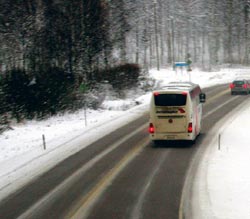 |
| The quality of the Finnish roads is such that the plane may well land on them |
Finland:
Mottitis for a fighter
The quality of the Finnish roads is such that in an hour and a half, many of them are able to turn into runways for military aviation. The author did not have to see such lines with his own eyes, but the corresponding photograph - a fighter landing on the highway - hung on the Ministry of Defense for a long time.
By three plus
The total length of the transport network in Finland is 78.1 thousand km, of which 51 thousand km is a capital coating highway. To this, it should be added to 5 thousand km of roads that are bicycle tracks built along public roads.
There are not many high -speed highweacs (motto) - their length does not exceed 500 km. The speed restriction on these roads in the winter is 100 km/h, in the summer - 120 km/h (on other roads - 80 km/h, in settlements - 50 km/h). At the same time, all roads in the country are free.
Publishing polls show that residents of the country evaluate the quality of their transport system quite highly: at 3.6 on a 5-point system. This is not surprising, because mortality on the roads of Finland does not exceed 7.6 cases per 100 thousand people, and only 1.3 thousand km (0.02%) of roads in the country requires major repairs.
The high quality of local highways is explained by their strategic role: the developed center of the country through the southeastern transport system trades with Russia, and through the north-west-with Sweden and Norway. For a small country, Suomi is fundamentally important commercial arteries. According to the official status for 2009, 344 million tons of cargo were transported along the roads of Finland. Industrial enterprises (pulp and paper, chemical, mining) are scattered throughout the country, and most of them have the only connection with markets-roads. Trade with Russia, which accounts for about 10% of all volumes of freight transportation according to our motiveism, is especially intensively.
Thanks to the competition!
Russian colleagues and partners often ask us the question: how can the Finns manage to ensure such high quality road network - in difficult weather conditions (frequent snowfalls and rains) and with a high transport load on them? In the late 1990s and early 2000s, the Revo Construction reform was carried out in Finland: dozens of private companies have come to replace the unified state corporation, which was responsible for the construction and maintenance of roads, bridges and tunnels, which are now competing on the construction, repair and maintenance of the transport system on a par with the state Destia. Moreover, for private and state -owned companies in Finland, the rules for access to contracts and money are one.
Competition allows you to build high-quality roads at very moderate prices: 1 km of Caarka-Mattila route cost the Finnish taxpayer € 2.8 million, Scandinavia in the Helsinki area-€ 3.4 million. The annual cost of the content of 1 km of the road in Finland is € 4.5 thousand. It is competition that leads to the fact that the companies find road materials, most of them, the most Suitable for local weather conditions, provide a high -quality drainage system that can cope with almost any precipitation, and guarantee the possibility of long -term operation of asphalt coating without repair. The latest achievements of innovators are the construction of roads with a special material that absorbs noise, and the use of cold asphalt technology, which allows you to build highways quickly and without the use of multi -ton technique.
However, it does not do without corruption in the road sector: from 1994 to 2002, a cartel of seven large construction companies operated in Finland, which overestimated the cost of asphalt work. In 2009, the country's Supreme Administrative Court made a fine of these companies the size of € 82.5 million.
The material was prepared by Dmitry Krylov