
Translated material
Exoplanets (modern facts)
Worlds outside the solar system have long been one of the areas of natural science that most of the public public excite. If this interest was not, the human race would not cost a penny: what could be more natural than attempts to understand whether our world is unique or not, attempts to imagine or even find other inhabited worlds.
About how to really find planets in other stars (exoplanets), they thought in the 19th century, then the first applications for discoveries appeared that were not confirmed. There were many erroneous applications in the XX century. The first observation of the exoplanets, which was confirmed, was made in 1988 by Canadian astronomers (star near Cepheus). However, it was on the verge of the sensitivity of the method, they did not believe in the discovery. The presence of a planet at Cepheus was confirmed only in 2002, when the opening of exoplanets became a routine business.
In 1992, a planetary system at Pulsar was reliably registered. This is much easier than finding a planet in a normal star: Pulsar radiates strictly periodic bursts of radio radiation. If the pulsar's speed of the sight of vision (towards us) has changed, the pulse phase will begin to shift. In this case, you can catch changes in speed of tens of centimeters per second. Further, if there are several planets, these movements remain to be decomposed by the amount of Kepler orbits. However, Pulsar's planets are not normal planets.
Pulsar is a neutron star formed during the explosion of Supernova. The normal planetary system during the explosion is destroyed. These planets formed around the neutron star after the explosion - from part of the thrown substance. So they are something completely exotic, which has nothing to do with the question of other worlds suitable for habitat.
The breakthrough in the search for exoplanets occurred in 1995. First, we will talk about the method by which there was a breakthrough and which to this day is the main thing in the search for planets from other stars. As in the case of "pulsar" planets, it is based on the measurement of speed by the ray of vision.
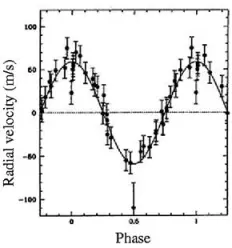
The planet and the star rotate around the common center of gravity. The sun, under the influence of all planets, describes a complex trajectory, but the main element of this trajectory is an ellipse (almost a circle) from Jupiter's gravity, the speed of the sun in this circle is 12 m/s. Is it possible to measure this speed thanks to the Doppler shift of the star spectrum: in the case of Jupiter, one thirty millionth wavelength. The problem is that in the case of a conventional star there are no perfect frequencies, as in the case of pulsar. There are spectral lines of light absorption in the star atmosphere. But they are quite wide. The star rotates, its upper layers and atmosphere in motion. And most importantly - all atoms are randomly moved at speeds for many kilometers per second, since the atmosphere is hot. And you need to feel a change in the average speed of the atmosphere of the star by meters per second. That is, to catch the displacements of the spectrum less than one thousandth of the width of the lines and one stomillion -free wavelength! And this is done!
Find the displacements of the spectrum for one stomillion “in the forehead” is the same as measuring micron displacements with a roulette of a hundred -meter length. Need a trick. The trick is based on the fact that you can very well measure the distortion of the spectrum shape, much better than displacements. And for the displacement of the spectrum to distort its shape, the light of the stars is passed through a gas with a strongly cut spectrum, for example, through pairs of iodine. The spectrometer gets superposition of the spectra of star and iodine. The first walks back and forth, the second stands still and does not change: the temperature of iodine vapor is maintained constant. The shape of the superposition is most strongly changing where the steep slope of the star line is superimposed on the steep slope of the iodine line. The cutness of both spectra guarantees that there will be a lot of such coincidences and even insignificant displacements will give a measurable effect. But that's not all.
Not only the star moves, the observer moves, moreover, with much greater accelerations, since he sits on a lighter heavenly body. From the radial speed of the star, it is necessary to subtract the movement of the earth around the Sun, outraged by the moon and all the planets of the solar system, as well as the daily rotation of the Earth. Thus, accuracy about a meter per second is achieved. This is the speed of a person walking a walking step. Recall that this is the speed of a heated hot star, measured with a sophisticated trajectory rushing along the space speed of the planet. By the way, for these measurements, cosmic or even record ground telescopes are not needed.
By 1995, the achieved accuracy of measuring the radiation speed of the stars was significantly lower-10-15 m/s. This was not enough to confidently count on quick success: we recall that the speed of the sun around the common center of gravity with Jupiter is 12 m/s. But reality presented a gift.

By 1995, two competing groups were leading in the search for exoplanets: Michelle Major, Didier Kelos (University of Geneva) and Jeff Marsi, Paul Batler (University of Berkeley, USA). The first to be the Swiss. The history of the discovery described below, I learned mainly from the report of Jeff Marsi. By the fall of 1995, both groups had a working methodology and conducted a systematic search. According to Marsy, their accuracy was better: it was they who came up with a cell with iodine vapor. The Swiss, however, used a similar methodology. Be that as it may, October 6, the Swiss saw periodic fluctuations in the radiation speed of the star 51 Pegasus, with a huge amplitude - 60 m/s and a very short period - 4.2 days. Nobody expected this! Jeff Marsi claims that they were simply unlucky: in the catalog that they used, 51 Pegasus was mistakenly listed as a flashing star, and they excluded her from the list of goals. Probably, this was really the subject of luck, since after 2 weeks Marsi with the batler confirmed the opening, and with better accuracy.
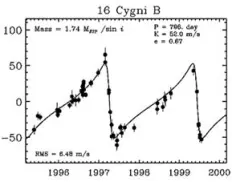
But the public did not believe in the discovery immediately. The result was very unexpected. He meant that around the star, similar to the sun, at a distance, 20 times closer than the earth to the Sun, a huge planet rotates, comparable in mass with Jupiter. From there to get Jupiter! After all, the star at such a distance from itself evaporates all protoplanetary dust, and there just nothing can form! Many have assumed that this is the “breath” of the star, it is compressed and expanding with a period of 4.2 days. The arguments were put forward against this. The disputes were hot and did not last long. New discoveries appeared, which soon went into the category of serial. The variety grew rapidly, and soon the confidence that the fluctuations of the radiation speed were caused by planets .. According to the same Marsi, when you see the sinusoid, there are always some doubts, maybe the star really breathes. But when they found an asymmetric curve, which was perfectly driven by the movement through a heavily elongated Kepler orbit, all doubts fell away.
It quickly turned out that large planets in small orbits are very common. They were nicknamed the "hot Jupiters" for the high equilibrium atmosphere temperature. Among the open exoplanets, they make up at least a quarter. However, they are easiest to find, so the real share of hot Jupiters should be much less; According to estimates, 1-1.5% of stars like the sun have them. Another unexpected fact is a lot of planets with very elongated orbits. This is also poorly consistent with the fact that we see at home (all orbits are close to circular), and with existing ideas about the formation of planetary systems.
To date, 429 exoplanets have been discovered. Most of them were found by the spectrometric method described above. The next productivity method is called "transit photometry." The orbits of some planets can pass through the disc disk, if you look from the ground. In this case, the brightness of the star falls slightly, which is quite amenable to measurement. The disadvantage of the method is that the probability of a projection of the orbit on a star is small - the less, the more orbit. But the sensitivity of the method is higher: the passage of the earth along the disk of the Sun can be confidently recorded from a distance of dozens of parsecks. In addition, the size of the planet is measured, you can establish the presence of rings and large satellites, even get the spectral lines of the atmosphere of the planet. Now 98 planets have been found in transit. Two specialized satellites were launched to search for transit. The first is the European Corot (mirror diameter - 30 cm, launched on December 27, 2006), the second - Kepler, launched NASA (mirror diameter - 95 cm, launched on March 7, 2009). The search strategy is to look into one area of the sky, observing about 100 thousand stars at the same time. To date, Corot found about 10 new exoplanets, Kepler - 5. According to estimates, Kepler should find dozens of earth -type planets, but this takes time.
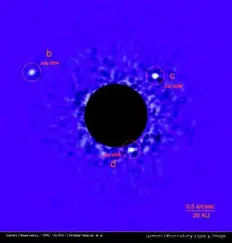
There are also methods that are less productive, but having their advantages. First of all, this is a direct observation of the planets when the light of the star is blocked with a coronograph. It is easier to see the planet in the infrared range - it is in it that two planetary systems were found. And another planet was found in a visible light - the rather bright star Fomalgaut. Moreover, according to two pictures taken at different times, it is clear how the planet shifted, moving in orbit (see TRV No. 44 ). The advantage of the method: it allows you to see planets far from a star, which is almost impossible to detect with a spectrometric method and is extremely unlikely to detect transit. Although, of course, you can see only giant planets.
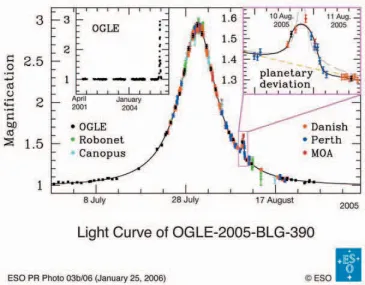
A little more exotic method is gravitational microlysis. This is a well -known effect used to search for objects invisible to the telescope. When the gravitating body and a more distant star find themselves on one radiation of vision, the observed brightness of this star increases many times. An ordinary star can be a lens. Since all the stars move, the increase in shine lasts relatively shortly, for example for several weeks. If the Linza star does not have planets, the shine of the lensed star will describe the symmetrical peak. If there are planets, the lens is distorted, and so that small areas of additional amplification, kaustics appear. If a distant star passes very close to the caustic of the planet, an additional sharp diet appears on the slope of the peak. Then the stars diverge, and the event is not repeated: to follow the star in the hope of seeing a new micro -insal event is useless due to an insignificant probability. This is a lack of method. But there are advantages. Firstly, microlynzing allows you to find quite far from the star and relatively small planets that are not caught by other methods. Secondly, all probabilities are well considered. If we conduct a systematic review of the sky for microlysis, then the probability of finding a planet of this type is known, which means that according to the planets found, albeit a small number, you can restore their real prevalence. Now about 10 planets have been found by microlysising by microlysis, and they fall into an area that is not covered by other methods. In particular, the planet was found about 5 earthly masses, which is in relation to its star somewhere between our Mars and Jupiter.
Now let's try to give a common summary. So, at the beginning of March 2010, the catch is 429 planets in 362 stars. In 45 systems, at least two planets were found (five records). The first thing that catches your eye: (a) a huge variety, (b) discrepancy with the former ideas about planetary systems. Most of the planetary systems found are not only not similar to sunny, but are hardly suitable for life. If the system has a hot Jupiter, then the chances of the presence of the terrestrial group planets are small. The fact is that the giant planet could not appear in a cramped orbit - she could only migrate there from colder areas, destroying everything in her path. If there is a giant planet with a strongly elongated orbit, then the orbits of the remaining planets, comparable in size, will be unstable. There are quite a lot of such orbits: for example, if the orbit of the earthly or more order, then about half of them have an eccentricity of more than 0.3.
Of course, the effect of observation selection works against solar systems. Our system in such observations would be represented by one Jupiter, and it would be more difficult to detect it than most other, already found giant planets with smaller orbits. Are there any similar systems among the found systems that ours would look like? There are several pieces of 362. In fact, adjusted for observant selection, their share should be higher. They may well have planets of the Earth type on the corresponding orbites. Are there any discovered planets with stable orbits such as earthly? There are several pieces, but these are planets-giants (it has not yet reached the discovery of an analogue of the Earth). But if these giants have satellites similar to Jupiter's companions, life is possible on them. In addition to gas giants such as Jupiter, a lot of smaller “ice giants” such as Neptune were found. Finally, there are several planets called “super -earths” - they are only a few times superior to the Earth by mass and, apparently, have a similar composition. One of these super -earth rotates around the red dwarf in a zone suitable for life. This is Gliese 581 D (there are 4 more planets in the system). The fact that the star is a red dwarf does not at all harm life; On the contrary, it will shine much longer than the sun.
Most of the stars in which planets are found are close in terms of luminosity to the sun. If the star is much brighter, it evaporates dust far around itself, and dust is a building material for planets. More dull planet stars were found less. It is possible that the number of planets in red dwarfs is no less, just the planets are smaller and more difficult to find.
To try to comprehend the situation and understand how rare or typical the solar system is, the data available is not enough. The data seems to be said that the solar system is atypical, but we recall that there is an effect of observation selection that works against its detection. It is also necessary to comprehend how and why such systems are formed, which we observe, where hot Jupiters and elongated orbits come from, under what conditions it can be expected that an analogue of the solar system is formed, and in which something completely unsuitable for habitat. The following article will be devoted to this.
Boris Stern