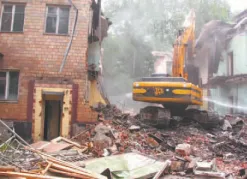
From the main building of the Presidium of the Russian Academy of Sciences on the Sparrow Mountains of the web, numerous institutions of the Academy of Sciences disperse. After the collapse of the USSR, the lack of financing, the outflow of scientists and the complete spit of the authorities, the institutions have been falling apart for a long time and inevitably, the Hileli, and the attention to them disappeared. True, not from large business. If the scientific value was naught, then the market, on the contrary, increased. Each institute of Russian Academy of Sciences is assigned to land, which became more expensive from year to year.
The protocol of noble intentions
On May 7, 2002, Yuri Osipov and Mayor of Moscow, Yuri Luzhkov, signed “Protocol on intentions in the procedure for implementing housing construction projects with the necessary infrastructure in the withdrawn RAS and its scientific organizations in Moscow”. His goal was expressed in the following noble words: “Support for fundamental science in Russia ... strengthening and developing the staff, ... as well as in order to consolidate young specialists in scientific institutions of the Russian Academy of Sciences ...”. This document served as the starting point for the active development of federal lands given for use by the Russian Academy of Sciences.
And the noble intentions on the paper were actually expressed: in the construction of elite houses with an approximate value of 20 thousand dollars per square meter. meter; in the demolition of kindergartens and existing scientific laboratory corps; in the alienation of state property in favor of commercial structures; In the beating of protesting residents.
On September 8, 2008, the Prosecutor General’s Office sent the President of the Russian Academy of Sciences Yuri Osipov “On the elimination of violations of the legislation on the disposal of state property”. The main claim of prosecutors: when concluding investment contracts, “not in all cases, the protection of the property interests of the state was ensured, and the heads of some institutions subordinate to the Russian Academy of Sciences exceeded the powers granted to them.” This document is voluminous, so we give it only one of the most indicative examples.
Institute of Chemical Physics (ICF) named after NN Semenova RAS (this institution will be discussed in more detail below) on January 17, 2005, an investment contract was concluded for the construction of three four-story residential buildings and an administrative-laboratory corps on the street. Kosygina, house 4. In addition, the ICF concluded a contract with Gloria-Vintex LLC, 99 % of which belong to the Austrian LLC Avenue Ostrupa GMBH, for the restoration of the Dmitriev-Mamonov estate, which is a monument of the history and culture of federal significance. As compensation, the investor was given the right to build an elite house in the estate. However, the site on which the construction was planned was part of a specially protected natural area - the Vorobyovy Gory natural reserve. It is forbidden to build in the reserve and on the territory of the monument, in connection with which the Moscow prosecutor’s office and the Federal Property Management Agency went to court. The court of first instance did not agree with their lawsuit, but the ninth Arbitration Court of Appeal in May 2007 recognized the decision to carry out the work invalid.
However, at our disposal was a letter dated October 2008, a year and a half after the court decision, from the General Director of Gloria-Vintex LLC Yuri Datskovsky to the Deputy President of the Russian Academy of Sciences and the manager of the Russian Academy of Sciences Konstantin Solntsev. Despite the court ruling, the general director asks to apply for a power of attorney on behalf of the HIS RAS to the employees of his company “To accelerate the process of registering a land plot to the property of the Russian Federation for the subsequent transfer of Gloria-Vintex LLC 0.27 hectares, in order to design and build a residential building”. To find out if this intention was executed, we called the Avenue Management Management Company, representing Austrian Austrian Avenue Ostrupa GMBH in Russia. We were informed that Yuri Datskovsky no longer works there, and we could not contact the current general director Vladimir Simonenko.
Controlwideauthority
Particular attention in Datskovsky’s letter deserves that the construction received fundamental consent from the Interregional Territorial Administration of Property Management of the Russian Academy of Sciences (MTU of the Russian Academy of Sciences). This management was headed by Leopold Leontyev. However, our source, who worked in the MTU, said that all decisions on the construction and disposal of land were made not by Leontiev, already an elderly academician, but by the manager of the Russian Academy of Sciences - Solntsev. All investment contracts passed through it.
In the response to the Prosecutor General of the then acting President of the Russian Academy of Sciences, Alexander Nekipelov, said that numerous investment contracts were concluded due to the lack of sufficient funds for capital construction. And at the end of the letter, acting The president promised: “The Presidium of the Russian Academy of Sciences will be indicated by the heads of units and organizations subordinate to it ... on the need for strict observance of the rights of the Russian Federation in the conclusion and implementation of investment contracts, and ensuring control over their proper execution.”
But, apparently, it was not possible to ensure proper control. In February 2009, the MTU of the Russian Academy of Sciences was disbanded, and instead of it in the central apparatus of the Federal Property Management Agency created the property of the property of organizations of the scientific sphere. Behind this seemingly insignificant structural reform is hidden much.
In an unofficial conversation, one of the employees of the central apparatus of the Federal Property Management Agency said that there was a lot of hidden hype and a backstage struggle around this decision: people whose disposal was all the land of the Russian Academy of Sciences really did not want to part with their powers and tried in every possible way to block the decision to liquidate the MTU. However, it took place, and in the newly created department they are still trying to audit all movable and immovable property. It is extremely difficult to do this, according to our source: “Over the years, the property register in the MTU was somehow conducted, and now we can’t even understand in the central apparatus: what is ours and what is not, what is already irrevocably lost and what else can be returned?” And it seems that our interlocutor in the Federal Property Management Agency did not exaggerate: it turned out that in the central apparatus of the Federal Agency, they did not know anything about those problematic investment contracts, the details of which we were interested in. They simply did not find them in the Federal Property Management Agency.
Kosygina street, possession 7/2-13
Here is the Institute of Chemical Physics of the Russian Academy of Sciences, the one that has already been mentioned in the representation of the Prosecutor General. The institute rents a plot of land of 2.5 hectares. Part of this site (1.2 ha) is the territory of the institute itself, the other is the courtyard territory of neighboring houses on the street. Kosygin, as well as the passing part of the street. Academician Zelinsky with a section of the boulevard. On this earth, since the mid-90s, the ICF has planned a large-scale construction of elite housing. This caused the discontent of local residents, and also directly contradicts all norms (neither the street nor the boulevard are intended for housing construction and cannot be leased for these purposes).
In 2001, at one of the polling stations of the Gagarinsky district, Vladimir Putin spelled out there. The site was just located in the estate of the Dmitriev-Mamonov, occupied by the NISF RAS. The old grandmother, the Leningrad blockade, broke through the cordon of the guard, handed the president a letter from local residents, in which they asked to cancel the rent of 1.3 hectares of their courtyard, street and boulevard. The targeted influence played a role. Soon, the residents were answered from the presidential envoy to the Central Federal District of Georgy Poltavchenko and the deputy head of the complex of architecture, construction, development and reconstruction of Moscow Mikhail Balakin. They assured the inhabitants: the issue with the cancellation of a lease of 1.3 hectares is resolved.
However, this decision has not yet been implemented. Meanwhile, the preparation of documents for construction was in full swing: in 2004, the ISF RAS in the person of Director Alexander Berlin concluded an investment contract for construction with Su-155 CJSC represented by general director Alexander Meshcheryakov (there was no information that there was no competition). And the chairman of the board of directors of the construction company was already Mikhail Balakin, the one that once encouraged residents on behalf of the Moscow authorities.
Meanwhile, the other part of the site - the size of 1.2 hectares - was occupied by federal property. The investment contract indicated that the land is not free from property obligations: it contains the warehouse of the HIS RAS RAS with an area of 1905 square meters. m that must be demolished. In return before the construction of the Su-155, the building of the material warehouse with an area of 850 square meters was supposed to build a building. m. And, probably, no one would have noticed that the size of state property decreased more than doubled if the warehouse was still built. But work on the site began, but there is still no warehouse. And, judging by the development of events, it is unlikely to be.
In October 2008, builders from the contracting organization came to the territory - LLC Latgaly LLC and began to enclose the site with a fence. Moreover, along the old perimeter, which was listed in documents, canceled a year earlier by the Moscow prosecutor's office. In order to avoid protests from the residents, serious security was established, which did not go to work even by the HIS employees. Already an elderly scientist, in order to get to the institute, had to climb over a high fence. In February 2009, Mosgosstroynadzor suspended the construction permit due to violations in the documentation. But even after this work did not stop, 125 trees were cut down. The Department of Environmental Management confirmed the illegality of cutting down and estimated the damage caused by the environment more than 1 million rubles. The question was raised about bringing the contractor to criminal liability.
Soon, the work was continued again - now according to the demolition of the building, in which, as the director of the ISF Berlin reported in a letter to Leontiev and Solntsev, the services of institutes were placed and their employees worked. And in the investment contract, nothing is said about the availability of a federal property on the construction site of this facility - a general -purpose laboratory corps, which was in the operational management of another academic institution - the Institute of Biochemical Physics. N.M. Emmanuel RAS. The fate of this module has already been resolved. Although the permits for its demolition were not given either by the already disbanded MTU on the management of the property of the Russian Academy of Sciences, nor the Federal Property Management Agency, nor the Moscow bodies that formalize the implementation of demolition work.
Neither the President of the Russian Academy of Sciences, Yuri Osipov, or high -ranking politicians, of which and at the Academy, by the way, was opposed by the destruction of the current scientific laboratory. Only local residents and individual scientists resist in their own way, who still do not live in a market and business, but science. At our disposal was a letter written in 2002 (long before the conclusion of an investment contract), in which the former director of the Institute of Biochemical Physics, Alexander Shilov, asks Yuri Osipov and the Presidential Administration of the Russian Federation to protect the interests of the Russian state and Russian science and not demolish the module, which is known around the world, conducts joint research with scientific institutions of Canada, USA, Germany, China and which occupied prizes for the prizes for All -Russian and international exhibitions.
Shilov did not hear. In the fall of 2009, the module resembled an abandoned hive. The cabinets are turned upside down, equipment is carried out of them. Around with lowered eyes, scientists in white robes roam. Here I meet Professor Anatoly Alexandrovich Kuznetsov, Doctor of Sciences, Head of the Laboratory of the Doomed Module. He stutters slightly and burns. To hide trembling in his hands, he hides them in the pockets of the dressing gown. He often blinks and smiles sadly. Anatoly Alexandrovich, telling about the module, bombards me with scientific terms, from which I catch only the general meaning: this place has a very rich and long-standing story, all the devices that were used to test the atomic bomb were developed here, a gamma radiation of nuclear explosions was modeled here. And today: “The module has already been transferred to the balance of the institute of chemical physics for demolition. They shake us out of here, my laboratory was transferred to some basements. And in this place they are going to build a grand house. This case is dirty. For them, this is just a barn that needs to be demolished. All this is presented like this: a house will be built in its place, the apartments in which supposedly will go to the staff of the institute. It's just a lie. Although, maybe individual leaders will receive something.
I repeat that it was here that the atomic bomb was developed, these are glorious places that are worthy of monuments, not demolition. ”
Anatoly Alexandrovich worked at his institute for 54 years. He knew what the “nuclear superpower” was, but he would never understand what the “Super Power Energy” is. He, like his colleagues, forgotten in the showered semi -basements, no one can explain the simple truth: “energy superpower” at a price of oil of $ 100. For a barrel and a square meter of housing of 20 thousand dollars, science is not needed. It is only a hindrance to such a business. As well as kindergartens, sports grounds and hospitals.
Instead of the afterword
At the public hearing on the general plan and the rules for land use and development recently in Moscow, the proposal of the President of the Russian Academy of Sciences Yuri Osipov sounded. It is reflected in the protocol of the hearing. Osipov asks: “The Central Clinical Hospital of the Russian Academy of Sciences (Central Design Bureau of the Russian Academy of Sciences) concluded an investment contract No. 11-2004 of December 27, 2004 on the reconstruction of the existing building of the clinic and the construction of a multifunctional residential complex at the address: Fotieva St., Vl. 10, p. 1, 2, 3, 4, ow. 12, building. 3, agreed with the Federal Property Management Agency in the prescribed manner. As part of the execution of the specified investment contract, pre -design decisions on the development of the territory prepared by Mesonproekt LLC were developed and agreed. We ask us to support the RAS proposal to amend the urban planning regulations of the land at the address: Fotieva St., Vl. 10, pp. 1, 2, 3.4, Vl. 12, bldg. 3, provided by the Central Design Bureau of the Russian Academy of Sciences on the right of unlimited (permanent) use and establish the following construction zoning parameters: the type of territorial zone is 11-120, the density of the development is 35 thousand square meters. m/ha, height - 75 m. ” Instead of a hospital, Osipov proposes to build multi -storey residential buildings. The Academy has no money for the repair of the Central Design Bureau of the Russian Academy of Sciences.
Ilya Kirilov
Fotieva Street, possession 4
At this address until 2007, the kindergarten of the Russian Academy of Sciences was located, built for the institutes of the Russian Academy of Sciences by decision of the Executive Committee of the Moscow City Council of December 22, 1958. December 26, 2002, the “Housing and Communal Directorate of the Russian Academy of Sciences” draws up the right to economic maintenance to this building, and on July 24, 2003, it concludes an investment contract with MTK-Real Estate LLC (100% of the shares are owned by Cyprus. Offshore "Computer Devenwood Investments Limited") for the construction of a residential complex on this land plot. There is no information about whether the competition required by the law was made to the choice of the developer (the conclusion of investment contracts based on the results of the tender is also said in the “Protocol of intent”).
In 2005, the Moscow government accepts two orders with a difference of only one month: on September 5 “On the design and construction of a residential complex with a built-in attached premises for a children's preschool institution at the address: ul. Fotieva, d. 4 ”, October 6 is an almost identical order, but without an extension for kindergarten. At the same time, the very building of the garden and the site under it are federal property, to which the city of Moscow had no legal rights.
In 2007, the kindergarten of the Russian Academy of Sciences was demolished, and a multi -storey elite house begins to be built in its place. It is curious that both orders indicate: the entire area received by the Russian Academy of Sciences as a result of construction will be used to consolidate and develop the personnel composition of science, including young specialists.
Now the land plot has been leased to MTK-Real Estate LLC, and a new investment contract has been signed on March 19, 2008-between the general director of the developer Yuri Ivanov, Deputy President of the Russian Academy of Sciences, Konstantin Solntsev and the first deputy of the Mayor of Moscow, Yuri Roslyak. Under the contract, the Academy of Sciences in the built house will get 28.5 % of the living space. What is more curious: the document indicates that the object is not free from current property obligations, i.e. It allegedly still has a kindergarten building, which in fact was demolished in 2007.
Kosygina street, possession 2
Through the road from the building of the Presidium on the territory of the Institute of Physical Problems of the Russian Academy of Sciences are two new, almost completed residential buildings in 6 and 8 floors. The Moscow government adopted the order on their construction on October 13, 2004 in accordance with the already mentioned protocol on intent. The construction goals are all the same - the support of fundamental science, the strengthening and development of the personnel potential of scientific institutions of the Russian Academy of Sciences. The customer of design and construction was the Office of RAS affairs.
It is extremely curious by clause 2 of the orders, according to which “financing of the residential complex will be carried out at the expense of the RAS, employees and employees of the Academy and Individuals”. Фамилии этих лиц нам не известны, как не известно, есть ли среди них молодые ученые.
Как и в случае с Косыгина, д. 4, на момент выхода распоряжения вся территория Института физ-проблем входила в природный заказник «Воробьевы горы», что делало строительство невозможным. После неудачных попыток согласования документации с природоохранными органами был придуман новый ход. Институт обратился в суд, указав в своем иске, что статус особо охраняемой природной территории, установленный еще в 1998 г., создает ему препятствия в ведении хозяйственной деятельности. И этот суд выиграл, несмотря на то, что все сроки обжалования к тому моменту прошли. Суд посчитал уважительной указанную институтом причину пропуска срока — тот сообщил, что не знал, что находится на земле заказника.
From the editorial office.Представители руководства РАН неоднократно говорили, что «атаки на академию», «волна нападок» и т.п. связаны с посягательствами на имущество Академии. Так, в письме в журнал «Эксперт» (1 февраля 2010 г.) академик В.В. Ивантер писал, что интерес СМИ к монографии вице-президента А.Д. Некипелова вызван тем, что он «от имени РАН весьма эффективно ведет переговоры по финансовым и имущественным вопросам». No, that’s not the point. Монография — монографией, а имущественные вопросы — имущественными вопросами. Вполне можно поверить, что есть масса желающих наложить лапы на академические земли. Но, как показывает это расследование и предыдущая статья о ситуации с территорией ФИАН в Троицке («Троицкий вариант» № 8 (27) от 28 апреля 2009 г.), речь идет не о противостоянии коварных оккупантов и доблестных защитников, а о куда более прозаических вещах — о борьбе разных хозяйственных группировок за право распоряжаться академическим имуществом. А результаты этого, получается, одни и те же.