
Translated material
The presidents of the Russian Federation and the USA discussed sanctions against Iran: Medvedev - for the "smart", Obama - for "tough"
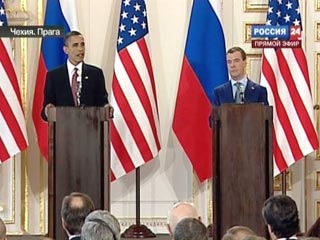
Russian President Dmitry Medvedev believes that possible sanctions against Iran should be “smart” and encourage lawful behavior. “If we talk about sanctions, although they are far from always successful, it should be smart sanctions that can encourage legitimate behavior,” the Russian leader said to a joint press conference in Prague with the US President, on Thursday, after signinga new agreement on measures to reduce and limit strategic offensive weapons.
“What are these sanctions - it is subject to separate coordination,” Medvedev added. “Today, in a frank, extremely simple and open manner, we talked about what is possible and what it is impossible. I outlined the limits of our understanding of such sanctions and said that as the President of the Russian Federation I will proceed from two messages - from the need to encourage Iran to legitimate behavior and, secondly, no less from the national interests of our country,” Interfax quotes the President of Russia quoted.
He considers it necessary to wonder why sanctions are needed. “In order to enjoy the fact of repression itself against one or another state? Or for something else. I am sure that all those present will say that sanctions are needed to encourage this or that person or one or another state to legitimate behavior,” Medvedev said, clarifying that we are talking about behavior that fits into the framework of international law and obligations adopted.
“Unfortunately, Tehran does not respond to a number of constructive, compromise agreements proposed to him, and we cannot close our eyes to it,” Medvedev noted. “Therefore, I do not exclude that the Security Council (UN) will be forced to again consider this issue.” “We will carefully monitor what steps are taken by our partners. But in any case, we will act with political and diplomatic methods that are developed by the“ six, ”Medvedev concluded.
In turn, Barack Obama said that the United States would insist on the adoption of the UN Security Council of Smart and Hard and Hard sanctions against Iran. “We will insist that smart and strict sanctions be accepted into the UN as a strong signal for Iran and for other countries that this is a question that the international community is very serious about,” the American leader at a press conference in Prague on Thursday said.
According to him, Russia "is a strong partner in the statement that it is not interested in damaging the government, the people and society of Iran." "We are for every country to fulfill its international obligations," Obama said.
He also noted that the signing of the START Treaty is "a signal to Iran that Russia and the United States fulfill its own obligations to non -proliferation." "We are sending a signal that we are ready to fulfill our obligations, and do not ask other countries to do something else. We urge to follow the rules that have been developed on an international scale," the US president said.
Iranian "six" will gather on April 9 in New York
The solution to the issue of new sanctions against Iran "goes to New York" (to the UN), said the deputy head of the Russian Foreign Ministry Sergei Ryabkov. The meeting of the "six" on Iran (5 permanent members of the UN and Germany Security Council will be held on Thursday, April 9, "at the level of permanent representatives or senior experts of the mission," he said. "It does not matter what level they gather at. The question of format does not matter. The question matters that the process is gradually starting to go to New York," the Russian diplomat noted.
Meanwhile, the official representative of the Russian Foreign Ministry Andrei Nesterenko stated that the Six countries continue to search for ways to settle the Iranian issue. “They hold regular telephone conferences at the level of political director,” said the diplomat. “We do not exclude a possible exchange of views on Iran and at the UN site in the near future.”
At the same time, Nesterenko emphasized that "the question of new sanctions against Iran is in a practical plane." “The problem is quite acute,” he confirmed. Regarding the statements of the Iranian side that Tehran has centrifuges of the new generation, which are used to enrich uranium up to 20%, the diplomat noted that "reports about the new achievements of Iranian nuclear nuclear users are quite expected on the eve of the national nuclear day" (April 9).
"The Magate stated that Iran was developing such centrifugs of an improved type for a long time, on which it was possible to conduct the process of enriching uranium up to 20%," the representative of the Ministry of Foreign Affairs of the Russian Federation continued. "Iran, within the framework of the non -pronunciation agreement, has the right to such development." At the same time, Nesterenko recalled that "the Iranian nuclear program still has questions." Tehran’s activity in the nuclear sphere "is contrary to the requirements of the UN Security Council," he added.