
Translated material
It is ordered to be considered proven
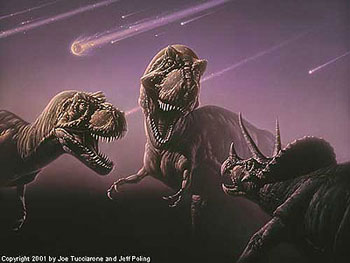
Recently, the news was held on the media: scientists have proved that the cause of extinction of dinosaurs 65 million years ago was the fall of a large meteorite of asteroid. And not some, but precisely the same, from which the 180-kilometer crater of the chicksulub on the Yukatan Peninsula and the sea shelf adjacent to it. In any case, this is the conclusion of a collective article published in one of the most authoritative international scientific journals - Science. The article was signed by 41 scientists from 33 universities and scientific centers of 12 countries of the world.
This hypothesis itself cannot be considered news in any way. The famous American physicist Luis Alvarez, nominated about 30 years ago, during this time she gained wide popularity both among the general public and among scientists (though mainly non-paleontologists). The image of the cosmic catastrophe, which put the end of the kingdom of dinosaurs, is already appearing in many popular science films, illustrations with this plot are decorated with the expositions of authoritative natural science museums. A little more - and the asteroid theory will be included in school textbooks.
True, during this time this theory has found many and weaknesses that its opponents regularly pointed to. In particular, she does not explain the selection of extinction. According to Alvareza’s hypothesis, the asteroid strike shot a huge amount of dust into the upper atmosphere, as well as smoke from the forest fires caused by it. For many years, this curtain closed the face of the Earth from sunlight, which led to a sharp cooling in the squading layer of air, the degradation of vegetation and, ultimately, to the death of dinosaurs.
However, it is completely incomprehensible why the cataclysm destroyed some groups of organisms without hitting others? Only dinosaurs died out on land, winged lizards - pterosaurs, ennanciurnis birds (a branch parallel to the real birds) and some other small groups. In the seas, extinction was affected by a larger number of forms, but also not all. It would seem that the most vulnerable to the “nuclear winter” caused by the asteroid should be green plants, and among animals - small creatures like insects. But just the species composition of insects and ground plants in the transition from the mesozoic to the Cenosis practically does not change - the impression is that these organisms simply did not notice the disaster.
The fact that after the fall of other asteroids comparable in size (for example, Eltaninsky, only fell about 2.5 million years ago, was not about 2.5 million years ago, there were no extinctions at all. And vice versa - other mass extinctions (which in the geological annals of the Earth, different authors count from 5 to 12) do not coincide with any falls of asteroids. There were no great extinction over the entire history of life on Earth, which took place about 250 million years ago, at the turn of the Perm and Triassic periods.
In addition to these theoretical objections in paleontology, specific facts began to accumulate that contradict the hypothesis of Alvareza. One of the main arguments in her favor was the “iridium layer” - the increased content of iridium in a thin layer of deposits with an age of about 65 million years. Irididius in the earth's crust is rare and, in addition, is scattered quite evenly, but some asteroids are rich in this metal. Since this layer is traced in all the studies of the corresponding age studied and everywhere is quite accurately timed to precisely to the chalk-paleogenic border (i.e., the border between the geological deposits of the Cretaceous and Paleogene periods), it is considered an unequivocal subsequent of the fall of the asteroid.
However, the synchronism of this fall with the change of geological ER upon careful consideration was not absolute. The iridium layer is thin and, apparently, really corresponds to some kind of single-moraine event. The extinction of the Mesozoic fauna was swiftly only by geological standards: it lasted at least tens of thousands of years and was not strictly simultaneously on different continents and for different groups. In particular, the characteristic Mesozoic cephalopods of the whitewood mollusks (their fossilized shells - “damn fingers” - know everything) disappear from the deposits even to the iridium mark. And vice versa: a number of deposits of the remains of dinosaurs and other Mesozoic reptiles were discovered above the iridium layer, one of them (in the place of hunting on the border of the New Mexico and Colorado) younger an asteroid blow for a good half a million years. Already for such a period, the dust raised by an asteroid should definitely have to settle for a long time!
The most, perhaps, thorough work of this kind was done by a group of scientists under the guidance of an employee of Princeton University Gertha Keller. Having examined the deposits of the corresponding age near the Mexican city of El Penon (only 600 km from the center of the Chiksulubsky crater), they found that the remains of the same sea fauna lie above and below the notorious iridium layer-the remains of the same marine fauna, and a noticeable change in the species composition begins only 300 thousand years later.
It would be logical to expect that the thorough work of four dozen authors will finally give answers to all these questions uncomfortable for an asteroid theory. But even from newspaper retelling of the article, one can understand that no original actual data in it is contained. According to the most benevolent commentators, the merit of its authors is that they collected all the information on this issue together, compared it with various hypotheses and demonstrated that the existing array of facts is best explained by the “asteroid” theory.
However, the text of the article itself does not give grounds for such a conclusion. The authors actually brought together all the evidence of the fall to the Earth 65 - 66 million years ago a large (10 - 15 km in diameter) asteroid: an iridium layer, quartz microspheres, formed only at high temperature and pressure, traces of soot from fires, and most importantly - the detection of all this in different regions of the Earth in the deposits of the same time (which indicates a single global source). Thus, the fall of asteroid at this time and in this place can really be considered proven.
But the evolutionary consequences of this fall are justified only by its synchronism with the disappearance of a number of groups characteristic of the Mesozoic fauna (including dinosaurs). The facts that contradict this synchronism are for the most part simply not discussed - as well as “uncomfortable” theoretical issues.
Only the work of the Keller group was awarded concrete criticism: according to the authors of the article in Science, the fall of the asteroid shot previously defamed precipitation into the water thickness, which then again settled on the bottom, forming layers, the formation of which would have gone under ordinary conditions hundreds of thousands of years. This, they say, explains the powerful layer of the remains of the “pre -auto -eater” fauna above the traces of the disaster. The question of why in these redesigned rainfalls not penetrated by asteroid Irididius is not considered. As well as fossils from New Mexico: it is quite difficult to imagine the whole dinosaur bones that have been flying in the air for years and falling to the ground after the settlement of dust particles.
Against the background of these eloquent defaults, the conclusion made by the authors of the “final evidence” of asteroid theory looks like an attempt to “take on the throat” - to compensate for the categorical tone (as well as the number and scientific regalia of co -authors) a clear lack of arguments. No wonder the report that formed the article in Science was not presented at any paleontological forum, but at the international conference on the moon and planets: full-time performance is not an article, they can ask a question there. It’s so better to speak to an audience whose questions can not be afraid: statements related to the competence of astronomers are justified quite reliably.
Humanly, this is understandable: while scientists remain living people, scientific disputes cannot be completely free from excitement, bias, evasions and other extra-vague components. So it would be and will be so. Another thing is more offensive: both in the ill-fated article and in the entire discussion about the causes and mechanisms of chalk-paleogen extraction, the main alternatives to the Chiksuluba asteroid are the same catastrophic events. In particular, the indefatigable critic of the asteroid theory of Herth Keller sees the cause of mass extinction in the unusually powerful volcanic activity in Hindustan, which formed the modern basalt plateau of the dean. At the same time, the huge volumes of carbon dioxide and dioxide sulfur caused sharp changes in climate, which caused the extinction of the Mesozoic fauna - fast, but still not instant.
Meanwhile, there are a number of facts that fit poorly not only the asteroid, but also in any “catastrophic” theory in general. It has already been said above that the species composition of plants and insects did not undergo significant changes at the turn of the mesozoic and cenozoic. The fact is that radical changes in these groups occurred several tens of millions of years earlier, in the first half of the Cretaceous period: the world had just appeared flowering plants and related insect groups (pollinators, leaflets, etc.).
This was followed by the last heyday of the dinosaur fauna (from the second half of the Cretaceous period, the same types of dinosaurs are known as from all previous deposits), and then its slow melting began. The extinction of specific species was no more intense than before, but virtue has practically stopped: if new ones came to the place of extinct species, now the number of species of dinosaurs slowly but steadily declined. So far, at the very end of the Cretaceous period (or even, as the new finds show, at the beginning of the paleogene) the last relics quietly have not faded.
This picture is convincingly explained by the concept of a medium -sized prichenic crisis , put forward by domestic paleontologists (primarily Vladimir Zherikhin) even a little earlier than asteroid theory. The extinction of dinosaurs in it is only the last link in the long process of the crash of mesozoic ecosystems, launched by the appearance of flowering plants - with their unprecedented features and capabilities.
In its original form, the concept described mainly events on land, but later hypotheses appeared to connect the sea extinctions with these events (for example, the hypothesis of the American researcher Helen Tapan, which suggests a sharp reduction in the washing of mineral salts from the continents to the oceans). However, these in the full sense of the word evolutionary hypotheses today occupy a rather marginal position. Much exceeding “catastrophic” theories in accordance with well -known facts and in fruitfulness, they are inferior to them in one: they cannot be stateed in the form of a comic book. This greatly limits their distribution outside the narrow circle of specialists. And vice versa: simple assumptions, easily translated into visual images, are becoming popular - for nothing that their compliance with the facts, to put it mildly, is unsatisfactory.
Georges Cuvier applauds from the coffin: his theory of disasters, it would seem, finally buried by the evolutionary concepts of Lyel and Darwin, defeated them from the inside. Not because it explains the famous facts better, but because it is more complying with the desire of the human mind to simple and visual explanations.
The drawing of an expert on drawing dinosaurs Joe Tucciarone.
See also:
- Zhukov B. Gene, separating hearts
- Zhukov B. Three families in one family