
Translated material
Kyrgyz cycles
Kyrgyzstan fell into a vicious circle
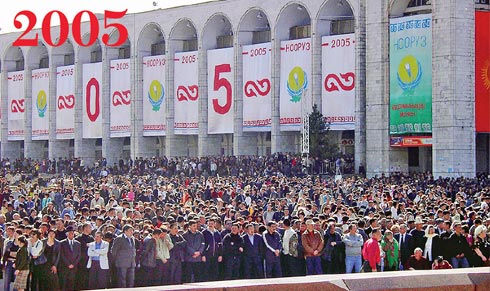
If the “tulip revolution” of 2005 with a certain stretch can be classified as “color” - it was still associated with protesting against the election manipulation and “tried to be peaceful”, then the current riot is much closer to the classic revolutions of the past - with street battles and taking the armed crowd of different “basstilians”, and at the same time - the robbery of the “palaces of tyrants” and the shops ” ordinary merchants
The fall of two Kyrgyz presidents in the interval of 5 years was accompanied by similar circumstances. What is associated with the same type of regimes they created - the regimes of personal power, camouflaged for democracy. This can be seen even in details: both Akayev and Bakiev, sons were engaged in the creation of a family business empire. Both of them excluded the possibility of the opposition’s legal and peaceful coming to power and ended equally: the rotation of the authorities still occurred, but by violently. However, there were significant differences between the two modes, which predetermined the difference in the revolutions of 2005 and 2010.
The "bright path" of the regime
Akayev is an academician and Democrat, at one time a member of the interregional deputy group, a person who made speeches about the greatness of Sakharov. He sought to maximize the benefits from his image of the only democrat president in Central Asia and for a long time went to the Western favorites. This, however, did not change the nature of the regime and vector of its evolution. Like his party -cat neighbors, Akayev dispersed the parliament, changed the constitution, extending his terms and increasing powers, manipulated elections, pressed the media and put his political opponents in prison on charges of criminal crimes. But the genesis and image of Akayev were still factors that softened the regime and slowed down its authoritarian evolution. Akayevsky authoritarianism was to the very end relatively soft and specifically “bashful”.
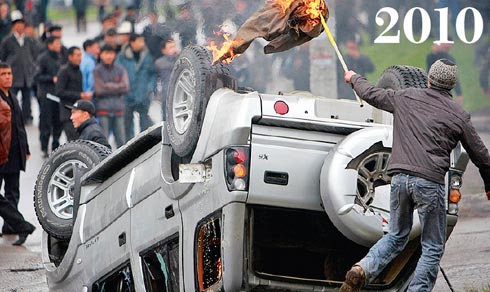
Kyrgyz cycles: Revolution - unstable democracy - authoritarianism - new revolution
The Bakiev regime that arose from the 2005 revolution, or rather, from the subsequent anarchy and the scream of the revolutionary leaders (the most cynical of which quickly removed his old associates, which now became the leaders of the new revolution), was completely deprived of any “bashfulness”. He evolved rapidly and in a few years turned into a regime, in comparison with which Akayevsky, even in his later stages, began to seem a real democracy. Unlike Akayev, Bakiyev, using Russian and Kazakhstani experience, created his own party of the “bright path” and provided it with full control over parliament, not allowing the main opposition parties to it at all. Moreover, not so long ago, he allowed himself what not a single post -Soviet president allowed himself: he publicly doubted the benefits of the elections and began to talk about the transition to the “advisory” democracy (this is cleaner than the “sovereign”). And if under Akayev the opponents of the president were accused of economic crimes, then under Bakiev they began to fall into automobile disasters and “unknown persons” began to beat them and throw them out of the windows. Bakiev was afraid of the repetition of the revolution that led him to power, and the repetition of the fate of Akayev, he sought to eliminate all the legal channels of protest expressions. As a result, the revolution adopted more stringent forms, and its fate, obviously, will be sadder than the fate of the predecessor professors at Moscow State University.
Revolution instead of elections
Why is the 2005 revolution, one of the leaders of which was Bakiev, led to the regime even more authoritarian than overthrown? And why did he be even less durable than his predecessor? Where does this "cyclicism" of Kyrgyz political development come from? The answer to these questions requires in -depth analysis. But some contours of the answer are already visible.
Kyrgyz loves to talk about their traditions of "steppe democracy." Indeed, unlike the Uzbeks or Russians, the Kyrgyz in the past did not have a despotic statehood. It is difficult to rely on history here, it is not perceived as a natural, normal form of government. In addition, the Kyrgyz in the Kyrgyz are very strong tribal and regional loyalities, which also limit authoritarian power - she is forced to take into account and think about observing the balance of forces. Both the northerner Akayev and the southerly Bakiev violated this balance, and if in the 2005 revolution the protest of the intelligentsia concentrated in Bishkek was supported by deprived southerners, then in 2010 the main protest mass was concentrated in the north. The Kyrgyzs are not very afraid of the authorities and easily arrange rallies, block roads, organize "trips to the Bishkek", etc. But although in our time any protest and any riot is ideologically formalized as the struggle for democracy, the local freedom and rejection of authoritarianism are very far from legal democracy - the laws of the Kyrgyz are even less. It is easier for them to arrange a revolution than to hold normal elections. Even the events of 2005 did not lead to honest elections: the winners did not dissolve the parliament, elected with gross violations, which served as a pretext of the revolution - they only expelled Acaev deputies from it. And the next elections were already organized by Bakiev.
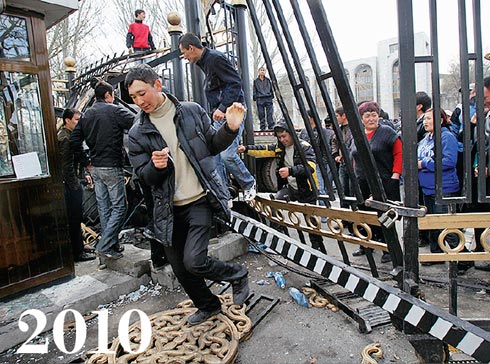
If society is not inclined to obey authoritarian power, but at the same time the psychological and cultural prerequisites of democracy are weak in it, it turns out that we see in Kyrgyzstan: weak and unstable democracies are replaced by weak and unstable authoritarian rule, the end of which is laid for revolutions that begin the new cycle. In the post -Soviet space, a similar combination of “freedom” of society and the weakness of it in it is the prerequisites of democracy in another country - Georgia. To get out of such cycles is very difficult, much more difficult than overthrowing a particular authoritarian ruler. The main task, objectively facing Kyrgyzstan, is a translation of steppe freedom and anti -autoritarian protest into a legal democratic direction. It is necessary to end these cycles: the revolution is chaotic and unstable democracy - authoritarianism - a new revolution. How? Nothing new: by democratic rotation of power based on elections. Then the 2010 revolution has a chance to become the last.