
Translated material
Is there life on ...?
This article continues the publication about the observation of exoplanets published in the TRV No. 49, which presents the main facts known at the moment. Repeat the main one.

So, 442 planets are known for other stars (at the time of writing the previous article was 429). Almost all of them are much more than the Earth, most comparable in mass with Jupiter. Their orbits are not at all like what we see in their system: many giant planets rotate very close to the star (“hot Jupiters”), and those that rotate away have elongated orbits, as if avoiding circular. In addition to the fact that these systems are not like sunny, they are mostly not suitable for life: there can be no analogue of the Earth with a stable orbit in them. Of course, such planetary systems are more easily detected than a copy of ours. Question: How much the “ugliness” of the discovered systems stems from observant selection and how much is it a sad truth in life?
Despite the fact that a lot of systems with hot Jupiters were discovered, they are not so typical. Giants with an orbital period of several days with modern methods are probably found from distances to a couple of hundred light years. And if the star does not find a hot Jupiter, then he really does not have it. It turns out that giants with a period of circulation in several days have only 1-1.5% of stars close to the Sun in terms of luminosity. GIENTS in orbit, comparable to the orbits of Mercury or Venus, are also found quite easily: 3-4.5 % of stars have such systems. In these systems, life is very problematic. For the overwhelming majority of stars, there is a complete scope for fantasy. Is it possible to somehow limit this scope using the theory? Perhaps yes.
The previously existing views on the formation of planetary systems developed under the strong influence of the only well -known copy. In the theory of formation of the solar system, everything is logical: the gas-pile protoplanetary disk became increasingly flat and structured (such as the rings of Saturn). Everything moved in circular orbits. Closer to the sun -only dust, away -dust, ice particles and gas. Due to the sticking of particles, blocks form, from them - the embryos of the planets. The gravity of large embryos becomes noticeable, and the growth rate is accelerated. Closer to the star, where there are few gas, the planets of the earth's group are formed, at a distance-solid embryos with a mass of ten earthly are pulled over gas, growing into giant planets. Far from the star, where the gas is slightly smaller formed icy giants (Uranus and Neptune). The process proceeds at least 10 million years, as a result, a well -balanced stable system is formed. This, of course, is a strongly simplified picture.
Revision
Now there are many known specimens, and they, as already mentioned, do not fit into this picture. Firstly, hot Jupiters. Where they are found, they could not form - the star sweeps all the building material from these areas. Their discovery stimulated the theory: the effect of planet migration was opened. Having formed, the planet eats a ring gap in the disk. However, it interacts with the substance of the disk outside the gap, and if the disk is massive enough, then the orbit of the planet begins to change. As a rule, it decreases, but sometimes it can increase. The orbit changes until the planet migrates outside the disk, for example, in the nearest neighborhood of the star, where the entire substance is estimated by its radiation and wind. She remains there.
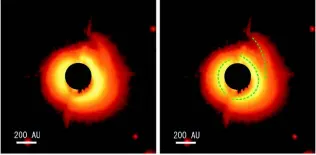
The second radical revolution in the performances came with the understanding that the protoplanetary disk does not have to be as perfect as the rings of Saturn. It can be crooked (this is observed), it can be heterogeneous along the azimutal corner and even have spiral sleeves similar to galactic. Alan boss (Carnegie, USA) in 1997, using numerical modeling, revealed the formation of spiral sleeves in the protoplanetary disk and their compaction to the stage when gravitational instability should begin-direct and fast collapse of large clouds of gas in the planet-giants without any hard germs. Subsequently, numerical modeling was carried out with the best resolution, which allowed to trace the process further. A certain idea of him gives Fig. 3, which shows the evolution of the disk in a very short period of time - for literally several orbital periods. It is also evident that the process speed is very much dependent on the density of the disk: the change by 10% radically changes the picture. So, instability develops instantly on astronomical scale, and giant planets are born immediately by numerous broods, as can be seen from the lower right picture.
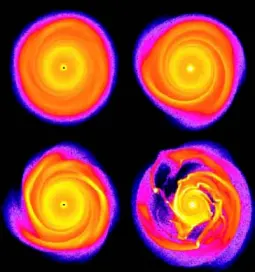
The birth of many giants at once does not end - the mutual "billiards" begins due to the gravitational interaction of the planets. They exchange impulse, some are thrown into outer space, replenishing a lot of freely flying planets, part falls on fairly close orbits with relatively large eccentricities, which are mainly observed. There is no place for life in such a scenario again: the Earth is likely to be thrown out of its orbit. And in what script is a place for life?
To survive the earthly planets on the right orbit, the density of the protoplanetary disk should not be too large-less than required for the mass birth of the giant planets and the process of migration to the star. But too small density is also not suitable. The point is not only that the planets of the earth type should form. In order for life in the system to exist, the absence of Jupiter in an unnecessary place is not enough - its presence is also required in the right place, i.e. In a fairly large orbit. A massive planet in the system plays the role of a garbage man, cleansing the internal areas of the "construction waste" that remained after the formation of the planets. Now almost all of our garbage - behind the orbit pluto in the cloud of Oort. Without Jupiter, the intensity of the Earth’s bombardment with comets and asteroids would be many times higher.
So, apparently, planetary systems suitable for life arise in some kind of density of the protoplanetary disk, when giant planets are formed through the formation of solid embryos in a small amount. How much this range is narrow, now it is impossible to say. But, based on the observed abundance of planetary systems, it can be expected that the nearest Earth is not at the other end of the galaxy, but within one or two hundred light years. It would seem, what's the difference? And in that and in another case, it will be beyond the limits of visibility and even more so ...
See another land?
The analogue of the Earth at a sufficiently large distance can be detected by transit (passing along the disk of the star), see the previous article in TRV No. 5 (49). In this case, you can roughly estimate its size, and that’s it. You can get much more information, but by other means. Two projects were aimed at this -the European Darwin and the NASA project TPF (Terrestial Planet Finder). Darwin has already been closed, practically without starting (in 2007), TPF is not yet (but funding has not yet been allocated). Imagine that we could learn about the double of the Earth from a distance of about 30 light years if the Darwin project had been implemented.
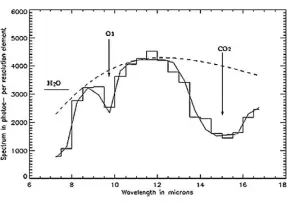
Darwin was conceived as a space interferometer of several infrared telescopes similar to the already launched Hersell. The project is based on the method of interferometric stamping of the light of the star. If several of these telescopes, located tens of meters from each other, can be controlled with micron accuracy with the help of microdisters, it can be achieved that the light from the selected star will be almost completely caught, and the light of the planets circling around it is not. The most important thing is that at the same time you can remove the spectrum of the planet in the infrared range, and this spectrum can say a lot. In Fig. 4 - the estimated spectrum of the Earth, as it would be shot by Darwin from a distance of 10 parsecs in 100 hours. The molecular strips of absorption CO2, water and, most importantly, ozone are perfectly visible. Such an amount of ozone (respectively oxygen in general) can only be if there is life on the planet. The fact is that oxygen is a very active element, it should be chemically connected. A small amount of oxygen can give cosmic rays, breaking CO2 or water molecules. But a large amount of oxygen in the atmosphere clearly suggests that a powerful nonequilibrium process is on the planet. We know only one such process - life.
Almost science fiction
I would very much like to live to the opening of an extraterrestrial life, but judging by the “enthusiasm” with which the relevant projects are developing, it is time to come to terms with the unreality of this dream. Future generations, of course, will find planets with oxygen absorption lines. What next? In principle, these planets can be considered better by spending much more funds: somewhere on paper there is a concept of a large array of space telescopes that can give a picture of the Earth from a distance of 30 light years with a resolution of 25 x 25 pixels.
Is it possible to send a probe there? "Bolvan", which will arrive in that area after a million years? No problem. But in principle, a probe is also possible, which will fly over the historical scale of time - thousands of years and will be able to transmit information to Earth (if there is still someone who is able to accept it). There are a lot of problems, but not fundamental scientific, but technological, in principle solved at high costs. But the main problem is different: a person is not such a biological species that has a natural motivation to make efforts for the sake of distant generations. At least now is not.
Are there any projects designed for generations in history in history? At the same time, there is no need to consider utopian theories - only practical steps associated with a serious cost of effort and means. I heard about one such. The Swedish king from the Vasa dynasty (probably Gustav Adolf) back in the XVII century. He commanded to put on the island in the lake. For decades for decades, the vettern is stealing the lower branches of the oaks so that by 2000 a slender ship oak forest for the Swedish fleet grows. And such a forest really grew up - now tourists go there with a rampart, completely paying off the costs of three -century ago. This inspires some hope.
The main meaning of many large -scale projects, if you look from a great distance, is often different from the declared. Suppose, the cost of the efforts of a group of states comparable to the efforts of the Egyptians in the construction of the pyramids, several probes have been launched to promising exoplanets. Nuclear installations, plasma engines, large antennas, etc. The main data is expected in thousands of years, and on Earth the current working data come to Earth. Is the main meaning of the project in those long -awaited data from exoplanets? Or maybe the main meaning is that, as the instinct tells, all this will greatly increase the chances of the existence of people who can accept the data sent for the design deadline?
Boris Stern