
Translated material
Tax greenhouse
Details of the relationship of the corporation with the budget
The fact that every fifth ruble entering the budget belongs to Gazprom, in our country, probably he heard everyone: obsessive advertising of the gas monopoly does not allow to forget about this. But the fact that the share of taxes in the revenue of Gazprom is several times less than that of any other energy company in the country, advertising is silent. How a monopoly interacts with the budget - the New Times sorted out
In 2008, Gazprom transferred 685.8 billion rubles to the budget: tax deductions amounted to only 19% of the revenue. * * The official reporting for 2009 has not yet been made public. And the Lukoil oil company gave the state 56% of its income. In 2007, Gazprom paid $ 7.3 to the budget from the barrel of oil and gas - against almost $ 40 paid by the largest domestic oil companies. The reasons for such a low return should be to look for a gas monster in the past.
We cry, but love
Experts with irony call Gazprom a “eternal wallet of the government”. Since the beginning of the 90s, an unspoken agreement has been established between the company and the government: Gazprom pays to the budget as much as the state is necessary for urgent needs. Moreover, Viktor Chernomyrdin, the founding father of Gazprom, acted as a “petitioner” from the state. “Gazprom’s foreign exchange earnings played the role of a kind of stabilization fund in the 90s,” recalls Nikita Maslennikov, assistant to the chairman of the government of Viktor Chernomyrdin in 1993-1998. - It was a government background to cover the so -called cash register budget breaks: it was necessary to pay salaries, pensions, but there was no money for this. And when the “edge” came, there was a magic wand-lifesa-Gazprom. There were a lot of such cases. ”
One such case recalls the former first deputy prime minister Boris Nemtsov: “In 1997, when the government faced the task of paying off the payment of pensions, President Yeltsin gave the Gazprom management immediately to find 10 trillion rubles for the Pension Fund ($ 2 billion at the then rate). Within a month, the money was found. ”
However, Gazprom was not engaged in charity. An agreement was concluded between the company and the tax service. Its essence: Gazprom received an interest -free tax loan for 1998-1999 "for the amount of the difference between the amount of accrued and paid taxes." However, in early 1998, Gazprom did not even fulfill a sparing agreement. On June 2, 1998, Prime Minister Sergei Kiriyenko announced the need to break the trust agreement with the head of the company Rem Vyakhirev and the arrest of Gazprom accounts. On June 17, Vyakhirev arrived for support to the Duma, where he uttered a historical phrase: "We love the Ministry of Finance ... we cry, but we love." The Duma supported Gazprom, Vyakhirev remained at his post, and accounts at his disposal.
The Accounts Chamber subsequently estimated the loss of the budget from the operation of the Gazprom special settlement with the tax service of 22 billion denominated rubles. Thus, the model of the state’s relationship with Gazprom in those years was not based on laws, but on agreements - the state was forced to meet Gazprom: gas supplies to domestic consumers, as well as consumers in the CIS, were carried out at prices that did not provide Gazprom profit.
In addition, Gazprom came across large non -payments. The result is logical, Nikita Maslennikov believes: "Even then, the company was very bloodless according to its investment programs, and there was not enough money to master its own deposits."
Anti-Lyr
In the early 2000s, with the coming to power in the country of Vladimir Putin, and in Gazprom-his protege Alexei Miller, the situation began to change. In 2001, the Accounts Chamber noted the aggravated financial problems of the gas monopoly. And at the beginning of 2002, the Federal Tax Service accused Gazprom of underestimating revenue, arrears of more than $ 1 billion and threatened management, led by Alexei Miller, criminal cases. On the same day, the company's shares collapsed by 8%. It was then that Gazprom demonstrated its “latest” political resource: during the rapid trial, all charges from Gazprom were removed. There was only one position from a billion claim - $ 17.5 (this is not a typo - seventeen and a half US dollars)! But the monopoly did not fight for her and preferred to pay this amount to the budget. So it was demonstrated: the new team of top managers, selected by Vladimir Putin, is inviolable.
Under Alexei Milelre, although not immediately, the consolidation of the control package of Gazprom shares in the hands of the state. On March 31, 2003, the control of Gazprom’s “Daughter” was 17.4% of its shares. As of December 31, 2007-only 0.3%. In other words, Gazprom acted as an anti-lyre, returning to himself what he had previously handed out to the “daughters”.
True, in this operation, the state budget lost over $ 27 billion. How exactly - Boris Nemtsov and Vladimir Milov explained in the report “Putin and Gazprom”. In 2005, 10.7% of the monopolist shares was bought by the Rosneftegaz state -owned company. The remaining 6.7% simply disappeared somewhere from the balance of Gazprom. The price of the loss is $ 20 billion. If the Gazprom’s shares were transferred to the balance of the maternal company, the state would increase its stake from 39.3% to almost 48% free of charge, and the remaining slightly more than 2% of the shares could be purchased in the market for $ 500–700 million, the authors of the report were calculated. In fact, Rosneftegaz bought 10.7% of Gazprom’s shares in the market for $ 7.2 billion budget money.
In the management of information from Gazprom, in response to the request of The New Times, comment on the consolidation process of assets said that “a number of assets were illegally withdrawn from Gazprom at one time. The activities for their return were logical and necessary for the company. Further work with these assets included measures to improve them and increase economic efficiency. The subsequent sale of a number of these assets was carried out as part of the work of Gazprom to consolidate efforts on the development of specialized business areas, which are gas, oil and electric power industry. ”
Whip and gingerbread 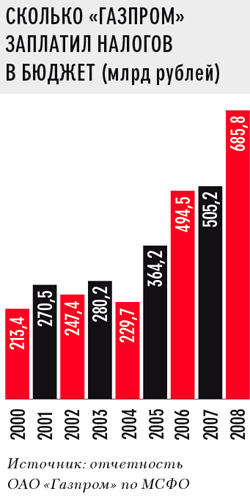
At the same time, Gazprom quite effectively reflected all attempts by fiscal departments to increase the tax burden on it. Say, in 2006, the gas NPI rate was increased from 107 to 147 rubles per thousand cubic meters, although the Ministry of Finance demanded 735 rubles. As a result, Gazprom pays a tax on mineral mining annually in the amount of less than $ 3 billion, but was supposed to, if the Ministry of Finance insisted on his own, about $ 10 billion.
In general, if the government has a tax whip for Gazprom, then the authorities are waving it very carefully. At the same time, a sweet gingerbread is always stored for a gas monopoly. On the eve of the resignation of Mikhail Fradkov in 2007, the Cabinet of Ministers adopted a resolution on raising gas tariffs. The pace of their growth was set, which should ensure the doubling of tariffs by 2011. Every year they grow by an average of 20%. And of course, the state does not dare to demand any dividends from its beloved company. Here is a good example: the Russian state belongs to a little more than 50% of Gazprom’s shares and 50% of the shares of the Russian-Vietnamese joint venture VITSEVPETRO. From Gazprom, the federal budget has never received any dividends. VITSovpetro replenishes it annually by an average of $ 1 billion.
“The gas monopoly was placed in frankly greenhouse conditions,” the former first deputy prime minister Boris Nemtsov concludes.