
Translated material
Leaky pipe
Big company - big difficulties
In the crisis, many large companies suffered. Gazprom was no exception: 2009 was the worst for him in the dynamics of indicators over the past ten years. How the company adapts to new conditions - the New Times found out
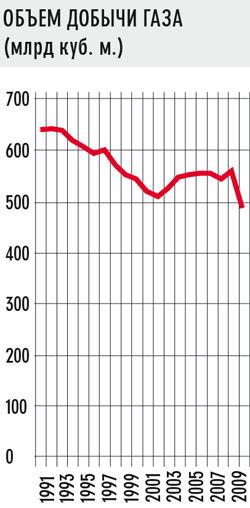
Gazprom survived the fall in almost all parameters. According to preliminary data, the company obtained 462 billion cubic meters of gas in 2009 - 87 billion cubic meters (almost 16%) less than a year before. The situation with sales in foreign markets also turned out to be dramatic. Gazprom managed to sell 140 billion cubic meters of gas in Europe and other far abroad countries-20 billion cubic meters less than in 2008.
In the post -Soviet space, sales collapsed even more. An increase in the average price by almost a quarter, to $ 209 per thousand cubic meters, led to the fact that consumers bought only 53 billion cubic meters from Gazprom (minus 44 billion cubic meters by 2008). Finally, for three quarters of 2009
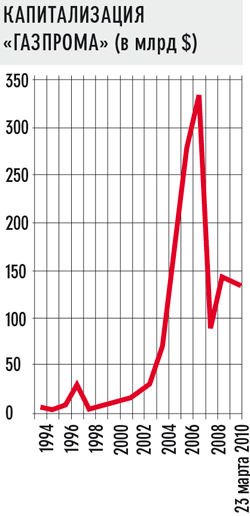
* * Gazprom has not yet made public more fresh statistics. The total debt of the concern came close to $ 60 billion, and the net (after deducting cash residues) is a record $ 49 billion. Capitalization of the Russian gas monopoly, according to the Bloomberg agency, has fallen 2.5 times over the past two years: now its assets are estimated at $ 144.87 billion (32nd place in the list of the largest companies in capitalization of the company Mira).
Metamorphoses of the market “In early 2009, oil prices fell sharply,” explains Vladimir Feigin, director of the Institute of Energy and Finance. - Gas prices under long -term contracts do not have such flexibility, they are late. When the situation in the economy is stable, they have their own validity. But when there is a sharp drop in these prices, and the alternative spoke market works and there are gas reserves in storage facilities, companies have a certain opportunity to optimize their portfolio. And they began to do this: in the first quarter of 2009, European countries have seriously reduced gas purchases from the Russian company and began to use other components of their balance as possible. ”
Gazprom did not want to put up with a new reality for a long time. But the Federal Court of the German City of Karlsruhe in March recognized the reservations in contracts about the possible adjustment of gas prices for end consumers in the case of changing oil prices. In fact, the court decision, which can become a case, prohibits broadcasting Gazprom’s increase in end consumers, pushing energy companies to the transition to the purchase of liquefied natural gas, which is now half cheaper, and in the midst of the crisis was three times cheaper. It is not by chance that in 2009, Gazprom’s export to Europe fell by 11.4%, its share in the European market decreased from 25%to 22%, and the export revenue of the monopoly, according to preliminary data, amounted to $ 40 billion against $ 64 billion in 2008.
The decrease in supplies from the Russian Federation was compensated by Europe primarily due to cheap Qatarian gas: in 2009, Qatar sold liquefied gas to Europe for $ 70–90 per thousand cubic meters against $ 260–300 under the long -term contracts of Gazprom. The largest consumers, such as Germany, Italy, Türkiye, which accounts for exactly half of Gazprom’s export sales to Europe, asked to reduce their minimum gas selection level
* In the contracts, the provision called Take-Ru-Pay is recorded, that is, regardless of price or needs, the party that signed the contract should take a certain amount of gas at previously agreed prices or pay a penalty. for 3-6 years. Realizing that it is pointless to rely on the previous rules of the game in the new conditions, Gazprom announced steps aimed at reducing the reducing of its gas - up to 15% of supplies to Europe will be carried out at sport prices.
“The decrease in spotal gas prices will force Gazprom to reduce the prices for long -term contracts by about $ 50–70 per 1000 cubic meters,” says Mikhail Krutikhin, Rusenergy analyst. “In this case, the company may not cope with the financing of many investment projects in the Russian Federation if the state does not begin to subsidize them at the expense of taxpayers, reducing the tax burden on the industry.”
“In the next 5-6 years, export prices for gas will not be restored to the level that Gazprom would give sufficient revenue and profit for large -scale investments,” confirms Vladimir Milov, the former deputy minister of energy of the Russian Federation. If in previous years, Gazprom could afford to live with an investment program of $ 10-15 million, now it needs 3-4 times more. To take these funds of the monopoly, says the expert. The deficit is already making itself felt: in February, a decision was made to freeze for three years of development of the Shtokmansky deposit, liquefied natural gas from which it was planned to be supplied to the United States.
What is ahead? “I'm afraid I don’t have very good news for Russia,” said Fatih Birol, chief economist of the International Energy Agency. According to his forecast, the oversaturation of the gas market will be observed until 2015. In Gazprom, they do not agree with such an assessment. The deputy chairman of the board Alexander Medvedev is sure that European demand will be restored by 2012. At the same time, Gazprom still relies on its large portfolio of long-term contracts in the European market. According to the gas giant, the company's sales in all export markets outside the space of the former USSR will increase until 2030 more than double and reach the volume of 320–345 billion cubic meters.
In addition, Gazprom expects the fact that domestic gas prices will increase. So far, the Ministry of Economic Development in its forecast lays the dynamics of gas prices for 15% annually in 2011 and 2012.
However, Vladimir Milov believes that all this is not enough for a monopoly can cope with the budget deficit and colossal debts: “Given the revaluation of the demand, Gazprom managers need to sit down and count all their cyclopic projects - like the launch of the northern and southern flows. So that it does not happen that they will bury a lot of financial resources there, and then the pipes will be half empty due to the lack of demand, as is now happening with a “blue stream”.
 |
| Source: Gazprom |