
Translated material
War on Moscow streets
How they survived in the capital
"Tell me about the war, how you lived and survived in Moscow." And she immediately remembered. In 1941, Tamara Borisovna Yunanova, aunt of the author of these lines, was 12 years old. She survived the war in house number 9 in the Theological Lane - this is not far from the editorial office of The New Times. True, it has long been gone for a long time: they demolished in the early 1970s, having built in its place a low-story brick condominium for the heroes of social labor and instructors of the CPSU Central Committee. Then this contingent changed ... Only the memory of the war remained
1941
October 16 was the hardest day. Many panic seized - the German stood very close. Shops got rid of the remnants of products - people outside the card norm were given flour, salt, etc. But dad told us: do not be afraid, anyway they (the Germans) cannot be here. For some reason, he was sure.
In the evening, in all houses, heavy brocade curtains on the windows were lowered - they were sold everywhere. To those who did not or forgot to do this, they came from the commandant’s office, and if they were re -violated, already from the NKVD. Once I saw on Bolshaya Bronnaya: military trucks are standing, sprinkled with a layer of plaster and cement. A bomb hit the neighboring house in the Theological Lane, on the first two floors many people died. There was silence around. It always was so when the rubble after the bombing was dismantled-suddenly somewhere living people remained to hear them. There have never been looting. Only the children went to the rubble and took books, if caught.
Another time, the bomb fell in a three-breed, right on my school, 120, three teachers died. Then all the schools closed. Many students were engaged in the house themselves. To those who graduated 7th grade, teachers came to the house-exams are taken to a certificate of incomplete secondary education.
Many bomb shelters were equipped in the cellars of theaters. Once they announced anxiety, we went to the bomb shelter in the chamber theater
* * Now in this building on Tver Boulevard is the Moscow Drama Theater named after A.S. Pushkin. - It was a wonderful theater, no worse than the Moscow Art Theater. The actors met everyone in the basement and determined in places.
1942
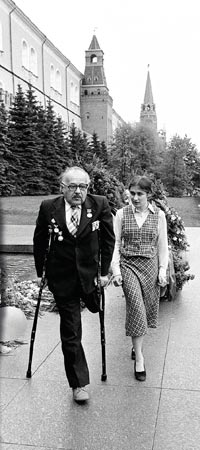 |
| May 9, 1983. Moscow. Aleksandrovsky Garden (photography of Viktor Akhlomov) |
Many English officers appeared in Moscow. There was talk that the “second front” would soon open. The newspaper “British ally” began to publish in the city - the British themselves produced it in Russian. Officers loved to go to the Bolshoi Theater-because he worked big-to watch Olga Lepeshinskaya: Ulanova and Semenova were evacuated to Kuibyshev, and Lepeshinskaya remained, dancing the whole war. Muscovites also went to big. There in the opera Barsova sang, Lemeshev ... They did not go anywhere.
A lot of products on Lend-Lease appeared: stew, condensed milk, egg powder, cheeses were different ... British, diplomats and the military, willingly took Muscovites as a wife, then marriage with a foreigner was still allowed. It was forbidden shortly after the war, and as if the law acted in reverse force: the husbands left for their home, but they did not let out many wives. American films went to the cinema - they said they were shot in Hollywood specifically for showing in Russia. I remember the tape “Song of Russia”, then the famous actor Robert Taylor and Mikhail Chekhov played there. The kids then used to go three times a day in the cinema: you are sitting in the cinema, and here - air anxiety, they put out everyone, but with the right to repeated viewing. How could you not use it!
We had a lot of expensive knitwear at home, good dishes, clothes ... The older sister Nina went to collective farmers in Savelovo to change all this to meat, milk, honey ... Why are the collective farmers luxury items? Firstly, then it was always possible to resell ... And then people hoped that the war would end soon, a normal life would return ...
Products in stores were given only by cards, for cash it was possible to buy bread, cabbage, potatoes, meat on the market ... They even sold sugar for cubes. 700-800 rubles were asked for a loaf of bread, a bottle of vodka was about the same. My girlfriend’s husband worked as a bus driver before the war, received 1000 rubles a month, and then she was 6 rubles.
Only foreigners were allowed into Eliseevsky. The Aragvi restaurant worked, but only for a limited contingent, people with ties there got vodka, cakes, something else delicious ... After all, the connections meant a lot. Wardy people were easier to transferred the war. Since my friend, since the pre -revolutionary times, there was an apartment in the Bulgakovsky house on the Patriarchals, but they never knew how to live, as it is customary to say, they sold everything that they had valuable in the house in a matter of months, and then their neighbors wore soup from potato cleanings - they cleaned potatoes specially for them.
People then in Moscow very compassionate, high quality, completely different people ... I remember that two orphans returned to our yard from evacuation, they had nothing to wear at all-so the whole yard sewed their clothes from old things.
1943
Some schools opened. Breeds for breakfast began to give bagels. The Germans have already been driven far from Moscow. But they still did not go. There was a military headquarters on Bolshaya Bronnaya, with him a dining room. The kids stuck out for a long time under the windows: then they came home and told how it smells tasty there.
1944
When they spent a lot of people gathered a lot on the Street of Gorky, the people gathered. There was complete silence - no cries or evil comments. Many soldiers, instead of shoes, have some windings, tattered wire, carried torn overcoats under his arm. They felt sorry for them. How and what their native soldiers are fighting, in which conditions, many did not know, they didn’t even know ... The newspapers and radio were silent about it.
1945, May 8
Nina brought two tickets to the concert to the Operetta Theater (he was where the satire theater is now, on Mayakovka). The concert was given in honor of May 1 - no one knew yet that tomorrow the war would end. Kozlovsky sang a bis nine times! Usually he only two or three times came out. Natalya Spiller sang, a big soloist, in a red dress ... The concert dragged on until two in the morning.
Everyone learned about the end of the war by radio. In almost every Moscow court there was a plate-crooking-radio receivers during the war of all Muscovites confiscated. One of the neighbors knocked on our door early in the morning: “Peace! The war is over! They just said on the radio! "
1946
The house on the corner of Tverskaya and Bolshaya Bronnaya, where McDonald's now, after the war, the prisoners of German soldiers built. The grandmothers approached and threw bread to them - the Germans looked miserable, everyone was sorry for them ...