
Translated material
Partisan ballad
From Belarusian forests - to the walls of the Reichstag
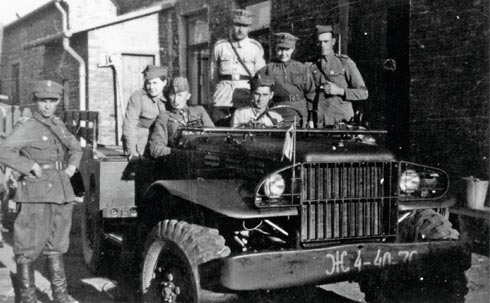
1945 somewhere in Germany. Guy - the third on the left, in a cap and with a cunning squint (from a personal archive)
In 1941, Senior Lieutenant Nikolai Dudkevich, the great -grandfather of the author’s line, organized one of the first Belarusian partisan detachments. In occupied Belarus, he was known under the nickname Gai, which means the Belarusian means - forest
Every year, when the cold came, Nikolai Vladimirovich Dudkevich began to limp on his right leg - a bullet faded in caviar, launched by the fascist soldier on March 8, 1943 in the deaf Belarusian forest. Lead has grown in the venous system that the doctors decided not to remove it: the veins did not know how to sew it yet, and there was no threat for life, except for seasonal inconvenience.
From Dudkevich, who had never raised his voice, there was always some incredible aura, which did not combine with his good-natured, decorated with a hooked nose-the fortitude, frightened even local young hooligans, who had to come across a veteran.
The great -grandfather collected a collection of books about the Second World War, which mentioned the Belarusian front, and a pencil pedantically emphasized all the places dedicated to his detachment. He was indignant when he met inaccuracies in numbers and dates, but he rarely spoke about the war. It is because of this partisan skill of playing the silence in his biography that there are a lot of folklore-transmitted from mouth to mouth, from generation to generation, the facts were overgrown with details, details, and contradictions.
The initial jerk
He was born in 1908 in the village of Senchuki, Tolochinsky district of the Vitebsk region. The third child in a peasant family is two older brothers, a younger brother and sister. The surname Dudkevich wore half the village, and he himself knew not only the Russian language, but also Polish, which, however, did not advertise. When the great -grandfather was asked about nationality, he replied: a communist. In the neighboring town of Drutsk, Kolya graduated from the seven-year-old, became a Komsomol member and went to Moscow to Moscow for a Rub-Tkatsky Factory for a Komsomol ticket in 1926. At the age of 21, he got to the armored school in Nizhny Novgorod. Shortly before that, Nikolai married Claudia, a daughter missing during the October Revolution of Putidian engineers. In 1931, twenty -three -year -old Nikolai joined the CPSU (b): the party card was handed to him by the commissar of the Bauman district committee of the party Nikita Khrushchev, the future Secretary General. Nikolai was always proud that he was born on one day (but two years later) with Leonid Brezhnev and joined the party in one year with him. In 1933, the son of Sasha was born to Dudkevich. By this time, Nikolai had already graduated from the school with the rank of lieutenant, learned the German language, and his family moved from unit to the unit in Ukraine. In 1937, in the rank of senior lieutenant, he became the commander of the authority of the battalion of aviation services (BAO) in Uman-a town in the center of Ukraine. There Dudkevichs and settled.
Environment
Great -grandfather began the war, the personnel officer of the Red Army, but did not stay long for them: his company was surrounded. They got through the forests, in German rear 6 months, with a gun on wheels - there were 43 people. So we got to Senchukov. Why went there? Dudkevich considered that not today the Red Army would definitely break the Nazis today, so, while the connection with Moscow is interrupted and complete confusion, it is necessary to go to the western border in order to help the army drive the fascist invaders there. But when they finally came to Senchuki, it was already December 1941, and the locals said: the Dnieper was red from the blood of the bodies of the shot prisoners dumped into the water, and the Germans, they say, took Moscow, nothing is clear, everything is bad.
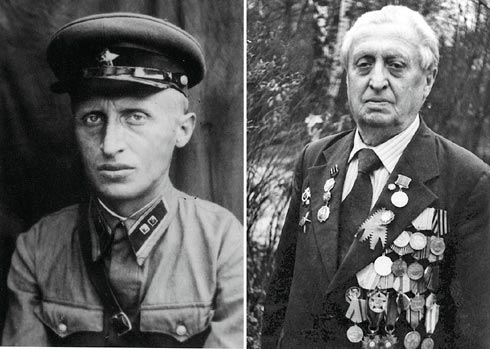
July 1937 Lieutenant Nikolai Dudkevich, city of Proskurov (since 1954 - Khmelnitsky)
Guy has two dozen medals. Among them are two silver Polish crosses,
medals "For Warsaw", "For Berlin", the Order of the Red Star,
medal "Partisan of the Patriotic War" I degree
(From the personal archive)
Senior Lieutenant Dudkevich realized that it was impossible to sit out in the cellars and under the underputs - if they find, they would kill not only them, but they will not spare the village. And then the detachment armed with a cannon and family with hand machine guns went into the forest. Forest in Belarusian-Guy. So the commander of the Dudkevich detachment began to call himself - Guy. The first battle was short, the newly made partisans attacked the German car motorcade and destroyed it in 12 minutes - the great -grandfather did not have a hand watch, but there was an alarm clock on which he detected the duration of the operations. The Germans raised a panic: they decided that a group of saboteurs who professionally destroy the enemy had abandoned the Tolochinsky district.
Hunting the head
Further in the partisan folklore of a small failure. Guy’s detachment began to grow. In the spring of 1942, from the Chekist detachment, Senior Lieutenant Gerasim Kirpich, operating on the border of the Kruglyansky and Shklovsky districts, and the Guy detachment, the Uncle Sasha Brigade, was formed at first by another senior lieutenant Alexander Morshinin, and then was taken by Sergey Zhunin, who was appointed Dudkevich and was appointed head headquarters. The brigade was renamed the 8th partisan, there were already over a thousand fighters in it. The great -grandfather destroyed the invaders with echelons: he, as is commonly believed among his relatives and comrades, put his hand in undermining almost all Belarusian railways, and launched more than one composition. The brigade equipped the airfield, set regular air traffic with the capital, and also shot down planes, attacked the columns and generally kept the Nazis in fear.
Behind Guy’s head or for information about his location, the Germans promised a major reward - he was hunted. The native village, half -populated by namesakes, would never have given out its countryman. But the Senchukovsky burgomaster was seduced by a monetary reward and made an attempt to track down Guy. He guessed that the son of one of the local women entered the Guy detachment, came to her house and beat her for several hours in a row: the woman died, without saying anything. The burgomaster was executed by the son of this woman - he dragged the local rivulet to the shore and cut, sprinkling with salt. Guy accepted the rules of the war and fulfilled: when they left the encirclement, he shot a panicked fighter. But the execution of the burgomaster followed him all his life: much later he said to his granddaughter, my mother, that he did not understand whether he was right, that he had not stopped that guy or not. On the one hand, revenge for his mother, on the other, how he killed, painfully reminded how the Nazis acted in the Belarusian villages, which means his fighter, a Soviet man, was likened to the fascist. In short, he blazed himself.
In the Polish army
Guy's partisan activity ended on March 8, 1943. The Germans carried out in their rear the laid before the start of the Operation Citadel - the Battle of Kursk. Guy’s detachment was broken, there were so many corpses that the Germans, afraid of the epidemic, allowed women to take the bodies of loved ones from the forest. The mother of Nikolai Dudkevich Gann also went between the bodies and peered into every face - looking for her son. And the further, the worse she became: if there is no corpse, then they were captured, then a terrible painful death.
But Guy did not be captured, he was wounded in his leg and even managed to bring the surviving comrades from the battlefield. The story about how he was taken by the plane on the mainland, to Moscow, the only one that great -grandfather was ready to tell endlessly. The wounded partisan was transferred to the capital's hospital, and after recovery they gave a vacation: he went to the Urals, to see his wife and son, whom he had not seen for two years.
"
Guy burst into one of the barracks and saw the rows
forged iron cells with human growth,
To the top filled with children's shoes.
Guy and his soldiers cried from this sight
"
In the summer of 1943, the Soviet government began to form the Polish Infantry Division in the Sectic camps near Ryazan. This division is part of the Polish People’s Army formed then. The lack of command personnel was compensated by the transfer of Soviet officers of Polish origin to the division: Dudkevich was transferred there. He became the captain of the author and went through the war to the end as a Polish officer. On July 22, 1944, Dudkevich liberated the Maidanek death camp: Guy burst into one of the barracks and saw the ranks of forged iron cells with human growth, filled with children's shoes. Guy and his soldiers cried from this spectacle. According to him, this was the only time that he “broke the thread”: for some time he stopped fighting, but began to kill. And he said: he went to every next fight with the only thought: to put as many fascists as possible. Then there was a battle for Warsaw, then Berlin.
In Berlin, Guy people drove him a car with a lifting staircase, and he signed in the Reichstag: "And I - from Belarus." He was always proud that he left the inscription above all.
Partisan hardening
In 1946, Nikolai was demobilized, replaced the Polish uniform and went to pick up the family, which by that time had already moved from the Urals near Zhytomyr, to the village of Trojanov. From the war, he brought several souvenirs. Firstly, the dull, motley Persian carpet, which he was given out in the Polish army: there was not enough woolen officer blankets for everyone. The wife brought white shoes with a boat, ladies browning with a pearl handle and a theatrical handbag suitable for him in size, and his son is an unprecedented wealth - a cook of sweets.
After the war, the Dudkevichs moved to the Belarusian town of Shklov near Mogilev.
In Shklov, the great -grandfather remained. Sasha’s son graduated from high school in Shklov, left to study in Moscow, married, and then drove both his daughters to his grandfather for the summer vacation. The granddaughters grew up, began to bring their husbands to the shocks, and then children, that is, partisan great -grandchildren.
Once, husbands of Gaev’s granddaughter, being young and naive people, sat down to drink with a veteran - quickly send a pensioner to sleep with the expectation. Gaya was already ninety then, he pretended that he sees nothing, but every time he was poured vodka, leaned his finger against the edge of the glass and said: "Dravybschiki, do you see a finger?" It all ended tragicomically: for several bottles of vodka, the moonshine came from, and when the young people were ready to surrender and made an attempt to crawl out of the kitchen quietly, Gai took out a bottle of port: “We lay it?”
At 6 o’clock in the morning, the “blind” Guy woke up, made a charge, went for a walk, went to the store for groceries, returned home, turned to his grandmother’s son -in -law in a commander’s voice, and then sat down at the table - to write a letter of support for the former GDR leader Erich Honecker on behalf of all Belarusian communists. Nikolai Dudkevich named Gai died in the summer of 2001 at the age of 93. He died in a dream, quietly. Partisan.
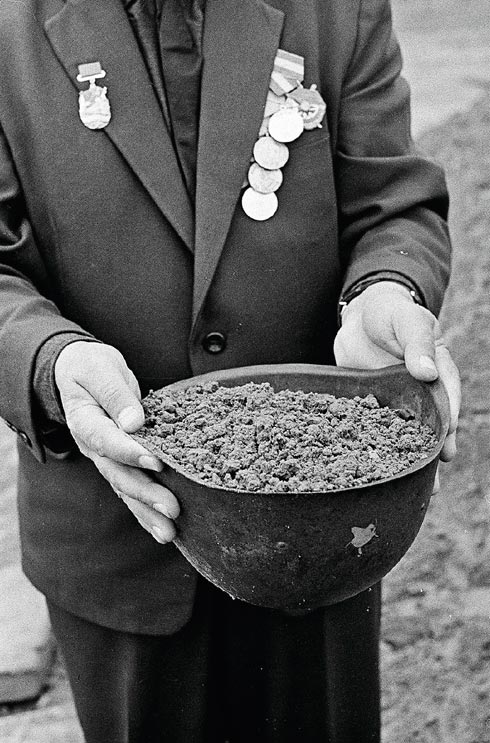
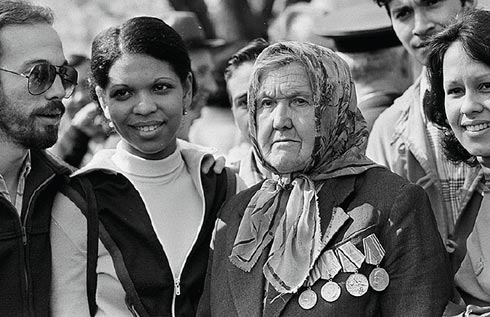
April 23, 1966. Orsha. Glory mound
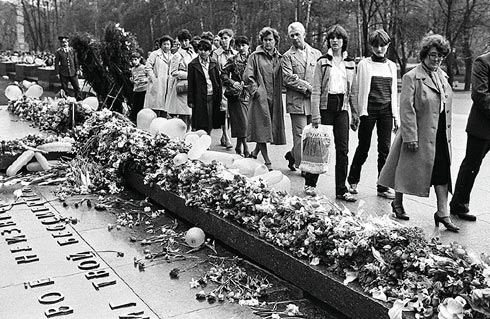
May 9, 1982. Moscow
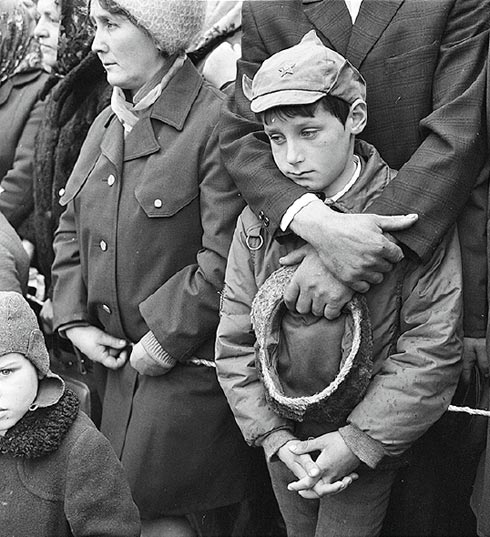
May 9, 1976. Smolensk region. Sychevka
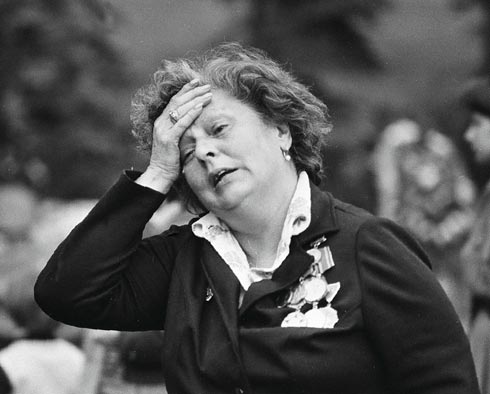
(Photos of Viktor Akhlomov)