
Translated material
There are things worse than war
Memories of the nurse of the evacuation hospital
"It was terribly sorry for people." Lyudmila Ivanovna Grigoryeva worked out the whole war with a nurse in Moscow evacuation students. She talks about this time with professional restraint. And he begins to cry when he recalls what was in her life before the war and after her
About the very beginning of Lyudmila Ivanovna, a strange memory, nowhere to read about it. As if on Sunday night, June 22, in the sky above Moscow there was a glow, as if everything was covered with a flame. She also remembers that when Molotov said on the radio, his voice was trembling. “But people somehow did not really run around the shops. He said: you do not worry, do not arrange panic, we have food over our heads. Everything will be fine, the victory will be behind us. ”
There is nowhere to run
In 1941, Lyala, as her name was then, was 15 years old. Schools were occupied by hospitals, and at the end of September she went to enter the medical school at the Dzerzhinsky hospital. “On the 16th, my friend and I came to classes, and the secretary sits in a coat and says to us:“ Run! Everyone runs from Moscow. ” Well, my mother and I have nowhere to run: where my mother worked, there was no organized evacuation. And what the Germans would come - we were not afraid, such a thought did not arise. " She took the documents from the secretary and went to Spiridonovka, to the medical school at the Filatov hospital. “Accept, I say, to study me. And the director looks at me and cannot understand in any way: "You have only 6 classes." This is true, only 6 classes were. I was very ill in childhood. There was such dead, there are no words. I am ashamed to say, but already as a student, I played dolls. But I had a desire to become a doctor. I say: "You take me, I can handle me." They accepted me. " In addition to Lyali with his mother and brother in the communal apartment, there were three more families. “Mom is baking pies - all the guys on the pie. Vorobyova makes pancakes - all by pancake. Of course, there were penny quarrels. But they put up. " And on that day on October 16, returning home, Lyalya saw that at the Petrovsky Gate - now there was a restaurant, and then there was a grocery store - they give oil on cards. “I got six hundred butter. Mom gasped: "Where did you get it?" And our neighbors, citrons, left. Mom shares this oil in half - gives them to us. Polina Anatolyevna gasped: “What are you doing? You yourself are unknown how you stay. ” Mom says: “Nothing. We are still in Moscow, and you are going where ... "
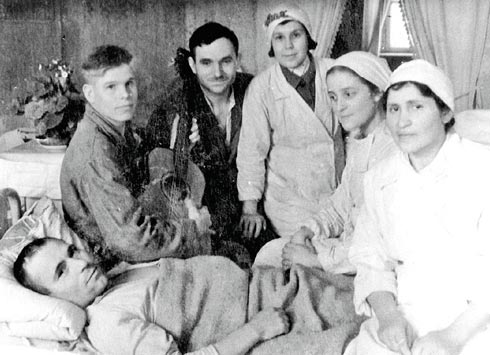
The wounded and those who nursed them in the Moscow evacuation hospital No. 3359. April 20, 1945. Lyalya - second on the right
1941 was the hardest. In the houses, neither warmth nor electricity. In winter, the apartment has a minus temperature, the restroom was picked up so that no one would go. “They ran to the struggle area, there was a city restroom. God, what was happening there! Then daddy's friend came, brought the stove. We had a “Morgasik” - a bubble with a wick. It is good in the bubble if kerosene, and so - what happened. Small, small light! The only joy, the girls, was when we came to the hospital (we didn’t always let it go there): we’ll sit down, sit down, we will sit down, we will bask. We studied in the basement, because the bombing has already begun. The duty in hospitals and hospitals was a pleasure because it was warm there. ”
Forestry
From their group of 18 people after 10 months, to release (accelerated training), 11 were left. They were distributed according to hospitals. Only one that was older was sent to the front. Lyudmila got into the evacuation hospital No. 3372 on Trifonovskaya. The hospital was neurological, mainly for shell -shocked. Work on white and black was not very divided, nurses had to not only do injections and massage, but also feed and wash. “We lived in a barracks position - you work for a day, a day at home. Well, not at home, they didn’t go home-on the 4th floor we had a bed. I was active, and our Ivan Vasilievich Strelchuk, the head of the hospital, appointed me the foreman of the sawmill. I work for a day, and the second day, Abram Mikhailovich and I were a good man, we sawed firewood. And two more people are with us, I have not remembered them very much. ” They also brought coal, it was unloaded with buckets, after which black, like blacks, came out.
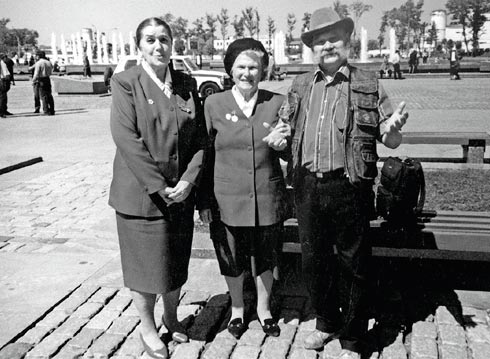
Poklonnaya Mountain. May 9, 2000. In 2000, Lyudmila Ivanovna (left) participated in a parade on Red Square. On the rehearsal of this parade and its veterans, director Tofik Shahverdiev shot the documentary “Victory March”
Then Lyudmila left this hospital - followed by Dr. Vera Vasilyevna Umanskaya, who took care of her, they then friends all their lives. Hospital No. 3359 was surgical, there Lyudmila already became a gypsumotechnical technician, applied the bandages, learned to do intravenous anesthesia, and the hexenal prick. In the surgical, the worst was the gas gangren, when the wounded limbs switched, and only amputation could stop it. Antibiotics appeared only at the end of the war. “Dressings, plentiful drink and aspirin - there was nothing more. It was incredible to them. You know, when they showed the wounded in Chechnya - I could not watch. ”
Deadly novel
Lyudmila Ivanovna in her 83 years is slim and beautiful, noble, not knowing age, and in his youth was a large -eyed blonde. She bypasses the novel topic, but it is clear that the wounded allocated her, someone fell in love with her, she liked one herself, he again got to the front after the hospital and died under Rzhev. Mikhail Vasilievich Reut - so she calls him a full name. The girlfriend was strict, men apparently felt and did not allow themselves. “Grandma said to me:“ Take care of the lower eye more than the upper. ” I got married as a girl at thirty years old. ” She spared the wounded, and they treated her well. “During the duty, it was impossible to sleep in any case. I had a sick Kalkin, he used to send me to his bed - she was in the far corner: “Take up knees and sleep, and I will be by the table. Who will go, I will let you know, and you seem to correct the bed. ” You see, so many years have passed, but I remember him. ” But her most important hospital novel was not a love, but some kind of literary, mystical, at least take a movie about Kolya Panchenko, whom she nursed and could not go out. And so, apparently, this turned her soul turned upside down, that she decided to bury him herself so that he would not get into the general grave and his name would not be lost, as thousands of names of the other dead in hospitals were lost. And she buried it - with her semi -children's hands, on the same willpower, on stubbornness. The funeral service in the church, a visionary dream, a night flight in the cemetery, the betrayal of loved ones, reburial after the war, when she, like Hamlet, was holding Colin Skull in her hands ... And in the final of this ancient tragedy, Catharsis, when, after the grueling running around, bureaucratic squiggle and despair, she saw the name on the board of Pyatnian cemetery. “I don’t know what pushed me then - and I wasn’t in love with him, he had a bride, he showed me a photo. He was from the Kuban, from the dispossessed, his father was sent out, only his mother remained there, his sister and niece. I corresponded with them, probably the year until 1946 ... "
Real fears
A person is rather ironic than sentimental, Lyudmila Ivanovna, nevertheless, cries several times during the story. But not about the war - "about life." Such a life fell such as our old people that the war in it was not always the most terrible test.
After the war, Lyudmila worked for ten years in the Filatovsky children's hospital with a senior operating sister. In horror, he tells how children had to do boiling. We now have no idea what it is, and then there was just a trouble. People did not have anything, and rats divorced and invisible, they were poisoned with caustic soda. And of course the children were poisoned. Cross - and a sharp narrowing of the esophagus began. And these unfortunate children were introduced a phone to expand the esophagus. And if it did not work, they put the artificial. The operation took 4-5 hours. Anesthetic anesthesia: the mask is iron, chloroform is given that the child is not so suffering, and then they begin to drip ether. “Only Elena Gavrilovna Dubaykovskaya did this operation, and only during my duty. All this had to be worried. "
A lot of family misfortune has been experienced. In 1937, her grandfather was arrested before her eyes. “When the grandfather was taken away, he says:“ Sasha (this is my grandmother), give 10 kopecks, ”and the man for him:“ You will not need, grandfather. You will live for free. ” Uncle was also arrested in a day. Then they met in Lubyanka. Grandfather was taken in August, and in October-November he died. Father disappeared before the war - he was taken right at work. In 1949, the turn of the mother came.
“Well, I exhausted my mother in 1952. I went to Siberia to her. Suslovo station, behind Novosibirsk. I went out - there is a huge composition, - here Lyudmila Ivanovna begins to irresistibly cry. - Grates, hands stick out from there - and throw letters. I see - the soldiers are coming. The muzzles are terrible. With pistols. And dogs. Mat ... indescribable. “Go away! I'll shoot you now, dog! " This is me. I collected a few letters. He is a kick ... "
As she got to her mother in the camp what she saw there and how she returned back - another unwritten novel. She said to her mother: "I will be exhausted to you." In Moscow, Lyudmila made her way to Shvernik. * * N. M. Shvernik in 1946-1953 - Chairman of the Presidium of the Supreme Soviet of the USSR. “We were put in a row. Documents in front of you. "Question?" I say: "About mom." - "Give." When she came out, she burst into tears. And the policeman says: “Daughter, do not cry. Once I got to the schorder, everything will be fine. ” And soon she was released ... "
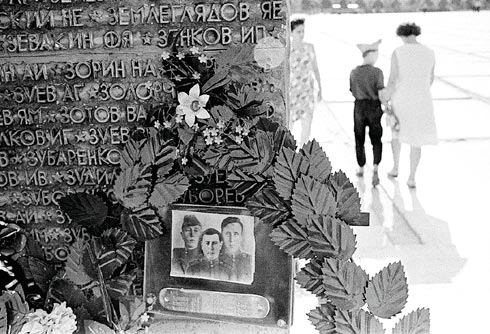
May 9, 1965. Novosibirsk
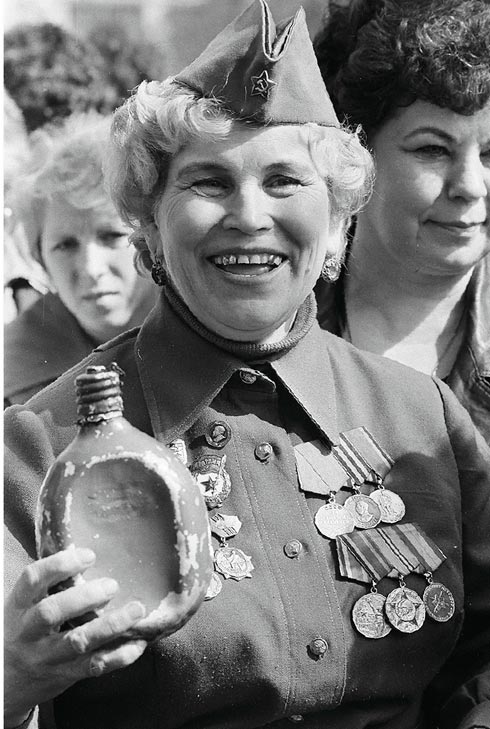
May 9, 1982. Moscow
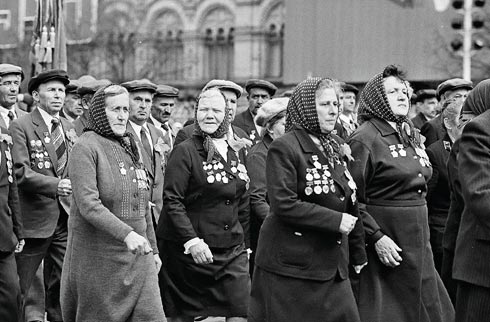
May 9, 1985. The 40th anniversary of the Victory. Moscow. Red Square
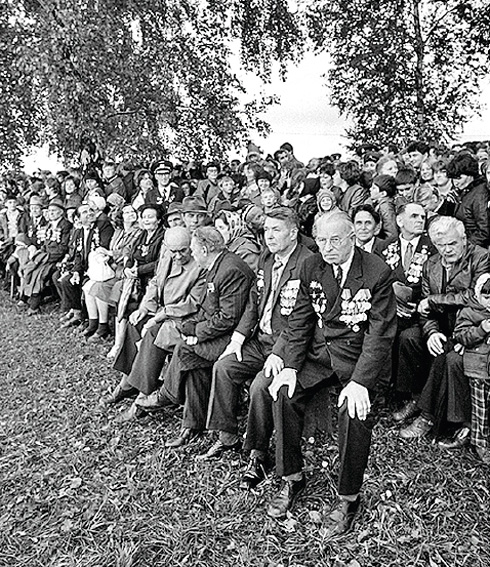
May 9, 1984. Borodino
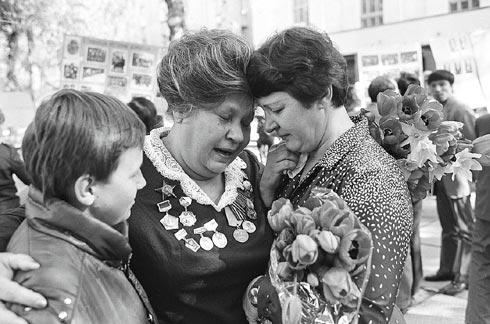
May 9, 1984. Moscow
(Photos of Viktor Akhlomov)