
Translated material
Five legends about surrender
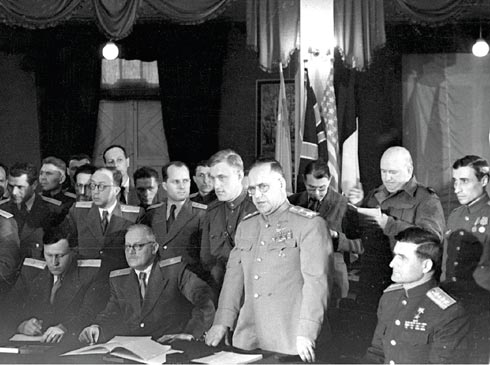
On behalf of the USSR, an act in Karlshorst was signed by Marshal G. Zhukov (standing)
War and the world are the most complex things in the world, an eternal occasion to create myths. We all recall the victory on May 9, because on this day of 1945 the country learned about the surrender of the Hitler Reich. But few know that the state of war between the USSR and Germany was discontinued only in January 1955, when the Presidium of the Supreme Soviet of the USSR issued a corresponding decree. But the specific circumstances of surrender are still perceived in a distorted light
A lot of surrender of Nazi Germany - May 7 and 8, 1945 - has been written. However, in almost all Russian publications on this subject, and the Western ones, too, to one degree or another, there are stamps of the Cold War, when each side formed its version of history. But how did the surrender really happen? Materials reflecting historical realities were found in the archives of the German-Russian “Berlin-Carlshorst Museum” (former surrender museum). It is located in the building where the surrender of Nazi Germany was signed. To compare the existing legends of surrender with facts and in this way the historical truth was the scientific director of the museum, Dr. Babetta Quinkert, we volunteered.
Legend No. 1: The Wehrmacht capitulated to the Western forces in Reims (France), at the headquarters of the Union Expeditionary Forces on May 7, and to the Soviet-May 8 in Karlshorst (district in the eastern part of Berlin).
In fact: both surrender took place with the participation of representatives of all countries of the anti -Hitler coalition - the USSR, England and the USA (the French representative was present as a witness). On May 7, 1945, the chief of staff of the expeditionary forces was signed by the chief of staff of the expeditionary forces, the American General Walter Smith and the officer for communication at the headquarters of the Western allies in Reims Major General Ivan Susloparov, who, however, made a written reservation about the possibility of a new ceremony of signing the capitulation, if one of the allied countries requires that. General Eisenhower accepted the reservation. On the German side, the capitulation act was signed by Colonel General Alfred Jodl. And as a witness-French-Major General Francois Sevais.
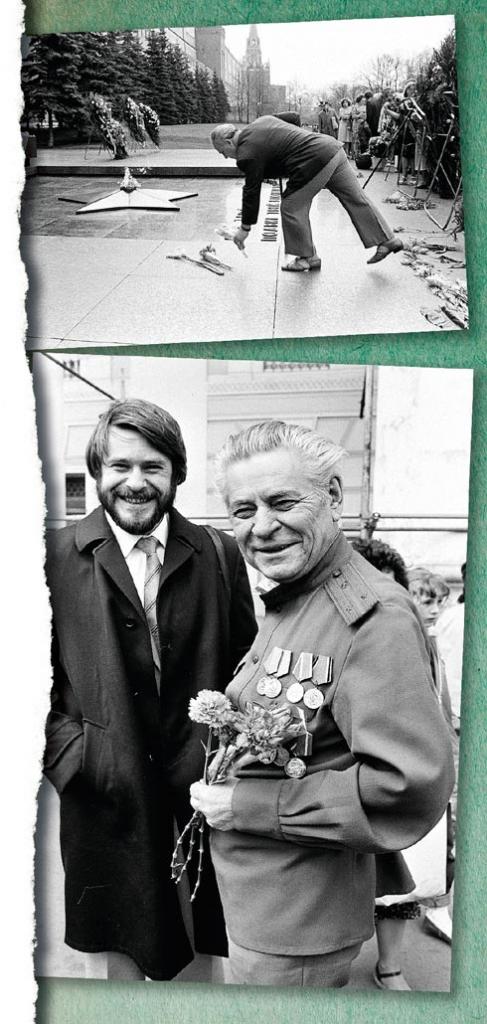
- May 8, 1980. Moscow. At the grave of an unknown soldier on May 2, 1990. Moscow. Frontovik journalist Anatoly Ivashchenko with his son at the Bolshoi Theater (photos of Viktor Akhlomov)
Legend No. 2 (had a walk in the former social camp): in Reims, not an act of surrender was signed, but only a preliminary protocol. The real surrender followed May 8/9 in Berlin. * * See, for example, Leonid Poritsky. “The act of military surrender of Germany:“ Preliminary procedure ”in Reims and“ Official Ratification in Berlin ”.
In fact: in Reims on May 7, an act of surrender, which has legal force, was signed. The text of the document is unequivocal and does not imply any discrepancies. It was also considered by the Soviet Union, which, using leaflets, informed German soldiers on the Eastern Front. However, after the outbreak of the Cold War, the fact of surrender in Reims was carefully hushed up in Soviet historiography.
Legend No. 3 (had a walk mainly in the West): after the Wehrmacht surrender on May 7 became a failed fact, Stalin did not want to recognize just such a modest act of signing. Due to his objections, the Western allies agreed to the second ceremony-“for the public”, that is, to the Carlshorstsky act of surrender, which was called “ratification”. Major General Susloparov, who signed the surrender in Reims, was sent, according to some sources, he was sent to Siberian camps, according to others-shot. “Such a youthful look (I have a color photograph of that event), with large facial features, mighty physique. Smiles at the top of his mouth. There is no doubt - he did not know what awaited him in a very near future, namely: execution. ... I am quite in solidarity with Stalin that surrender should have occurred in Berlin - the symbolism of the event demanded that. I can understand his dissatisfaction with Susloparov, who should not climb out of the Old Man. But shoot for this? .. The execution of his general put an end to the protocol about victory? " (Vladimir Pozner. "Everything for man." "Friendship of peoples" No. 6, 1998)
In fact: yes, Stalin was always afraid that Western countries could deceive him. He treated the greatest distrust of any negotiations of the Allies and Wehrmacht, especially at the end of the war. Indeed, even before May 7, German troops had already surrendered in Northern Italy, in north-west of Germany, in the Netherlands and Denmark. Yes, the German delegation in Reims really at first made a proposal to capitulate only to the Western allies and bring the situation on the eastern front beyond the issues discussed. And not only in order, as they claimed, to transport as many soldiers and refugees as possible to the western areas, but rather to push the allies among themselves, make a split and continue the struggle in the east. But General Eisenhower immediately rejected this proposal and demanded universal surrender on all fronts. General Susloparov received authority from Moscow to sign the surrender and did not get into any camp, not to mention the execution.
Legend No. 4: The second surrender was needed only for the peace of Stalin.
In fact: undoubtedly, another indicative ratification procedure was a gesture towards the extremely distrustful leader. But this was not the main thing. More precisely, not the most important thing. In Reims, the head of the German General Staff, that is, an officer without real command powers, signed the surrender. The British, for example, this signature seemed insufficient. After all, they still remembered the ceasefire of 1918, when, at the insistence of Gindenburg, the act of ceasefire signed a civilian and a little -known general, which made it possible to declare to Gindenburg the same: Germany was not defeated on the battlefield, but received a blow to the back from the revolutionary authorities. In order to avoid a repetition of such a situation, the British needed Field Marshal Keitel, who had real military authorities. Therefore, the second signing ceremony was quite happy with the British.

Acts on surrender in Reims (above) and Karlhorst
Legend No. 5: The Act on the surrender was not signed during the day, but on the night of May 8 to 9, because the allies could not agree on the exact text. Different dates in the act are because it was in Western Europe on May 8, and in Moscow the 9th. And in Berlin, Moscow time has already been introduced.
In fact: the transfer of the signing of the act from afternoon time to the night was not due to any political motives. At the heart - purely technical reasons. In Reims, only the English surrender text was signed. The Russian translation of the document was transferred to Berlin in incomplete. It took several hours to get the full version. Ratification certificate was signed in approximately 00.15 of the Middle European time. By that time, the main conditions for surrender have been operating for more than an hour. Moscow time was introduced in Berlin by order of the commandant of the city of General Berzarin only on May 20 and operated only a few weeks.
Thus, at the time of signing the final act on Western European time, it was 23.15, in the Middle European - 00.15, in Moscow - 02.15. The fact that for the USSR the date of surrender is considered May 9 is not connected with the time of its signing, but with the time of announcement for the Soviet people. This was another manifestation of the Stalinist will: the USSR appeared in the USSR.