
Translated material
Daily magazine: Mumba Yumba
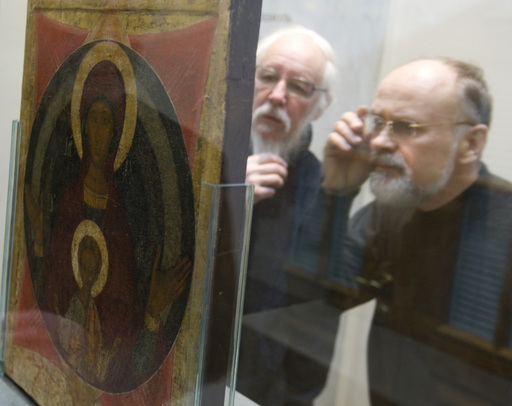
It would seem, more recently, at the beginning of the year, representatives of the Russian Orthodox Church, in particular, the head of the information department, Vladimir Legoyd, argued that the bill on religious organizations of religious property does not apply to museums and everything that is located in them is regulated by the Law “On Museum Funds”. But literally a few months have passed, and we already hear completely different songs.
At a meeting with the leadership of the Ural Federal District, Patriarch Kirill said that the bill that had made a lot of noise is at the final stage. At the same time, he “reassured” the cultural community: the expositions of museums will not be affected, unlike icons in the storerooms. The Patriarch drove on the media who scare people that the Russian Orthodox Church would not preserve the monuments of antiquity. “As one friend of mine said with surprise, the impression is that they return the values not to the Russian Orthodox Church, which created them and created for centuries, but the Mumba Yumba tribe,” the primate remarked with humor. Only this humor would not be black ...
Of course, the church has the right to get back what was looted in due time. There are a lot of such that can be given in museum reserves without causing serious damage to the culture of Russia. Icons of the XIX century, for example. But in practice, we are not talking about them, but about really significant works of art. Yes, many of them are stored in reserves, because otherwise they would suffer a lot of damage. Well, now, following the Toropetsk icon of the Mother of God, to send on a dangerous journey to an elite village with an unpredictable finale?
A lot was written about how the Church kept the national treasure transferred to her in the 90s. It is worth recalling the story with the Bogolyubskaya icon, with the iconostasis of the Trinity Cathedral in Pskov (in the photo below) , where, by the way, the works created by Archimandrite Zinon (Theodore), about the blackened Rublevsky frescoes in Zvenigorod and in Vladimir.
This is not about individual errors, but about systemic damage. Just a church, simple priests are sharpened to save souls, not monuments. Monuments in church everyday life carry irreparable loss. In the church, unfortunately, there are no personnel who could take care of antiquity. The words of some Orthodox activists that such personnel are in the Holy Tikhonovsky Theological University, to put it mildly, are inaccurate. And the level of these personnel is not comparable to museum, and in the church fence they rarely have decent use. It is no coincidence that in the entire history of the excavation of values from the museums, the dean of the faculty of church arts of St. Tikhonov University, a senior researcher at the museum Andrei Rublev Fr. Alexander Saltykov keeps a grave silence. It is afraid, very well, to tell the truth.
The very methodology of treating antiquities within the church fence has turned into an important cultural problem. Often full restoration work is replaced by cosmetic repairs. In order to adapt ancient buildings, windows expand for modern needs, heating is carried out into the summer cathedrals that are unacceptable for winter operation, which adversely affects the frescoes and the iconostasis. Say, in Ryazan, at the nobility hotel in the Kremlin, the work was carried out unprofessional, despite the fact that all the necessary documentation was handed over to her. Windows in the forms of the 18th century are not restored; when painting facades, the gray-blue color of 1903 was not used. And what is characteristic, church top managers perceive such things as granted. So, in a letter of three high -ranking representatives of the Russian Orthodox Church, the museum community directly says: “You point to something unacceptable to change the style of church decoration in connection with new trends in painting and architecture. Meanwhile, this is a common global practice. ” And as an example, the Cathedral in Aachen is given as an example, which has repeatedly been rebuilt.
If we keep in mind the cleaning of the historical urban environment that is carried out in Moscow, and throughout the country, then all this, of course, is trifles. But the movement towards the Mumba Yumbu tribe inside the church fence is evident.
The works of ancient Russian icon painting are an important factor in the self -identification of Russians. And the spraying of museum collections in many temples will undoubtedly lead to the loss of this factor. It is no accident that Patriarch Kirill stated in this regard that there can be no talk of pulling out funds. Then what about? On the creation of special church museums existing at the expense of the state?
Why not say it directly about this: we want to master the museum financial stream. We want to build remakes on the territory of Kremli and ancient temples and hand them over to offices, otherwise how to feed.
Or is the third party also involved here? According to the director of the Rybinsk Museum-Reserve Sergei Cherkalin, there is also a lobby of the antique market in this matter. It turned out to be strong enough to pull this bill. After all, taking a valuable icon from the church is much easier than from the museum.
Government officials, according to the director of the Rublevo Museum, Gennady Popov, seek to remove responsibility from the state and transfer objects of cultural heritage to religious organizations. At the same time, “museum workers” remain extreme in this situation. If something happened to the monuments, it was they who will be blamed for that they did not know where they should. How did this happen in the sensational story with the Bogolyuba Mother of God. Head of the press service of the Moscow Patriarchate of. Vladimir Vigilyansky stated in response to the questions of journalists: “What did the museum workers do? In this case, if it is joint use, then follow with dignity. The device does not work? But is this a museum device? "
Deputy Minister of Economic Development Igor Manylov says this without abysses : “Protection from these facilities will not be removed. The state will take all measures to ensure that the icons remain safe. It may be necessary to adjust the development of security legislation, this work is already going on. ” In other words, museum workers will have to protect values outside the walls of the State Museum, so to speak, in the field.
And here's what is interesting. Some museum workers agree to such a scenario, if only they would be given the opportunity to carry their mission and fulfill their duty. It was in the spirit of the outlined compromise that the latest speeches in the media of the director of the Tretyakov Gallery Irina Lebedeva, the head of the Center for Eastern Christian Culture Alexei Lidov and others, were maintained.
At the same time, many respected artists who are important, parishioners of the Russian Orthodox Church, believe that the law is completely unacceptable. These include the doctor of art history Olga Popova, who advocated in the 90s for the return of the shrines of the church. Now her position has changed. And she does not ask a rhetorical question : “Why are the church so excite material values?”
After the meeting of Patriarch Kirill with Gennady Popov, it became clear that the church agrees to cooperation with museums. However, bills regarding the transfer of monuments and their state financing have rigidly identified the privileges of the church as part of a large process of the formation of the ROC MP as the owner. Meanwhile, the rights and obligations of the museum workers were forgotten and not spelled out clearly.
Moreover, officials of the highest ranks somehow cease to be considered even with the Federal Law on the Museum Fund. Let's say, the Minister of Culture of the Russian Federation Alexander Avdeev initiated the transfer of 155 items from the Museum of the Ryazan Kremlin to the Ryazan diocese. Soon, the diocese prepared a proposal to transfer another 2600 exhibits to her, among them ancient icons. Defenders of the cultural property held a protest action in the regional center in early May. But who heard them?
The minister Alexander Avdeev presented another unpleasant surprise to the museum community at the end of April. He signed an order according to which the local museum-reserve will have to give 65 items from his funds the newly created by the Kirillo-Belozersky monastery. This is only the beginning. A large flow of tourists rushes into the Vologda region. And it is possible that the script tested in the Ipatiev Monastery, when the monastery actually destroyed the State Museum and himself took over the service of tourists, will be repeated here.
Talks about the protection of antiquity monuments are often only a smoke curtain for the development of financial flows. And when people are fighting for the loot, it is not like Mumba Yumbu-they kill their own.
Photos from RIA Novosti sites