
Translated material
Collections of Russian museums will be transferred to 3D format
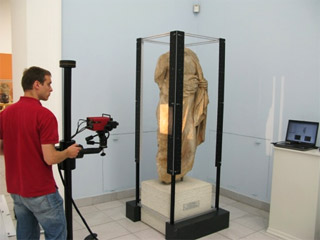
The unique technology of three-dimensional scanning of museum collections using the new 3D scanner was demonstrated at the scientific seminar at the State Central Museum of Modern History of Russia. The seminar was organized by the leadership of the museum with the participation of the Ministry of Culture of the Russian Federation. It is assumed that in this way the art funds of museums should be saved.
The 3D scan pilot project was launched on Wednesday. In one day, 20 exhibits were scanned in the State Central Museum of Modern History, ITAR-TASS reports.
A three -dimensional scanner is a device - Lightbox, inside which a spinning table is placed. The exhibit is placed in front of the device on the stand, and the moving camera inside the scanner takes about 200 pictures around it. Scanning one exhibit takes 5-7 minutes. After that, the pictures are transmitted to a computer where a special program collects a 3D roll from them. Thus, virgin, hemispherical and spherical images are created, allowing you to consider the exhibit from all sides. The cost of one such 3D scanner is approximately 1 million rubles.
So far, objects with a maximum size of 40x40 cm are digitized on a 3D scanner. In the future, exhibits will be scanned up to 2 m high and a weight of more than 350 kg. In total, up to 90% of museum funds can be translated into three -dimensional format.
The new technology will show the public dilapidated objects, while ensuring the safety of the originals.