
Translated material
The bowels opened
To whom and how much will the disaster cost in the well BP
An investigation of the causes of the accident in the British Petroleum drilling well in the Gulf of Mexico revealed a scandalous fact: within an hour before the explosion, the automation issued warnings about danger three times, but BP managers did not react to them. This is stated in the preliminary report of the specially created commission of the US Congress. The leadership of the rescue operation, the American government took on itself. Last Friday, President Barack Obama for the second time since the accident visited Louisiana to “evaluate the scale and pace of work” to eliminate the consequences of the accident. What can she do what BP, America and its neighbors, found out The New Times
The explosion on the floating drilling platform Deepwater Horizon, which claimed the lives of 11 people, occurred on April 20. After another 2 days, the platform went to the bottom. Oil poured into the ocean for more than a month. All last week, BP engineers attempted to close a gap at a depth of one and a half kilometers and last Thursday they seemed to succeed. It seems to be ... the company's specialists are justified: they did not have experience in carrying out repair work at such a depth.
A tanker named Nedra used to be like: an attacked a tanker on the rocks - and oil poured into the ocean, first desecrating it, and then the nearest coastal strip. People went out in rubber boots, scraped stones, wiped Gagar, and the region’s tourist industry mourned its death for several years to come. And soon everything was settled - until the next tanker. But the accident in the Gulf of Mexico is much worse. This time the “tanker” was very large, his name was the bowels. There was definitely enough for a large piece of the ocean of the ocean of oil. Daily in the Mexican bay, it poured up to 800 tons. The world press trumpet about the "unprecedented environmental disaster." President Barack Obama so far talks about "potentially unprecedented." However, Caroll Browner, who is responsible for ecology issues in the US administration, recently confirmed in an interview with ABC television company: there have never been an oil spoon of such size in American waters before.
Last year, 100 naval turtles died in the accident region, and this is already 156. And 156 dead turtles - is this a lot or a little? And what apocalypse will it pull on? Will he resolve or break through the ecological "katrina"?
* * This was the name of the Urakan unprecedented in its destructive force at the end of August 2005, as a result of which about 1800 inhabitants of the states of Louisian and Mississippi died, 800 thousand were left without shelter. Hopes and anxiety plus: the accident happened near the coast of the United States, which most adequately and openly oversee the situation. Financial analysts calculated that in the worst case, the elimination of the consequences will cost BP $ 12 billion.
Minus: Oil poured into the ocean, as experts noticed, in recent days it was getting darker and thicker. This is a sad and alarming news for ecologists that have been entrusted to the fact that the content of sulfur in "emergency oil" is low. The blackening of the flow also means that it actually becomes more oil in it than gas, which does not pollute the environment and evaporates easier. In addition, not all oil rises to the surface, part of it forms accumulations at the depths, and where the underwater currents will be taken and where it will pop up - no one can predict.
Another alarming sign: the Americans are ready to sit down at the negotiating table with Cubans and discuss with them the topic of a common threat hanging over the beaches of the northern part of the island of Freedom and the islands of the Florida braid. The warm circular current, which is included in the Mexican Gulf near the Yukatan peninsula, and flows out of it between Florida and Cuba, is about to catch the pouring oil and take it to the golf Stream. And then, under the threat of pollution, the Atlantic coast of the United States will be, and this is a disaster without any “but”. While the circular flow and the wind are constantly changing - the spilled oil has not yet been “picked up”. But if this still happens, its appearance off the coast of Florida is possible in the coming days. The vigilant Florida have already begun to comb the beaches and found oil lumps, however, laboratory inquiry showed that they consist of “wrong” oil. Nevertheless, the beaches of Western Florida have already managed to fly out of the dozens of the best in the country. In general, oil on white sand looks frightening, but it is cleaned well: it is simply carried away with the top layer. The situation is much worse with the purification of the mangroves, the wipes, swampy shores, and it is precisely these and are located closest to the scene of the accident.
The conclusions will be 19% of the entire water area of the Mexican Gulf are already declared closed for fish fishing. As compensation, BP offered fishermen - for $ 5 thousand to each - to take part in the work to eliminate the consequences of the accident. At the same time, they were demanded to sign the document that they refuse to sue BP for compensation for losses. Alabama prosecutor condemned the attempt to shut up the Roth to the fishermen - BP refused his venture. And then legal claims went to her: the compensation of $ 5 million already requires, for example, the Association of Mississippi shrimp catchers.
The author had to be on the coast of the Gulf of Mexico in Texas. There, the beach was rarely impeccably clean, oil spots came across everywhere, and the local people treated this calmly-after all, 30% of American oil was produced in the bay. That's when the Texas begin to worry, it is when the price of oil goes down and they lose their jobs. Therefore, people who live close to the place of the current accident and take upon themselves the first wave of wandering oil are much more restrained to intensified calls to tighten the nuts to oil companies and limit the drilling on the coastal shelf than, say, the inhabitants of the California Santa Barbara, who at home with a not -aimed down Pacific Ocean.
Nevertheless, America will make conclusions from what happened absolutely. Firstly, the friendly relations of the US oil lobby with such state organizations as the mineral resource management service, whose employees whose oil workers periodically invite to hunting and fishing will be revised. Secondly, everything that is associated with a shelf drill will look with a magnifying glass in the USA, under which the BP is already feeling very uncomfortable now. Thirdly, in America, new technologies for preventing emergency situations that are borrowed by other countries will appear. Surely other conclusions will be made. But too much depends on how much oil from the exploded platform will still have time to digest to the world ocean.
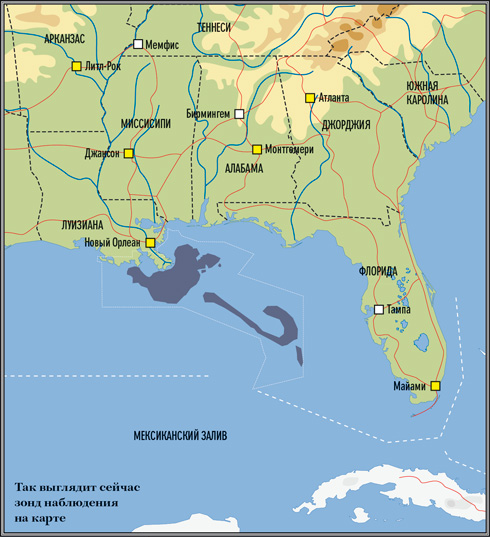
The 1979 disaster chronicle-as a result of an accident on the Mexican Icrock-1 Buruiner platform in the Gulf of Mexico in 1979, about 500 thousand tons of oil resulted in 9 months in the sea. Nevertheless, Fauna and Fauna Gulf in three years have been environmentally friendly almost completely.
1989 - after the Expoons Valdiz super -tank in Alaska in 1989, when 41 thousand tons of oil spilled into the ocean, the limit of compensation for third parties was established - $ 75 million. Now President Obama is advanced for its increase to $ 118 million. If oil at the site of the Deepwater Horizon accident will be spilled out The current pace, she will beat the Valdiza record in a week. As a result of the breakthrough of the Kharyaga -Osinsk oil pipeline (the Republic of the Komi of the Russian Federation) in 1994, the tundra was irrigated about 100 thousand tons of oil. Only in 2004, a “zone of environmental disaster” was removed from the flooded territory.
1999 - Erica tanker under the flag of the Maltese islands sank not far from the west coast of France. 11 thousand tons of oil spilled into the sea.
2002-the prestige tanker under the flag of the Bahamas broke into parts of the northwestern coast of Spain. 30 thousand tons of oil fell into the water, 270 km of the Galician coast were polluted.
2007-in the Kerch Strait, during the fault of the oil oil tanker, Volgonft-139, about 3 thousand tons of fuel oil fell into the water.
2010 - Bunga Tanker Klanna 3 and the Uilei dry truck collided in the Gulf of Singapore 13 km from the coast. About 2 thousand tons of oil fell into the sea.