
Translated material
Hell Czechoff
The performance of Frank Castorf "to Moscow! To Moscow!" opened the Chekhov International Theater Festival
In Moscow, the Chekhov International Theater Festival started. This year he is entirely dedicated to the 150th anniversary of the writer and playwright, whose plays in the world theater space are not inferior in popularity to Shakespeare
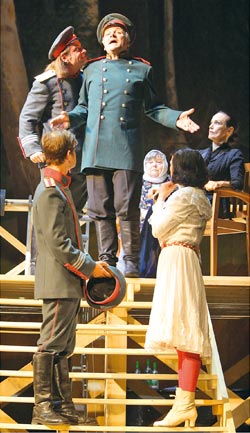 |
| The performance of Frank Castorf “To Moscow! To Moscow! " - It was a true blitzkrieg. After the first act (which lasted two and a half hours), the hall was empty - unable to withstand German aggression, the Russians fled, throwing programs on the battlefield |
Chekhov worships the whole theater world. He is the same Russian brand as Pushkin, Dostoevsky and Tolstoy. The Western Theater has its own view of the Chekhov drama, and today Moscow spectators have the opportunity to get acquainted with this look - detached, devoid of familiar stereotypes and Soviet prejudices, whose captivity we are still in.
The Berlin Theater “Volksbune” (“To Moscow! In Moscow!”, Director Frank Castorf), Argentine director Daniel Veroneze (“Uncle Vanya”), Chilean “Theater El Blanco” (“Neva”, several days from the life of the death of Chekhov, director of the Chekhov’s death, director of the Chekhov, will be presented at their Chekhov festival. Calderon), the Swedish Royal Theater "Dramaten" ("Cherry Orchard", director Mats Ek), the National Dramatic Center of Madrid (Platonov, director Herardo Vera) and the Canadian Trident Theater (Three Sisters, director Vazhodi Muavad, known in Russia at the ET Setera Theater). In addition to the drama at the festival, choreographic versions of Chekhov’s works will also be shown, among which the project of Joseph Naja (“Sherry-Brandy”, the Orleans Choreographic Center, the Theater de la Vil, France) is of particular interest. The Russian program of the festival includes the most interesting Chekhov premieres of the last two seasons.
The first performance shown at the opening of the festival made the effect of the cultural explosion and woke the public overfed with Chekhov. The German rebel Frank Castorf Easy Life at his play promised to anyone. And he fully realized his plan.
Alien Russian natives from East Germany, the head of the Berlin Volksbun, Frank Castorf, is not the first time to shock the Moscow audience-he once struck us with his version of the Bulgakovsky “Master and Margarita” with stunning Martin Wutok. To say that Castorf is very free to treat classical texts is to say nothing. He turns them inside out, wraps them on a fist and beats this fist of the public exactly between the eyes, forcing him to feel horror, pain and shame - emotions that should lead to self -purification.
In a play called "To Moscow! To Moscow! " (In the German version, it sounds especially aggressively, given the recent anniversary celebrations in honor of Victory Day) Castorf united two Chekhovs, it would seem, in no way connected with each other - the play “Three Sisters” and the story “Guys”. In his performance, the director reminded us of all about the general communist past and made it clear that Russia in its current form would not become a European power - until it stops to crap where it lives, steal and begs someone else's and until it outlines the complex of its chosenness.
The action takes place on two parallel plank structures: one of them depicts a collapsed hut with a pipe, and the other - the terrace of a lordly estate. In the hut - stench, drunkenness, mardow, porcino sin, dumb loales and the inescapable dream of bright paradise Moscow; On the terrace ... almost the same, camouflaged by French and English, turning into a melodic Russian (German actors speak impeccably in all languages). Both the people and the gentlemen are amazed at some kind of wild self-repaid and evoking egocentrism. Against the backdrop of pastoral watercolors depicting innocent birches, the endless meadows, the curved bridge and the blue river, gentlemen and men, are imbued with another life and destroy each other without pity and surprise.
The hell of the Canadian ... Here everyone is a little crazy: some from the ongoing drunkenness, others from their own unrealism and innate deafness. Intonations are torn, like broken dolls. Any event - from the children's top of Fedotics and the green belt of Natasha to a fire and a duel - is perceived as an universal disaster. "Again, get bored all evening from the director !!!" - Masha comes with a cry of a wounded bird, broken over the railing. The dead life is much more rapidly alive: there is no place for boredom and longing, the transition from one scene to another, from one time of year to another are instant and painless. So the worthless, meaningless life flies through, leading the heroes to the sacramental "more baron, one baron less, is it all the same." There is no gap between the engagement of Natasha and Andrei and their everyday hasty copulation, as between the appearance of a bobel and a sofopa. And it doesn’t matter when and how dear Natasha turns into a monster devouring chocolate candies in the royal vestment, sitting on the throne, about which Chebutykin will sample: “Ta-rabobia, I am sitting on the cabinet”. The transformation into a “rough stupid animal” is as inevitable as the death of Olga’s village hell (this is the plot of “men”). There will be no European political correctness - Russian laws of being are in effect on this territory. "German pig!" - Natasha will quit disgusting to the baron. Here Masha harnesses to the plow and crawls on all fours in dirty puddles, trying to understand what is the meaning of this stunned mantra about meaningless work. Her husband Kulygin speaks exclusively in English or French, demanding from her observing the accepted norms and decency, and then, having disturbed from these bonds, she will exhale in his face: “Churka! Canadian shit! " The angular Irina, similar to the German rocker Nina Hagen, will attack his brother with his fists with a cry: “And this is your b*di with raking hands!” Sebastian Kaiser added what Chekhov thought about, we will consider this.
"Welcome to hell!" Of course, it is difficult for the Russian viewer to perceive such Chekhov. It's a shame. Offensive. The heroine of the “peasants” crushed by the village savage, Olga will call the “ode” to the Russian man - envious, drinking, lazy, false, thieving, conscientious, fearless, corrupt. And the “queen of the world” Natasha Castorf gives a quote from Dostoevsky’s “demons”: “The true great people can never reconcile with a secondary role in humanity. If the great people do not believe that he alone is able to save everyone with their truth, then he immediately turns into ethnographic material, and not to the great people. Those who lose this faith are no longer a people. The single people of the “God -bearer” are the Russian people ... ”In her lips, this text acquires almost Goebbels intonations. A red banner will be ruined over the burned village hut, and the mocking Chebutykin will obey the arms of the Russian hall for obsolete and barks: “Welcome to hell!”
Moscow theaters participate in the Chekhov festival performances "Uncle Vanya"
Rimas Tuminas in the theater. Vakhtangov, “Cherry Orchard” Mark Zakharov in Lenkom, “Uncle Vanya” Andrei Konchalovsky in the theater named after Mossovet, “Ivanov” by Yuri Butusov in the Moscow Art Theater, as well as special projects created for the Chekhov festival: “Brothers of Ch” Alexander Galibin, based on the play by Elena Gremina about the private life of the writer and his family, “Chekhov-Gala” by Alexei Borodin on Chekhov’s one-activated plays and “Working on the occasion” of Dmitry Chernyakov according to the “man Case ".