
Translated material
Church and church ruins
It seems that the noise raised by the cultural community regarding the possible transfer of museum collections to religious organizations brought good fruits. In the new version of the bill “On the transfer of religious property to religious property”, the transfer of museum values to ownership is not provided for by religious organizations. Of course, the bill will still be considered in the relevant State Duma committees. But not only state and church officials, but also representatives of “museum workers” will already participate in his discussion, so there is hope that the process will accept civilized features.
Another thing is that church top managers did not abandon the idea of using museum collections to attract pilgrims and develop a tourist flow. Fortunately, this can be done in the framework of existing legislation. Religious organizations are increasingly required to transfer monuments for use for liturgical purposes. Like, let the property be state, and we will be the real owners.
Within the framework of this logic, it is worth understanding the decision of the Synod that has recently been held in St. Petersburg, which said the establishment of a special commission for interaction with the church community. The point is not only that it will be the odious archimandrite Tikhon (Shevkunov) from the church side, and in the very nature of the answer to the museum challenge. Alas, the ruins and ownerless fields are interested in the Russian Orthodox Church, which is less than, say, the values of the Kirillo-Belozersky monastery. The Church thinks about the creation of its own ancient storages to the detriment of the state museums, about what can be taken for use now, and with what to postpone, and not about the long -term strategy for preserving the monuments of church antiquity. Otherwise, in the Moscow Patriarchate, a special museum department would be created, which would really enter the art experts, and not experienced negotiators. And this department, for which the main thing would be the preservation and accounting of monuments within the church fence, professionally negotiated with museum workers.
So far, fierce disputes around the bill are boiling in society, 200 thousand monuments of Russian architecture of the XVI - early XX centuries die in the country. And it would be very good if the church actively joined their salvation. The beauty and real state of these monuments gives an idea that recently opened in the Museum “The House of Icon on the Spiridonovka” photo exhibition “Forgotten Masterples” (will last until June 27).
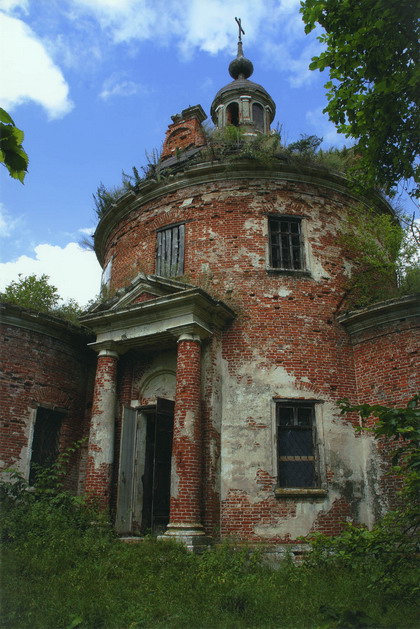
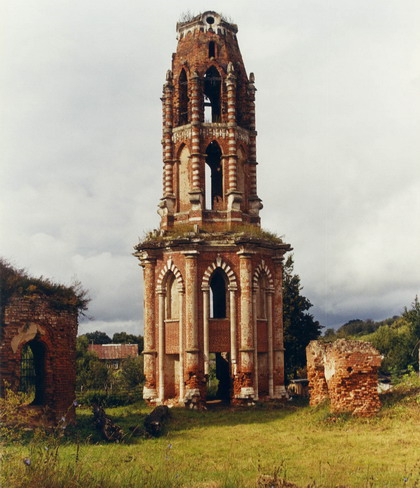
More format photos transfer us to the hard -to -reach corners of the Tver, Ryazan, Kaluga regions. Disrendered buildings, the remains of white -stone decor, fragments of wall murals ... In Soviet times, this dying beauty led many people to faith. Today she is on the verge of destruction. In some photographs, you can see construction forests - a comforting sign of the new time, a sign that part of the monuments (albeit very small) will be preserved for the future. But still, there is no hope for the salvation of most buildings standing in the ruins. True, you can collect information about them and leave documentary memory in the form of commercial drawings, descriptions, photographs.
This is what employees of the Department of the Code of Architecture of the State Institute of Art of Arts of Art. For 30 years, they go on an expedition, trying to save masterpieces. In scientific expeditions, remarkable works of architecture of the XVIII - early XX centuries were shot, scattered around the cities and villages of the Russian province. Since 2002, enthusiasts began to arrange exhibitions based on expeditions. The current exhibition is already the 25th in a row, a kind of anniversary.
“Our cultural heritage is in poor condition,” admits the leading researcher of the department, Ekaterina Shorban. - Of course, the Russian Orthodox Church restores many temples. But in most cases, there is no talk of any professional restoration. Destructible temples in poor villages are often not at all interested in the ruling bishops. They say that it is necessary to restore churches primarily in cities. That there is not always enough funds for this. ”
“We are ready to cooperate with the Russian Orthodox Church in preserving the monuments of the past,” Ekaterina Antonovna continues the conversation, “we help with documentation, give expert conclusions, we answer some requests. But will the scope of this cooperation expand - does not depend on us. ”
It seems that it is with such organizations as the department of the architects of architectural monuments, the church and it is worth negotiations. And the loot from tourist financial flows will wait. This applies little to the salvation of the soul.
In the pictures: Spasskaya Church, the end of the 18th century, the village of Protasiev corner, Ryazan region.
Bell tower, con. XVIII century. Experts say that without conservation in two or three years this bell tower will die completely .
Photos are provided by the author