Translated material
With things to exit
A suitcase mood took possession of Russian businessmen
At a meeting with the Asset of United Russia on May 28, Dmitry Medvedev suddenly entered into a polemic with the Internet, from which he learned that 85% of Russian businessmen were “sitting on suitcases”. “You know, but I think that this is an absolutely incorrect thing ... to talk about the current time as a period when everyone is sitting on suitcases, at least dishonest,” the head of state said. The New Times decided to study the “suitcase mood” of Russian business
51-year-old Igor Alexandrovich is now a rare guest in his native Dolgoprudny. On the laptop screen, he demonstrates the views of his mansion in the suburbs of London: this, of course, is not an oligarch castle, but it looks good too ... In 2008, the interlocutor of The New Times (he certified himself as a former banker in the 1990s and a former developer in the 2000s) sold his business in the suburbs and left with his family in England. “It so happened that all my business projects were over that year, but there was no strength to start new. Tired of fighting the bureaucracy, and there was an attempt on me, and a raider seizure. Tired of "torture": I decided that the money earned is enough for me and my children for a calm life. " The ex-entrepreneur believes that he did not lose at all: "Many of my colleagues in business went bankrupt, and who did not go broke-they can hardly make ends meet, but I managed to go to the cache."
Suitcase, station, diamonds ...
This story in the entrepreneurial environment is by no means exotic, as shown by the UBS and Campden Research survey, conducted among 25 Russians - business owners with an annual turnover of $ 100 million. All, except for two respondents, said that they were ready to sell business for a good price, the majority in the next 2–4 years. In 84%, money is stored abroad, the most popular countries - Cyprus, Switzerland, Virgin Islands. According to businessmen, offshores are not used for tax optimization, but to protect capital. The founders of large conditions complain of corruption and bureaucracy, which is especially strong in the regions, the study says. What is no wonder: according to Transparency International, in 2009 Russia took 146th place out of 180 in the perception of corruption-on a par with Kenia, Zimbabwe, Sierra Leone.
Some statements of the survey participants are curious: “In this country, you don’t have to be an entrepreneur in order to become rich, you just need to rotate in the right circles: bureaucrats make money,” one of the interlocutors said. “I want to get my business out of radars, I feel safe when not very noticeable,” another adds.
“Russian entrepreneurs really seek to withdraw a significant part of the capital from the country,” confirms Olga Krystanovskaya, head of the study sector of the Institute of Sociology of the Russian Academy of Sciences. However, the sociologist clarifies, this does not mean readiness to immediately quit everything and leave the country for good. Just businessmen are in the “low start” position, realizing that their business is poorly protected from the arbitrariness of the authorities. That the system, allowing you to earn money, can select the business at any time. Therefore, many businessmen transport capital abroad, and in Russia they hold assets in a “mobile” state - in the form of diamonds or securities.
For two houses
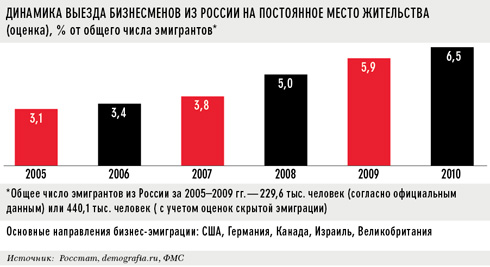
“The exact figures - 80% of businessmen, 50% or 20% are now“ sitting on suitcases ” - no one knows, but what is the problem - this is for sure,” says Nikolai Kovarsky, the co -chair of the club 2015. “Many entrepreneurs begin to reduce their operations in Russia, preserve it until better times or completely sell their business.” According to the observations of Kovara, now in business there is an unnatural change in generations. Before those who spent 20 heavy years in the pursuit of profits in the business, the crisis raised the question: what next? “The situation in the country for entrepreneurs is becoming tougher: the profits are falling, administrative pressure is growing,” the expert notes. - And business logic requires constant development. In the current situation, many businessmen do not see the ways for development anymore. ” Hence, in the minds of those who over 40-50, a different strategy arises: retire early. As a rule, such a strategy involves leaving the country or at least two houses in Russia and somewhere else: “Because here, as you know, it is uncomfortable, unsafe, not at a high level of education and health care.”
The reasons for this peculiar life for two houses were explained by Igor Nikolaev, the head of the Department of Strategic Analysis of the FBK: “Businessmen, especially close to the authorities, understand: nowhere in the world there are no such conditions for making money, like ours, there are no more profit and technologies anywhere, allowing hundreds of millions in a few months. Those who are friends with the authorities even benefited from the crisis, the expert believes, after they gratefully accepted the multi -billion dollar anti -crisis assistance from the state.
However, businessmen who were not lucky enough to have “right” friends are increasingly watching where to go from Russia. A fresh example is Valery Morozov, the head of the Mosko -Service. Fearing the Kremlin’s revenge, a businessman who betrayed the facts of corruption in the construction of Olympic facilities in Sochi, was forced to flee to the UK.
Geography of departure
However, London, despite the fact that there the Russian community is constantly growing, for many not the perfect choice, Nikolaev believes: it is expensive to live, the competition is strong, and the profit is small - not to compare with the one that they do in the Fatherland. Moreover, it is difficult for those whose entrepreneurial success grew out of friendship with the governor or government officials. Igor Vdovin, professor at the Department of Theory and Practice of the Interaction between Business and GU-LES, does not agree with him: according to his observations, those who have already earned everything and are ready to leave the business for a delicious pension. And as a “sun lust”, the UK is still more in demand, Canada and South of Europe are also in fashion. Kovarasky agrees with this: “Businessmen, whom I know, choose London most often for life,” he says. - This is a business center, and a good education for children, and English ... There are those who choose Israel - most often at the call of blood. Some go to France or Italy - they simply love these countries with their azure shores, although there are rather stringent requirements for foreign businessmen. ”
Fathers and children
At the same time, many entrepreneurs, remaining at the helm of their business, seek to take out not only capital, but also family from Russia. And children are trained abroad. Partly, says Olga Krystanovskaya, this is an element of “prestige of consumption”. But the main reasons are the quality of education and safety. In his homeland, the sociologist believes, a businessman cannot feel calm for children: risks - from bad temptations to criminal tangling. In addition, Professor Vdovin adds, training abroad - in England or Switzerland - gives the teenager the opportunity to feel like a citizen of the world, and get an education that will then choose where to work - in Europe, Asia or America.
“My children are now at the school in the UK, there they will be able to absorb true values,” wrote one of the participants in the UBS and Campden Research survey. Under these words, many wealthy people can subscribe to: in 2009, the number of Russian students in British schools became four -digit for the first time - it exceeded 1000. So far, the children learn and prepare to choose their homeland and business, the fathers made their choice: to earn capital here, and to save - away from here.