
Translated material
Putin before a trip to France said that he still trusts the euro
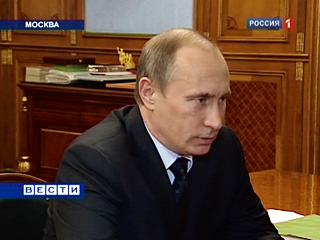
Russia still trusts the Euro - Russian Prime Minister Vladimir Putin said this in an interview with Agence France Press and France 2 on the eve of his visit to Paris. “We trust and believe. Otherwise, they would not hold such a huge number of our funds, gold and foreign exchange reserves, in the European currency,” Putin announced.
“In general, the fundamental foundations of the European economy are quite strong. There are unconditional leaders of stability: these are the economy of Germany and France. And no one is interested in destroying the European Union,” Interfax quoted the Russian prime minister.
Putin believes in the euro: there are no objective conditions for his fall
"I think that Madame Merkel is right: there will be no euro - there will be no European Union, even if it is called something to be called the European Union," Putin said.
There are problems in the euro zone, and European leaders talk a lot about this. “It is necessary to increase discipline, it is necessary to monitor the budget deficits. It is necessary to change the currency legislation partly, it is necessary that it be the same, in any case as the same as the same for all members of the European Union,” he advises. Putin believes that “there are no objective conditions for falling the euro”: “Yes, there are some difficulties. They are sure, they are temporary. Yes, of course, it will be necessary to print a little banknotes to the European Central Bank, because it cannot be otherwise if the European Central Bank announced that he was ready to buy up state races,” the head of the Russian office of ministers emphasized.
He recalled that many countries use the euro as their reserves: "Euro in many countries of the world. I think I am even sure that this issue in the European economy will not be reflected somehow especially negatively. Yes, there are reserves, you can use reserves in the end."
The Russian prime minister approved the actions of the European authorities: in general, they "act absolutely correctly and correctly." "This is another confirmation that we are not going to change our attitude to the euro as a reserve currency, as a part of our reserve."
Weakening euro into the hands of French manufacturers
As the consequences of the crisis in Russia, despite the weakening of the euro, is overcome, Putin continued with the countries of Europe. “For the first quarter of this year, the turnover between France and Russia has grown somewhere around 30%. This is a very good indicator. I really expect that development will be even more powerful, positive. With some European countries, for example, with Germany, the turnover has already grown by 50% over the same period of time,” he said.
The weakening of the euro, in his opinion, into the hands of the European economy, the French and German economies, that is, exportly oriented. "This creates certain difficulties for us, because in many industries - with France, say, we are obvious partners , but in some we are competitors, Putin continued.“ For example, in the field of nuclear energy and energy engineering. In conditions of weak euros, in this case, French manufacturers receive obvious bonuses, headards. ” “But this is a challenge for our engineering. Our producers should produce products better in quality and cheaper in price. They are capable of this,” the prime minister emphasized.
Russia will not buy Mistral without production technology
During the conversation, it also came to the acquisition of a French helicopter carrier like Mistral . Before the end of the transaction is still far away, at the expert level it is necessary to work out many issues related to the condition of the Moscow’s parallel transmission of technologies, Putin said.
He suggested that "the public of France and the media is so preoccupied with the question whether we will buy Mistral or will not" due to the fact that the consequences of the global economic and financial crisis have not yet been overcome.
“This is a good deal for French manufacturers,” he said, evading some promises. “One such helicopter carrier costs somewhere around 300 million euros. For us, this transaction can only be of interest if it is carried out with a parallel transmission of technologies. In order for our shipbuilding - both military and civilian, it would receive new technological tremors to development.”
According to the prime minister, Russia and France "are well interacting in the field of aircraft industry. "French partners are working on the engine of our modern Superjet -100 civilian aircraft in the Far East. When I was there last year, I came directly to the enterprise - this is very far from France, - French speech was heard there. French specialists bring cars right on the spot," he said.
“I repeat, the question is very important for us: to what volume and what will be done at Russian enterprises? There are a lot of questions, and at the expert level it, as it should, has not yet been worked out. We must start this work, then we’ll see it,” the prime minister emphasized.
Reminding further that "the Russian military -industrial complex is quite developed , and Russia is one of the world's largest weapons producers and occupies one of the leading places in the world armament market," the head of government cited two theses, calling the "unconditional" "exchange of competence, the exchange of technology, and the exchange of the final results of this production."
“The second part,” he added, “is that cooperation in such a sensitive area as military -industrial production, of course, leads to an increase in trust between countries.” In Putin's opinion "this is no less important than the first - the economic or technological part."
Vladimir Putin will visit France on June 10-11 on a working visit, during which his meetings with President Nicolas Sarkozy and Prime Minister Francois Fiion will take place, the press service of the Government of the Russian Federation said.
The program of the head of the Russian government in Paris also provides for participation in the opening ceremony of the Russian National Exhibition, which will be held within the framework of the "cross" years of Russia and France.