
Translated material
In Jalal-Abad, the pogrom-kirgizi killed 700 Uzbeks, says the Uzbek community
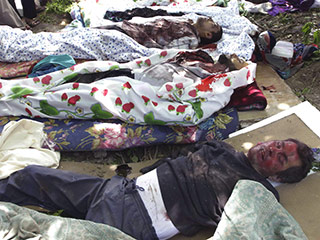
During the riots in the Kyrgyz Jalal-Abad, 700 local Uzbeks were killed, they say in the Uzbek community of the city. These people were killed by pogroms or died during fires, one of the leaders of the community told Interfax . This information has not officially confirmed: according to the latest data from the Ministry of Health of Kyrgyzstan, the total number of victims of the conflict in the south of the republic is 138 people.
The interlocutor of Interfax insists that "information about the dead was recorded by the local community." Only "yesterday and today the funeral of 12 dead passed," he said. "The bodies of many of the dead are currently in the mosques in Jalal-Abad, but it is still impossible to take them from there because of security issues," the representative of the diaspora added.
On Monday, Jalal-Abad began negotiations of authoritative leaders and elders of the Kyrgyz and Uzbek communities, designed to put an end to the bloody interethnic clashes that began on Friday, ITAR-TASS reports.
- SNB: Tajik citizens are involved in the riots
- In fear of pogroms from Kyrgyzstan, from 60 to 75 thousand Uzbeks fled
- in Osh they caught snipers who shot at civilians
- Rumors about sending Russian conscripts to Kyrgyzstan reached the president
- Sat UN held emergency consultations
Negotiations on a truce in the south of Kyrgyzstan are conducted everywhere, confirmed by the head of the information and cordination center of the Provisional Government of the Republic, Farid Niyazov. “Almost always, such meetings end in good results,” he said. According to Niyazov, during such meetings, the parties come to a consensus that this conflict was provoked and well organized.
Meanwhile, from Osh and Jalal-Abad, the parties began to hand over weapons from Osh and Jalal-Abad that as a result of negotiations of representatives of the Kyrgyz and Uzbek communities, the parties began to take weapons. According to official figures, in Osh the situation was almost completely normalized, and in Jalal-Abad there are isolated cases of arson of buildings and houses.
At the same time, eyewitnesses argue that the situation in Jalal-Abad is tense, despite all the statements of the authorities about normalization . “In some areas, shooting, pogroms and arson of houses continues, mainly those where Uzbek families live,” the townspeople say. Over the past day, military and police officers have become much harder to suppress violations, the townspeople recognize, but they still cannot completely take control of the situation.
Earlier, according to local residents, according to Jalal-Abad, people in masks, who randomly shot at the townspeople, despite their nationality, moved in cars without numbers.
The situation in the neighboring regional center of Osha, apparently, was really stabilized . The authorities promised to send troops to areas whose inhabitants refuse to lay down their weapons in order to restore order there. Recall that after the clashes, certain areas of residence of the Uzbeks in Osh were barricaded: local residents refused to miss even representatives of the authorities.
Earlier, to stabilize the situation, the Kyrgyz authorities transferred the additional forces of the Ministry of Defense, the Ministry of Internal Affairs, internal troops to Osh and Jalal-Abad, as well as detachments of volunteers formed from veterans of power structures, the Ministry of Internal Affairs and combatants. The military and police were allowed to use military weapons in case of threat of their lives or the safety of civilians.
Mass unrest and clashes between ethnic Kyrgyz and Uzbeks began in the southern regional center of Osha on the night of June 11. The next day, they spread to the Jalal-Abad region. In the clashes zone, the Kyrgyz authorities announced a state of emergency and introduced a commandant hour.
The President of the transition period of Kyrgyzstan, Rosa Otunbaev on Saturday, admitted that the republic was not able to independently resolve the situation and turned to Russia for military assistance. In organizing tragic events, the president accused his native brothers and close former head of the Republic Kurmanbek Bakiev - he himself rejected all involvement in the events in the south of Kyrgyzstan.
The Provisional Government decided to legalize voluntary national squads and announced partial mobilization.
According to the latest data from the Ministry of Health of the Republic, during the conflict in the south of Kyrgyzstan, 138 people were killed and more than 1,700 applied for medical help. In the list of the dead there are policemen, border guard, deputy of the city council of Osh, fireman and employee of the Ministry of Emergencies.
"According to the Ministry of Health at 11:00 on June 14, a total of 1761 citizen turned to doctors in total, 826, 797 outpatients, and the dead - 138, - quoted the Ministry of Information Portal Akipress .
It also notes that "in the Osh region: appeals - 1267, hospitalized - 665, outpatients - 505, dead 95. In the Jalal -Abad region: appeals - 494, hospitalized - 161, outpatients - 290, dead - 43". As noted in the Ministry of Health, the number of dead is the official registered dead in medical organizations.
In fear of pogroms from Kyrgyzstan, from 60 to 75 thousand Uzbeks fled
In connection with the ongoing clashes from Kyrgyzstan, the mass outcome of representatives of the Uzbek diaspora began. According to the authorities of Uzbekistan, from 60 to 75 thousand people became refugees. According to the Kyrgyz side, during the conflict, only 6 thousand refugees crossed the border with Uzbekistan.
Meanwhile, at least one of the checkpoints from Kyrgyzstan, they stopped passing to Uzbekistan at least one of the checkpoints, 24.KG news agency reports with reference to eyewitnesses. According to them, refugees are not allowed through the Hanabad checkpoint. "About 2 thousand people were not allowed to the territory of Uzbekistan. People are returning back, but due to the fact that they are afraid to go to the city of Jalal-Abad, remain in the settlements of the border zone," the witnesses say.
Many arriving at the border requires emergency medical care. Mostly people of the older generation, women and children flee from Kyrgyzstan: young people remained to protect their property.
“Our houses are burned. I don’t know how to live, how to communicate with people who shot at us,” said one of the beiges quoted by ITAR -TASS. Together with other people, she, among the first, crossed the border with Uzbekistan on Saturday. During the flight on the road, a group of people was fired by unknown, many received gunshot wounds, the woman claims. “There were a lot of dead. I saw one man who died from wound to the chest right on the road,” said Rea.
Witnesses talk about how the jubilant crowd of Kyrgyz burned houses, shops and cafes belonging to ethnic Uzbeks. The city of Osh with a population of 250 thousand people in several night hours has turned into a arena of fierce interethnic clashes.
According to the stories of the witnesses, the city was given to the looting of the looters, neither the army, nor the police on the streets of Osh, the inhabitants did not see help from representatives of the authorities. The crowd of Kyrgyz youth managed to capture cars and warehouses with firearms at attacked and plundered police posts.
In Jalal-Abad, according to the stories of witnesses, there, armed with guns and metal rods, thousands of Kyrgyz teenagers marched along the central streets of the city, burning property belonging to the Uzbeks, while frightened police officers did not interfere in the conflict. The crowd tried to storm the local prison and the hospital, but was stopped by local residents.