
Translated material
Kremlin and Baltic. 70 years later
Around Russia
 Kremlin and Baltic. 70 years later
June 15, 2010 Vladimir Kara-Murza (ml)
Annexation (Latin Annexio , from Annexus - annexed) : forcibly joining (capture) of the entire or part of the territory of another state or people. (...) In some cases, annexation is considered some types of colonial captures, and its variety is the creation of states with puppet regimes. (...) According to the norms of modern international law, the annexation is illegal. (Big Soviet Encyclopedia )
In the Baltic countries, memorable events are held on the 70th anniversary of the Soviet invasion. A moral and legal assessment of the events of the summer of 1940 as occupation and subsequent annexation was given not only by the Council of Europe, the European Parliament, the European Court of Human Rights and the US Congress, but also at the highest level - the Russian Federation. In the preamble to the Russian-Lithuanian Treaty on the basics of interstate relations, President Boris Yeltsin officially recognized the fact of Soviet annexation.
For the current Russian authorities, such a trifle as historical truth means a little. High officials, without realizing the depth of blasphemy, continue to repeat that Stalin’s actions “did not conflict with the norms of international law at that time” and that the military capture of Latvia, Lithuania and Estonia was carried out “on a contractual basis”.
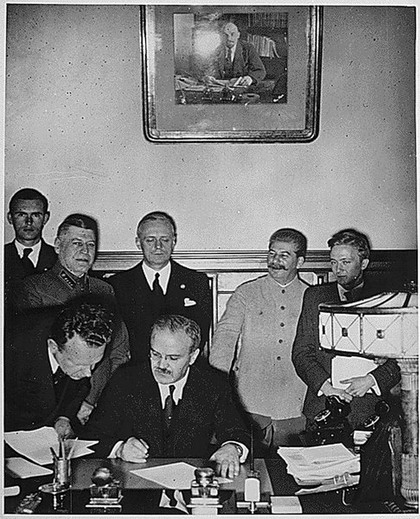
The latter statement is partly true. On August 23, 1939, the German Foreign Minister Joachim von Ribbentrop and the People's Commissar of Foreign Affairs of the Soviet Union Vyacheslav Molotov signed a non -aggression agreement. In the secret additional protocol, the Hitler Reich and the Stalinist USSR divided Europe into spheres of influence. The Kremlin sphere, in particular, included Latvia and Estonia. On September 28, the Soviet-German treaty and the border handed over to Stalin and Lithuania.
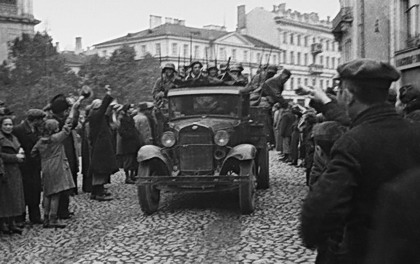
On September 24, 1939, a week after the introduction of the Red Army to East Poland, Molotov informed the head of the Estonian Foreign Ministry Karl Selter about the USSR intention to place military bases in Estonia. “Do not force us to use force,” the Stalin People's Commissar warned. A similar requirement was presented to two other Baltic states. In the context of the war, when the countries of the anti-Hitler coalition, the UK and France, were not able to intervene in the situation in the east of Europe, the Baltic countries were forced to accept Moscow demands and sign “mutual assistance agreements”, which provided for the placement of the 70,000th Red Army contingent on their territory. Already in October, the first Soviet echelons crossed the borders of the Baltic countries. Parts of the Red Army were located in Liepae, Ventspils, Prixule and Patigse (Latvia), in Paldiski, Haapsalu, on the islands of Saaremaa and Hiyumaa (Estonia), in New Vileyka, Alitus, Preenee and Gayzhunay (Lithuania). At the end of October, the Kirov cruiser and the destroyers and the “Smaching” and “swift” arrived in Liepay.
Entering the city of Vilno parts of the Soviet Army , 1939
In May 1940, Germany began a massive offensive in Western Europe. On May 10, the Wehrmacht forces invaded France, Belgium, the Netherlands and Luxembourg. On June 4, the troops of the Leningrad, Kalinin and Belarusian military districts of the Red Army, under the guise of exercises, advanced to the borders of the Baltic states. Soviet garrisons in the territory of Latvia, Lithuania and Estonia were brought into a state of combat readiness. June 14 Paris fell. On the same day, Vyacheslav Molotov handed the Minister of Foreign Affairs of Lithuania to Yuozas Urbshis Ultimatum: to form a pro -Soviet government and provide free access to additional parts of the Red Army. Two days later, on June 16, the same ultimatum was presented to Latvia’s ambassador to Fricice Cocynsch and the ambassador of Estonia August Reyu. Lithuania President Antanas Smeten called for armed resistance, but most of its ministers considered that there are no real alternative to the fulfillment of Soviet requirements. The same decision, when choosing between the “soft” and “tough” occupation, was made by the presidents of Latvia and Estonia, Carlis Ulmanis and Konstantin Pyts (in the same way on March 15, 1939, Czechoslovakian President Emil Khach formally “approved” his country's transition to the patronage of Nazi Germany).
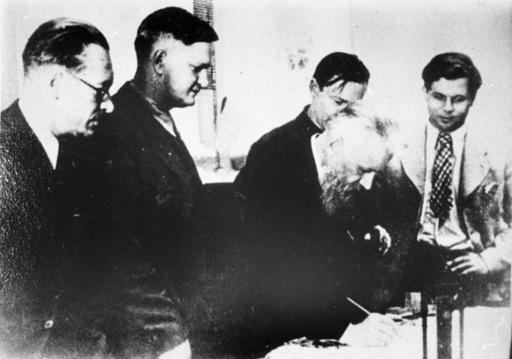
Chairman of the "People's Sejm" Lithuania Ludas Adomauskas signs the adopted declarations
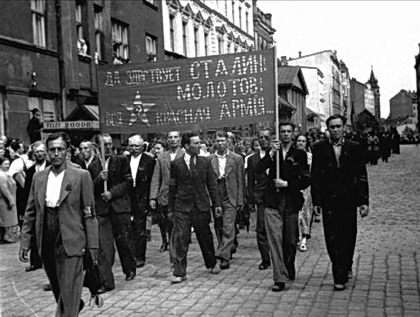
On June 15, 1940, the Red Army crossed the Soviet-Lithuanian border, and on June 17 entered Estonia and Latvia. Under the dictation of the Stalinist emissaries Andrei Vyshinsky (Latvia), Vladimir Dekanov (Lithuania) and Andrei Zhdanov (Estonia) in the Baltic countries, puppet “folk governments” were formed. On July 14, under the supervision of the Soviet troops in Latvia, Lithuania and Estonia, non -alternative “elections” were held, on which only one pro -communist list of candidates appeared. The “elected” “parliaments” of the Baltic countries already proclaimed the creation of the Soviet republics on July 21-22 and turned to the USSR with a request to accept them in their composition, which was made by the VII session of the Supreme Council on August 3-6.
Even before the formal annexation, at the end of July, the presidents of Latvia and Estonia were deported to the Soviet Union (the Lithuanian President of Smetona managed to leave the country immediately after the commissioning of the Soviet troops). President Ulmanis died in 1942 during the transfer to Turkmenistan. President Pyts died in a psychiatric hospital near Kalinin in 1956.
Soviet annexation was not recognized de jure. In Washington and London until 1991, diplomatic missions of actually nonexistent states continued to operate; Among the flags of the countries of the world exhibited in the lobby of the American State Department were the flags of Latvia, Lithuania and Estonia. On July 23, 1940, the acting was announced about the non -recognition of the annexation US Secretary of State Sumner Wells: In his declaration it was said that America "opens against robbery, regardless of whether it is caused by the use of force or the threat of force." The US position has never changed. During the ratification of the Helsinki agreements in 1975, Congress especially stipulated that the Baltic states are not recognized as part of the Soviet Union.
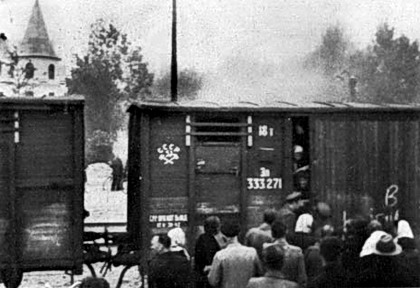
A year after the annexation, June 14, 1941, the NKVD bodies began deportation from the Baltic republics (as well as from Moldova and Western regions of Belarus and Ukraine) of “socially alien elements”.
Within one week, 45 thousand people were evicted from Latvia, Lithuania and Estonia to Kazakhstan and Siberia. People woke up at night, gave one hour to fees (while almost all of their property was confiscated) and plunged into cars for the transportation of livestock. Thousands of deported died on the road. The second, even more powerful wave of deportations swept in March 1949: during the so-called surgery, approved by the Decree of the USSR Council of Ministers No. 390-138, of the three Baltic republics, 90 thousand people were evicted, 28% of them were children under 16 years of age.
Russia, more than others, suffered in the 20th century at the hands of the Bolshevik usurpators, is not moral responsibility for the crimes of communism. But today's power, which denies the indisputable fact of the occupation of the Baltic, protecting the punisher Kononov, who shot a woman pregnant at the ninth month, and protesting against the international condemnation of Stalinism, does everything possible for the world to identify Russia with Stalin.
Author - historian, publicist, member of the Federal Political Council of the Movement "Solidarity"